A modern sports car with an aluminum chassis, advanced electronics and a BMW turbocharged engine sounds completely ordinary. Then you look beneath the body and discover something that seems to belong to another century: wood. Morgan, the British sports-car maker, still uses ash wood to build the body frames of its Plus Four and Supersport. The surprising part is not that the company has refused to modernize, but that wood still has a practical place in a modern Morgan.
Yes, Morgan Still Uses Wood
Ask whether Morgan sports cars are made from wood and the answer is both yes and no. The confusion comes from the way the cars are constructed: the chassis, which provides the main structural platform, is not wooden. On Morgan’s modern cars, that chassis is made from aluminum, while an ash-wood frame is used to form and support the body on models such as the Plus Four and Supersport.
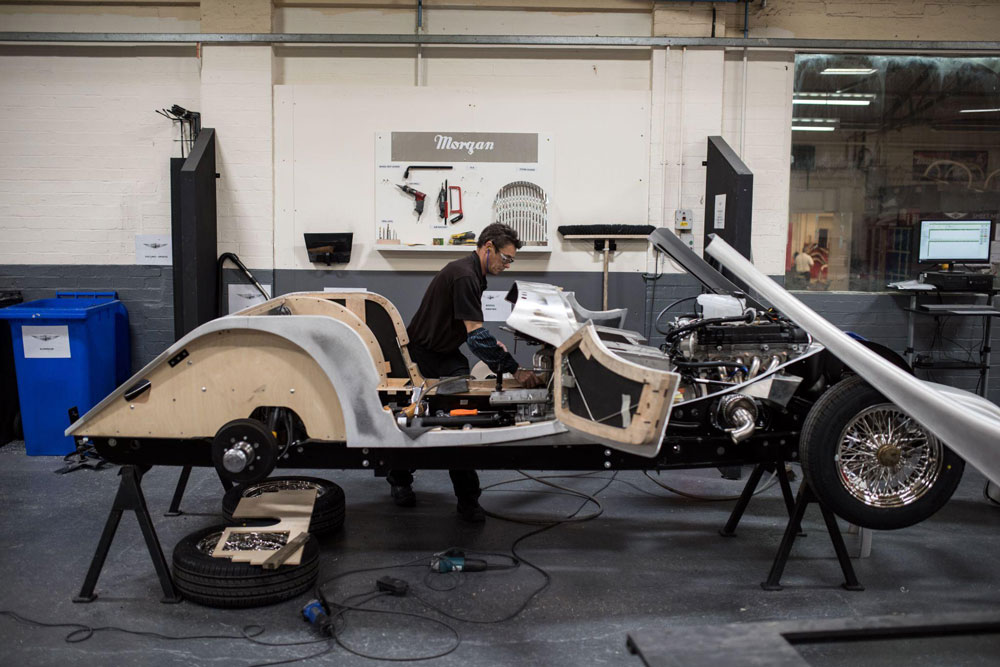
That distinction matters because the popular image of a “wooden sports car” makes Morgan sound as though it never left the early days of motoring. The reality is much more unusual. A modern Morgan combines a bonded aluminum chassis with a hand-built wooden body frame, followed by aluminum panels shaped over that structure. It is not an old wooden car with a modern engine dropped into it; it is a deliberate mixture of modern engineering and traditional coachbuilding.
Morgan has continued this approach because the wooden frame remains useful to the company’s manufacturing process. It provides a framework around which the body can be formed while allowing craftsmen to work with the same basic principles that have defined the company for generations. The result is a car that combines materials and technology from very different eras without pretending they are the same thing.

Why Put Wood Inside a Modern Sports Car?
The obvious question is why Morgan would bother with wood at all when modern cars have access to steel, aluminum, composites and other highly engineered materials. The answer is closely connected to the way the company builds its vehicles. Rather than producing enormous numbers of identical bodies through highly automated industrial stamping, Morgan uses a coachbuilding approach in which the body is constructed around a supporting frame.
Ash wood is well suited to that process because it is relatively light, workable and capable of being shaped into the complex forms required for the body structure. Morgan’s craftsmen can cut, shape, laminate and assemble the wood before the aluminum panels are fitted around it. The company combines traditional woodworking skills with modern design and manufacturing methods, including CAD technology used to create the geometry of the parts.
That makes the wooden frame more than a nostalgic decoration hidden beneath the bodywork. It is part of the method by which the car is actually built. Morgan has described its approach as “21st Century Coachbuilding,” a philosophy that deliberately combines traditional craftsmanship with contemporary engineering rather than replacing one with the other.
Step inside the iconic factory where British craftsmanship lives on! Watch master artisans build legendary Morgan Cars completely by hand, frame by frame, with incredible precision and timeless style. No robots, no noise—just pure, authentic coachbuilding at its finest. Don’t miss out on this mesmerizing journey into classic automotive history. Click to watch the full video now.
The Wood Is Handmade, Too
The strangest part of the story may not be that wood remains inside a modern sports car. It is that people still build much of that wooden structure by hand. Morgan says its ash body frames are produced by skilled craftsmen, with individual components formed and assembled through techniques developed across generations.
The process begins with a modern understanding of the car’s dimensions and geometry, but the physical construction still relies heavily on human judgment and manual skill. Curved sections can be produced from laminated pieces of wood, while joints and individual components are carefully fitted together to create the finished body frame. Once the structure is ready, the aluminum panels are formed over it to create the exterior.
This is one of the clearest examples of what makes Morgan different from a conventional high-volume manufacturer. A modern factory may use robots and automated presses to produce thousands of identical panels with extraordinary consistency. Morgan instead accepts a slower and more labor-intensive process because craftsmanship is part of what customers are buying.

And Then There Is a BMW Engine
Look at a Morgan from the outside and the wood story may be the first thing that catches your attention. Look under the hood and the contrast becomes even stranger. The current Plus Four uses a 2.0-liter BMW TwinPower Turbo four-cylinder engine, meaning that beneath its traditional hand-built body construction sits a thoroughly modern powertrain.
Morgan lists the Plus Four with around 255 bhp and a relatively low weight of roughly 1,000 kilograms, depending on specification. The car is available with either a six-speed manual or an eight-speed automatic transmission, and Morgan lists a top speed of 149 mph. The automatic version is capable of reaching 62 mph in about 4.8 seconds according to the company’s published figures.
Those numbers make it clear that the Plus Four is not some museum piece preserved for nostalgia. It is a genuine modern performance car, with contemporary suspension, braking, electronics and powertrain technology. Yet the engineers did not see a contradiction in placing all of that technology around a body frame that still begins with pieces of ash wood.
That combination is precisely what makes the Morgan story so unusual. One part of the car represents modern automotive engineering, while another continues a craft tradition that predates almost every technology used elsewhere in the vehicle.

Morgan’s Secret Was Never About Being Old
Morgan’s history stretches back to 1909, and the company has continued manufacturing its cars in Malvern, Worcestershire. Over more than a century, the business has built a reputation around low-volume production, individualized cars and craftsmanship rather than competing directly with mass-market manufacturers.
That helps explain why Morgan never followed the obvious route of simply replacing its traditional construction methods with industrial manufacturing. For a company producing millions of vehicles, automation and standardization are essential. For a specialist manufacturer building relatively small numbers of highly individual cars, the economics and purpose are very different.
Morgan itself presents the difference as part of the product. Customers are not simply buying transportation; they are buying a car built through a process that still involves human hands and traditional skills. The wooden frame therefore became more than a component hidden beneath the aluminum body. It became part of the company’s identity.
That identity would be difficult to reproduce with a completely automated manufacturing system. Morgan could undoubtedly build its cars using more conventional materials and production methods, but doing so would also remove much of what makes a Morgan a Morgan.

The Old Material That Survived the Modern Era
There is a common assumption in engineering that newer materials inevitably replace older ones. Cars moved from wood to steel, then increasingly toward aluminum and composites, while modern manufacturing introduced technologies that would have seemed unimaginable when Morgan was founded. Yet in Malvern, one old material has survived because it still fits the job.
The important point is that Morgan does not use wood because it believes wood is universally better than modern materials. The company uses aluminum for its chassis and body panels, modern electronics throughout the vehicle and a contemporary BMW engine for the Plus Four. The ash frame remains because it works with the particular coachbuilding process Morgan has chosen to preserve.
That makes the story more interesting than the simple claim that “Morgan still makes cars out of wood.” The company has not rejected modern engineering. Instead, it has been selective about which traditional techniques it believes are still worth keeping.
In a sense, the wooden frame survived not because Morgan refused to move forward, but because the company moved forward without believing that everything old had to be discarded.

Why Morgan Refuses to Let the Wood Disappear
Morgan describes its philosophy as “21st Century Coachbuilding,” and the phrase captures the company’s approach surprisingly well. The modern Morgan is not an antique recreated for modern roads. It is a contemporary sports car assembled through a manufacturing process that deliberately preserves elements of an older craft.
The chassis is aluminum. The body panels are aluminum. The engine can come from BMW, and the car uses modern suspension, braking and electronic systems. But behind those components is still an ash-wood frame assembled by craftsmen who use techniques passed down through generations.
That mixture would make little sense if Morgan were trying to become a mass-market automaker. But Morgan has never really been about producing cars as efficiently as possible. Its appeal comes from individuality, craftsmanship and the feeling that the machine was built rather than simply assembled.
That may be why the wood has survived. It is not there because Morgan is trapped in the past. It is there because the company’s version of modernity includes deciding which traditions are still worth carrying forward.

Morgan’s modern sports cars may look like relics from another era, but beneath the classic styling is a thoroughly modern machine. Aluminum chassis, contemporary technology and BMW engines work alongside an ash-wood body frame that craftsmen still build by hand. That unusual combination is not simply a refusal to modernize. It reflects Morgan’s belief that some traditional methods still have value when they serve a clear purpose. In an industry increasingly shaped by automation, Morgan has managed to preserve something remarkably rare: a genuine connection between modern performance and old-world craftsmanship.
This story draws on Autoweek’s examination of whether Morgan cars are still made with wood, together with Morgan Motor Company’s information about its ash-wood body frames, aluminum chassis and “21st Century Coachbuilding” process. Source: https://www.autoweek.com/car-life/classic-cars/a31118918/are-morgan-cars-still-made-from-wood/