The dam never collapsed. Nearly 2,000 people died anyway. On a clear October night in 1963, an enormous section of mountain suddenly crashed into Italy’s Vajont reservoir, throwing a wall of water over the massive concrete dam and into the town below. The terrifying part was that the mountain had been showing signs of instability for years. Engineers had studied the danger, cracks had appeared and warnings had been raised. Yet on that night, the mountain finally moved—and almost an entire town paid the price.
The Dam Was Built in a Dangerous Valley
The Vajont project was designed in a steep Alpine valley along the Vajont River, on the border between the Italian regions of Friuli and Veneto. The dam rose more than 260 meters and created an artificial reservoir intended for hydroelectric power generation. At first glance, the project represented exactly the kind of monumental engineering that Italy wanted to showcase in the postwar era.
But the mountain surrounding the reservoir was not as stable as it appeared. When the reservoir began filling in 1960, small movements were detected on Monte Toc, the mountain rising beside the lake. Further geological studies found that the unstable area was not simply a shallow layer of loose rock; it was connected to an ancient landslide mass extending deep into the mountain.
A crack eventually opened high on the face of Monte Toc, stretching for roughly two kilometers. Investigators understood that a massive section of the mountain was moving, and attempts were made to control the situation by changing the reservoir level. The problem was that the scale of the potential landslide was extraordinarily difficult to predict, and the project continued despite the growing evidence that the mountain posed a serious risk.
How does a massive dam survive a disaster while thousands of lives are lost? Discover the tragic, untold science behind the Vajont Dam disaster—an avoidable catastrophe caused by human negligence. Watch the full story here.
The Warning Signs Kept Getting Harder to Ignore
The danger was not discovered on the night of the disaster. Movement on Monte Toc had already been detected during the years when the reservoir was being filled, and geological investigations continued as engineers tried to understand what the mountain was doing. The evidence suggested that the slope could eventually move into the reservoir, creating a potentially devastating wave.
The key problem was not simply a lack of information. There was disagreement over what the information meant and how large the final landslide might become. Engineers could observe cracks, ground movement and changes in the mountain, but translating those warnings into a decision to abandon or radically alter the project proved much harder.
The story became even more troubling because concerns were not confined to specialists. Journalist Tina Merlin reported on local fears and wrote about the instability around the reservoir. According to historical accounts, her warnings became serious enough to lead to legal action, and a Milan court later acquitted her while recognizing that the concerns she had raised had a factual basis.
By October 1963, the mountain was still moving. In the days before the disaster, cracks were widening and technicians were monitoring the slopes. The warning signs had accumulated for years, but no one expected the entire unstable mass to move with the speed and force that were about to occur.

Then Monte Toc Came Down
At about 10:39 p.m. on October 9, 1963, an enormous section of Monte Toc broke loose and plunged into the reservoir. The landslide involved roughly 250 million cubic meters of rock and earth, according to the U.S. Geological Survey. The mass moved with enormous speed as it slammed into the water, displacing the reservoir on a scale that transformed the lake itself into the source of the disaster.
The resulting wave rose to roughly 100 meters above the normal reservoir level and surged across the top of the dam. The dam itself largely survived the impact, an almost unbelievable fact considering the scale of the event. But the water that crossed the dam raced down the narrow valley toward the communities below, carrying devastating amounts of energy with it.
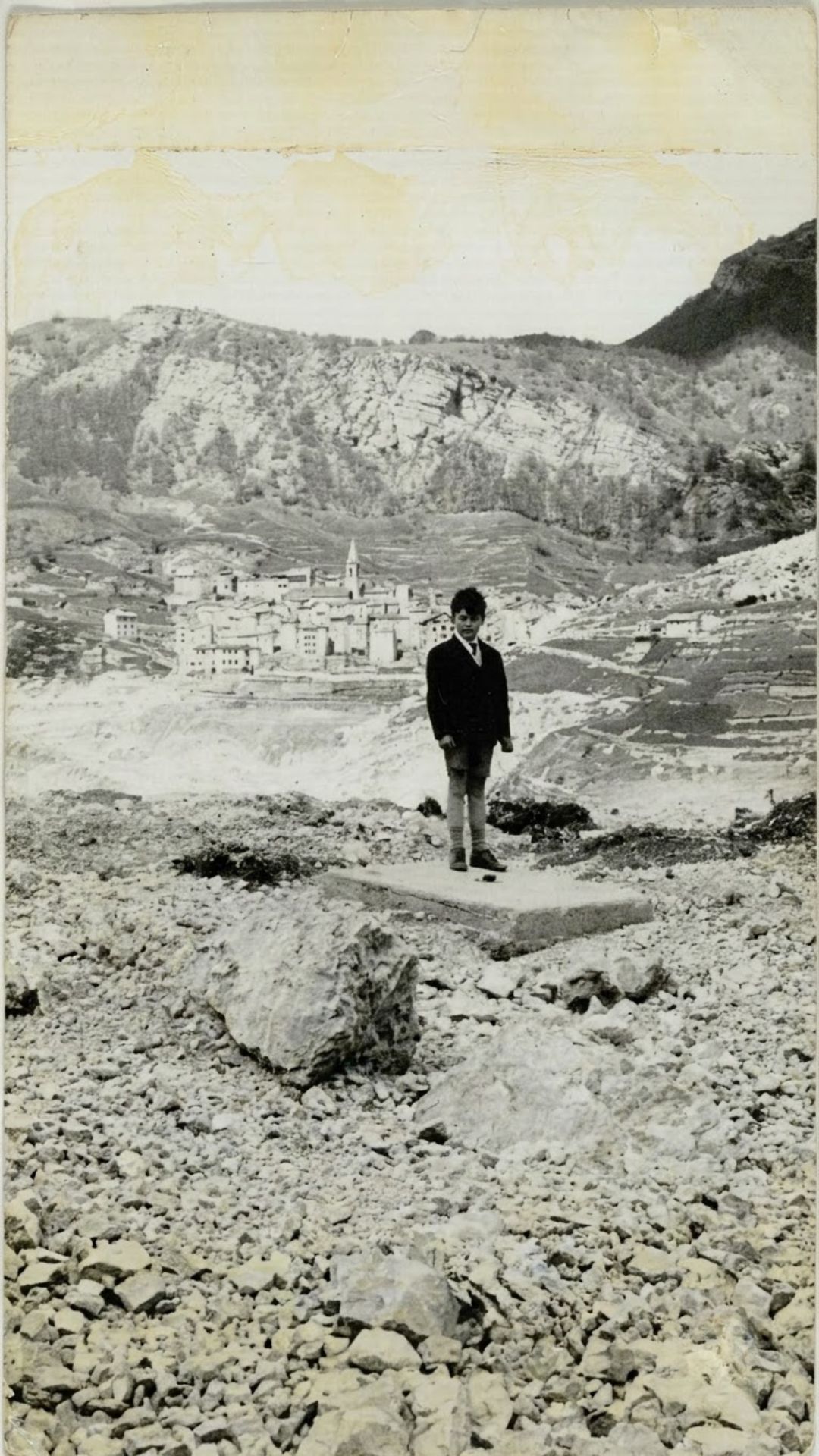
Longarone was directly in the path of the flood. The town was overwhelmed and essentially destroyed, while other settlements in the valley were also heavily damaged. The wave traveled with such force that the destruction unfolded almost instantly, leaving little opportunity for people below to understand what was happening, let alone escape.
When the water receded, the scale of the destruction became clear. Italy’s Civil Protection records the final death toll at 1,917 people. Nearly every part of the valley’s human landscape had been changed in a matter of minutes.
The Dam Was Still Standing
This is the detail that makes Vajont so difficult to understand.
The dam itself had not failed in the conventional sense. It had not cracked open, collapsed or been swept away. Instead, an external geological event had turned the reservoir into a giant wave-generating mechanism, allowing water to pass over the structure with catastrophic consequences.
That distinction changed the way the disaster was understood. A dam can be structurally sound and still be part of a catastrophic failure if the conditions around it have been misunderstood. In Vajont, the decisive threat was not that the concrete structure could not withstand the water; it was that engineers underestimated what would happen when an enormous landslide entered the reservoir.
The tragedy therefore exposed a much larger problem with complex infrastructure. Engineering does not end with building a strong structure. A project also depends on understanding the landscape around it, recognizing how different systems interact and knowing when a warning is serious enough to justify stopping the project.
The Investigation Turned Toward Human Decisions
After the disaster, attention increasingly focused on whether the tragedy could have been prevented. Geological conditions had been studied, the mountain had moved before the final collapse and concerns had been raised about the stability of the slope. The central issue became whether those warnings had been properly understood and acted upon.
USGS later described the Vajont landslide as a catastrophic event involving about 250 million cubic meters of material and a wave that overtopped the dam. Its assessment noted that unfavorable geological conditions could have been anticipated through earlier geological study and that movement had been detected weeks before the collapse.
The official Italian Civil Protection history similarly describes the landslide as the event that caused water to overtop the dam and destroy Longarone. The disaster became an important case in discussions about geological risk, infrastructure planning and the responsibility of institutions to act when technical evidence points toward danger.
That is why Vajont is remembered as more than a natural disaster. A mountain falling into a reservoir was the immediate trigger, but the long story involved engineering decisions, geological uncertainty, warnings and the consequences of continuing to operate in a landscape whose behavior was not fully understood.

The Real Failure Was Bigger Than the Concrete
The most haunting way to remember Vajont is not as a story about a dam that broke. It is a story about a dam that held while the world around it failed.
The concrete structure remained standing, but the system that was supposed to keep people safe had not adequately accounted for what the mountain could do. The USGS estimates place the landslide at about 250 million cubic meters and the death toll at around 2,000, while Italian Civil Protection records 1,917 victims.
That distinction still matters today. Modern engineering projects depend not only on stronger materials and better machines, but on monitoring, independent review, risk assessment and the willingness to act when evidence contradicts the original plan. A warning that is correctly measured but ignored is not much safer than a warning that was never detected.
Vajont has therefore survived as one of the clearest examples of how a technically impressive project can become dangerous when human decisions fail to keep pace with what the environment is telling them. The dam was a remarkable piece of engineering. The disaster showed that even a remarkable structure cannot protect people if the larger system around it fails to recognize the danger in time.
And that is what makes the story so unsettling. The mountain warned them. The dam held. The valley below was destroyed.

The Vajont disaster remains one of history’s most haunting engineering tragedies because the dam itself did not collapse. The catastrophe came when a gigantic section of Monte Toc plunged into the reservoir, generating a wave that swept over the dam and destroyed Longarone, killing 1,917 people. But the event was not without warning: movement, cracks and geological concerns had been documented for years. Vajont became a lasting reminder that the greatest danger in a complex project may not always be the structure itself, but the failure to understand when the world around it is telling you to stop.
The Vajont disaster remains one of the clearest examples of how a massive engineering project can fail without the structure itself collapsing. The story examines the landslide, the warning signs that came before it and the decisions that turned a known danger into a catastrophe. Sources: https://www.evapremkbogataj.com/post/the-dam-vajont-held-the-system-failed