They wanted to remove both of his hind legs. Most people would have expected the little Boxer to spend the rest of his life unable to move normally. Instead, after surgery, something happened that even his rescuers struggled to believe: Duncan Lou Who got up and started walking on his front legs. The bigger surprise came later, when he learned to run, climb and play as a two-legged dog—forcing everyone to rethink what his damaged body was actually capable of.
The Problem Was More Than Missing Legs
Duncan was taken in by Panda Paws Rescue, founded by Amanda Giese and Gary Walters. His rear legs were not simply weak or injured; they were fused together, twisted and considered completely unusable, while the abnormal structure was placing strain on his spine.
The rescuers were told that the remaining options were limited. According to Duncan’s caretakers, his deformed hind legs would eventually have caused severe pain and other complications, so they decided that double amputation offered the better chance at a meaningful life.
The decision was controversial, but there was one important fact working in Duncan’s favor: he could already move using his front legs before surgery. The question was whether removing the heavy, unusable rear limbs would make that movement easier or leave him unable to function normally.
Meet Duncan Lou Who, a boxer puppy with only two legs but an unstoppable spirit. His journey is a powerful reminder that life is all about perspective. You don’t want to miss this heartwarming story!
Then the Two-Legged Dog Started Walking
Duncan underwent the double amputation at about 12 weeks old. What happened afterward surprised the people caring for him: the rescue’s account says he was standing and walking on his front legs within about an hour, while another account from his family recalls him getting up roughly 30 minutes after surgery.
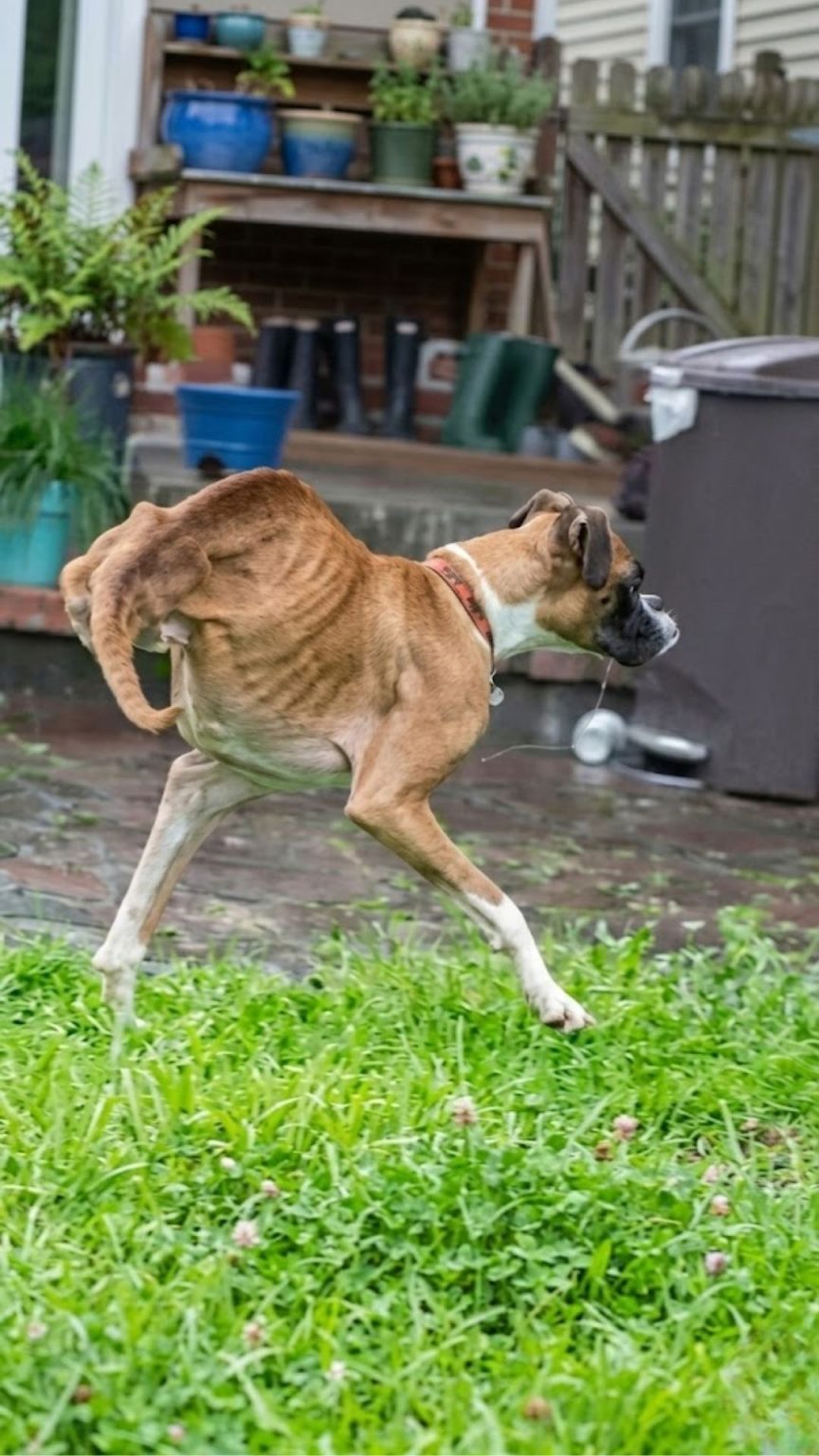
Removing the hind legs also removed their weight, making it easier for Duncan to balance over his front end. Instead of rebuilding the kind of gait a four-legged Boxer normally uses, he developed a completely different way of moving—shifting his body over his front legs and learning to use his rear body and tail for balance.
That adaptation became especially obvious when Duncan was taken to the beach. Video showed him running across the sand on his two front legs, and his family emphasized that although some footage was slowed down, the running itself had not been sped up.

Why Didn’t He Use the Wheelchair?
You might expect a two-legged dog to depend on wheels. Duncan had several custom wheelchairs made for him. But instead of calmly using them, he tried to lift or carry them, placing significant stress on his front legs, so his caretakers decided it was better to let him move in the way he had naturally developed.
That choice came with a cost. Duncan’s caretakers acknowledged that moving this way put additional strain on his body and would contribute to premature wear on his joints. He was not living as though his body had become normal again; he was adapting around a permanent limitation.
Yet his adaptation allowed him to do things that initially seemed unlikely. He could walk, run, climb stairs and play, while using his front legs as the primary source of movement and his body position and tail to maintain balance.
Then a Car Crash Tested Everything
Duncan’s story took another dramatic turn in 2017, when he was traveling with his family near Island Park, Idaho. Their Ford Excursion collided with a bison, causing the vehicle to roll repeatedly; in the chaos after the crash, Duncan disappeared from the wreck.
For approximately 17 hours, his family and volunteers searched the surrounding area. The situation looked especially dangerous because Duncan had been thrown from a violently damaged vehicle and was now somewhere in unfamiliar wilderness without the protection of his family.
Then a call came from a quarry roughly three miles from the crash site. Someone had spotted a two-legged dog, and when rescuers arrived, Duncan was too frightened to approach them. He finally responded when Amanda Giese’s daughter, Jade, called out, “Do you want a cookie?” and Duncan came toward the familiar voice.
The heartwarming journey home: See how Duncan the boxer survived the impossible and reunited with his family. You won’t believe the ending of this story! Watch now.
The Real Lesson Was Adaptation, Not a Miracle
Duncan’s story is often presented as if he somehow defeated biology. The reality is more interesting: his body had to reorganize the way it moved after losing two unusable limbs.
His front legs became the primary load-bearing and locomotion system, while his posture, rear body and tail helped him maintain balance. The adaptation was not effortless and it was not without consequences, but it gave him a way to move independently that worked for his particular body.
His life also showed the limits of that adaptation. His caretakers reported that his unusual gait placed substantial stress on his joints, and he developed episodes of tendinitis in his right shoulder that were treated with physical therapy and laser therapy.
That makes Duncan’s achievement more meaningful, not less. He was not “fixed”; he learned to function with a body that was permanently different.

Duncan Lou Who’s story began with a severe congenital deformity that left his hind legs fused and unusable. After veterinarians removed both legs, he quickly began walking on his front legs and eventually learned to run, balance and navigate the world without the wheelchair his caretakers had tried to give him. His 2017 survival after a serious vehicle crash added another chapter to the story, but the real value of Duncan’s life was simpler: his body changed the way it moved because the old way no longer worked. Duncan died in July 2023, but his story remains an extraordinary example of adaptation and resilience.