For years, a large old painting hung quietly in a French home, partly hidden whenever the door to the television room was opened. The family knew it had been there for generations and casually referred to it as “the Brueghel,” but no one knew whether it was genuine. Then auctioneer Malo de Lussac came to inspect the property. One look at the painting was enough to make him stop. The artwork had been hiding in plain sight—and its true identity was about to change everything.
A Forgotten Painting Caught the Auctioneer’s Eye
Malo de Lussac had been asked to inventory the contents of a château in France’s Indre-et-Loire region. The job involved examining furniture, antiques and other objects accumulated by the family over generations. Then he noticed something unusual.
Behind an open door hung a large painting. Much of the work was hidden from view, but what remained visible immediately caught his attention. The family had long known about the painting and reportedly called it “the Brueghel,” yet they apparently believed it could simply be an old copy.
De Lussac saw enough to think otherwise.
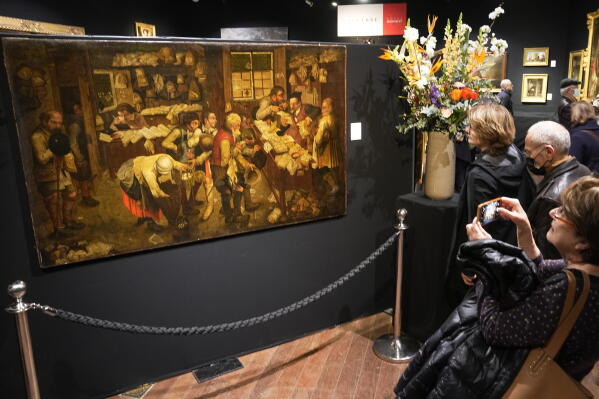
The painting measured approximately 112 by 184 centimeters and depicted a crowded scene filled with villagers, papers, books and baskets of food. The composition looked familiar. It appeared to belong to The Village Lawyer, one of the subjects strongly associated with the Flemish artist Pieter Brueghel the Younger.
A painting hidden behind a door turned out to be worth $845,000. Watch the video to discover how one forgotten artwork was recognized as a masterpiece after years of being overlooked.
The Door Had Hidden a 400-Year-Old Mystery
Finding an old painting is one thing. Proving who painted it is another.
The family could associate the work with the Brueghel name, but that did not establish authenticity. Pieter Brueghel the Younger and his workshop produced numerous versions of popular compositions, while later artists also copied those works. An apparent Brueghel could represent an original painting, a workshop production or a much later imitation.
The size of this painting made it particularly interesting. At approximately 112 by 184 centimeters, it was larger than many known versions of The Village Lawyer. Its details and overall quality suggested that the work deserved professional examination.
The painting was therefore sent for expert evaluation. What began as a routine inspection of a family property was quickly becoming a major Old Master discovery.

Experts Were Called In to Determine the Truth
Authentication involved specialists, including the Paris-based Cabinet Turquin and Klaus Ertz, one of the leading experts on Pieter Brueghel the Younger.
The process focused on more than simply comparing the painting with photographs of other works. Experts examined its composition, artistic technique and historical position among known versions of The Village Lawyer. The goal was to determine whether the work could genuinely be attributed to Pieter Brueghel the Younger rather than to his workshop or a later copyist.
In December 2022, Ertz confirmed the attribution. The painting was dated to approximately 1615–1617, placing it firmly within the artist’s lifetime.
The object hanging behind the door was no longer simply an old family painting.
It was now considered an authentic work by one of the major Flemish artists of the 17th century.
The Painting Went From a Family Home to a Major Auction
With the attribution established, the painting was prepared for sale at Hôtel Drouot in Paris.
Its discovery attracted widespread attention because of the extraordinary circumstances. The painting had not been recovered from a shipwreck or discovered inside a sealed vault. It had remained inside a private home, partly hidden by an ordinary door.
On March 28, 2023, the work went under the hammer and sold for €780,000, equivalent to roughly $845,000. Reports said the buyer was a Swiss collector.
The result demonstrated the enormous difference that authentication can make. Before expert examination, the painting was an old object with uncertain value. After its attribution to Pieter Brueghel the Younger, it entered the international market as a significant Old Master work.
Why Pieter Brueghel the Younger Still Commands Attention
Pieter Brueghel the Younger was the son of Pieter Bruegel the Elder, one of the most influential artists of the Northern Renaissance. Although the younger Brueghel is often associated with reproducing compositions created by his famous father, he became an important artist in his own right.
His workshop produced scenes of peasant life, religious subjects and crowded interiors filled with small details. These paintings were highly appealing to collectors because viewers could spend long periods examining individual figures and objects within the composition.
The Village Lawyer was one of the subjects most closely associated with Pieter Brueghel the Younger. The scene typically depicts a chaotic group of villagers waiting to deal with a legal official, carrying documents and gifts or payments that reveal both the bureaucracy and humor of everyday life.
Because multiple versions of the composition exist, establishing the status of a previously unknown example can be highly significant. The larger scale and quality of the newly identified painting added to its importance.

The Painting Never Changed—Only the Way People Saw It
Perhaps the most remarkable part of the story is that the artwork itself did not suddenly become valuable.
It had always been the same painting.
The family had lived with it. The door had partially blocked it. Generations had passed without anyone definitively proving who painted it. What changed was the attention it received.
One auctioneer looked closely enough to question the accepted assumption. Experts then spent time examining the evidence. Finally, authentication gave the painting a new identity—and the art market assigned it a new price.
That sequence explains why the world of Old Master discoveries can be so unpredictable. Important works do not always arrive with perfect documentation or dramatic histories. Sometimes they survive quietly inside private homes, waiting for someone with the right knowledge to recognize them.
The painting spent years hanging behind a door, partly concealed and never fully understood. Then one careful inspection transformed its future. Expert analysis identified the work as an authentic Pieter Brueghel the Younger, and a painting once treated as a family curiosity sold for €780,000. Its story is a reminder that art does not need to be physically lost to be forgotten. Sometimes a masterpiece can remain in plain sight for generations—until someone finally realizes what they are looking at.