A forest in northern Finland may be hiding a clue to buried gold—but not in the form of glittering nuggets or veins exposed in the rock. Researchers examining ordinary Norway spruce trees discovered microscopic particles of gold inside some of their needles. Even stranger, those particles were associated with bacteria living inside the trees. The discovery could help scientists better understand how metals move from the ground into plants—and perhaps turn forests into a new tool for finding hidden mineral deposits.
The Trees Were Growing Above Hidden Gold
The discovery came from a gold-mineralized area in northern Finland. Researchers from the University of Oulu and the Geological Survey of Finland collected 138 needle samples from 23 individual Norway spruce trees growing on a satellite mineral deposit associated with the Kittilä gold mine. Their goal was not to find gold that could be harvested from trees, but to investigate a much stranger question: how do traces of metals buried underground eventually end up inside living plants?
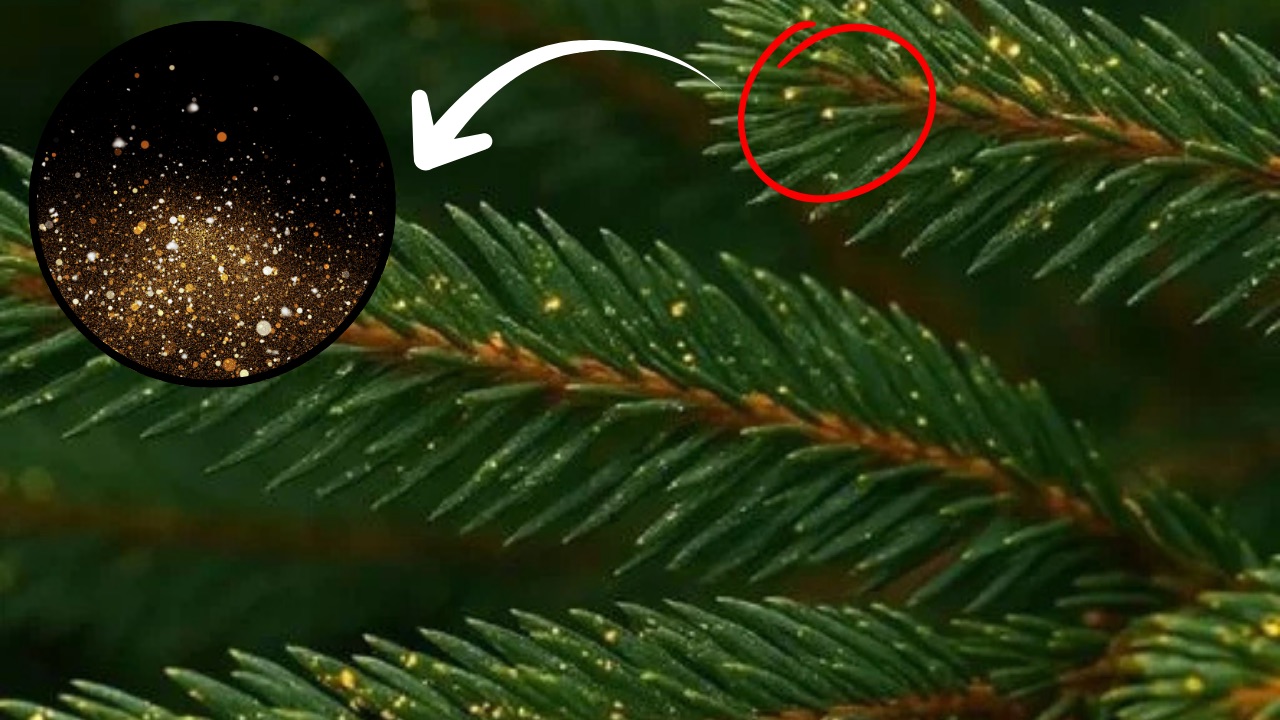
The answer began to emerge when researchers found gold nanoparticles in four of the 23 trees. The phenomenon was real, but extremely rare and localized. These were not visible flakes of gold or tiny nuggets hiding in the needles. They were microscopic particles, far beyond what the human eye could detect. The trees were not “growing gold” in any commercially useful sense—but they appeared to be recording evidence of gold hidden beneath the landscape.
What if trees could help us find hidden gold? Scientists in Finland discovered microscopic gold particles inside spruce needles—and bacteria may be part of the reason. Watch the video to explore this remarkable connection between forests, microbes and buried treasure.
The Gold Was Smaller Than a Grain of Dust
The gold particles were detected using advanced analytical techniques, including field-emission scanning electron microscopy combined with energy-dispersive X-ray spectroscopy. Researchers also used DNA sequencing to study the bacterial communities living inside the spruce needles. The gold itself existed at the nanoscale, meaning these particles were extraordinarily small and impossible to collect for commercial use.
That distinction is important because the discovery sounds more dramatic than its practical value might initially suggest. No one is about to start cutting down forests to extract gold from tree needles. The amount of gold is far too small. What makes the finding valuable is not the metal itself, but the information it carries. A tree growing above a mineral deposit may absorb chemical traces from the ground, potentially giving geologists clues about what lies beneath soil and rock cover.

The Strange Clue Was the Bacteria Living Inside the Needles
The real twist came when scientists examined the environment surrounding the gold nanoparticles. The particles were associated with microbial cells enclosed in a biofilm matrix, suggesting that microorganisms living inside the plant could be involved in the biomineralization process—the formation and deposition of minerals within living tissues.
DNA analysis identified several bacterial groups associated with gold-containing needles, including P3OB-42, Cutibacterium and Corynebacterium. Researchers emphasize that the evidence shows an association and supports the idea that endophytic bacteria may play a role in transforming dissolved gold into solid nanoparticles. It does not mean scientists have fully solved the mechanism or proven that one specific bacterium is solely responsible for “making gold.”
How Gold May Travel From the Ground Into a Tree
The proposed process begins underground. Gold-bearing mineral deposits can release gold into the surrounding environment in soluble forms through geological and biological processes. Water then carries those dissolved materials through the soil, where plants absorb water and nutrients through their roots. From there, traces of gold may move through the tree’s internal transport system toward shoots and needles.
Inside the needles, microbes may help change that dissolved gold into solid nanoparticles. This process is part of a broader phenomenon known as biomineralization, in which living organisms influence the accumulation or formation of minerals. The exact mechanism remains poorly understood, and the process appears to be localized rather than something that happens in every tree. But the Finnish study provides preliminary evidence connecting the movement of gold into spruce tissues with the microbial communities living there.
Could Trees Help Humans Find Buried Gold?
This is where the discovery becomes particularly interesting for geology and mineral exploration. Searching for deposits beneath thick layers of soil or sediment can require drilling, extensive sampling and other expensive methods. Biogeochemical exploration offers another possibility: studying chemical signals that have moved from underground deposits into living organisms at the surface.
Scientists have already known that plants can contain traces of metals from their environment. The new research adds another layer by examining what may happen after those elements enter plant tissues. If certain bacterial communities are consistently associated with gold-bearing plants, future exploration could potentially look not only for the metal itself but also for biological signals connected to the mineralization process. In other words, a forest might reveal clues about the geology beneath it before a drill ever enters the ground.

The Bigger Discovery May Not Be About Gold at All
Gold provides the headline, but the broader scientific implications may be even more significant. Understanding biomineralization could help researchers develop new methods for locating other minerals and studying how plants and microbes interact with metals in the environment. Similar processes are also being investigated in mosses, where microorganisms may help precipitate metals inside plant tissues and potentially contribute to future approaches for removing metals from contaminated water.
That makes the Finnish discovery part of a much larger story. A tree is not simply a passive object standing above the ground. It is connected to the soil through roots, water, microbes and chemical processes that can carry information from deep underground into its tissues. Scientists may eventually learn to read those biological signals more effectively, turning forests into a kind of natural geological detection system.

The spruce trees of northern Finland are not producing gold anyone can mine. The particles hidden inside their needles are microscopic and commercially worthless. But the discovery may still prove extremely valuable. By linking gold nanoparticles with bacteria living inside Norway spruce, researchers have opened a new window into the relationship between geology, plants and microorganisms. The real treasure may not be the gold itself, but the possibility that forests can quietly reveal what lies hidden beneath the ground.