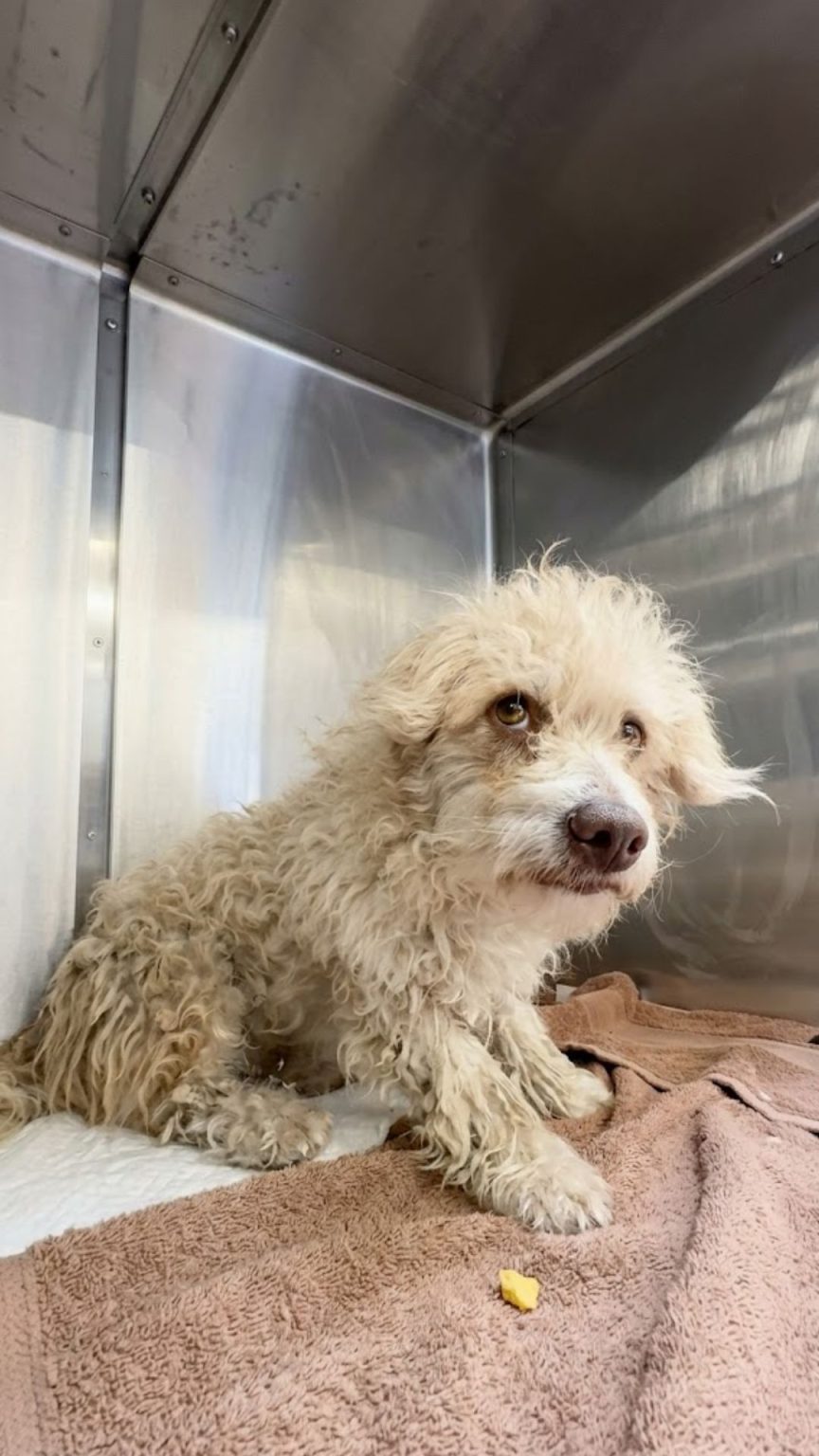
When rescuers first encountered Milo, they saw a dog that seemed impossible to approach. He was terrified, defensive and ready to snap whenever someone came too close. His behavior made him look aggressive, and touching him appeared dangerous. But the more carefully people looked, the clearer it became that Milo’s aggression might not be aggression at all. Beneath his tangled coat was a painful secret that had turned fear into a desperate form of self-defense.
The Dog Everyone Was Afraid to Touch
Milo did not behave like a dog waiting to be rescued. He resisted human contact, growled and reacted aggressively when people attempted to get close. To anyone seeing only his behavior, the conclusion seemed obvious: this was a difficult and potentially dangerous dog.
But behavior does not always explain its own cause. A dog that growls may be threatening someone—or warning them to stay away because it is afraid. A dog that snaps may be naturally aggressive, but it may also be responding to pain. For a stray animal with an unknown history, those possibilities can be difficult to separate.
Milo’s appearance offered an important clue. His coat was severely tangled and neglected, hiding much of what was happening underneath. Before anyone could understand his behavior, they first needed to understand what his body had been through.
They thought Milo was aggressive and impossible to touch. But beneath his tangled coat was a painful secret that explained everything. Watch the video to see how one rescue changed his life.
Beneath the Tangled Coat Was a Painful Secret
The truth began to emerge when rescuers examined Milo more carefully. His matted fur had trapped numerous burrs and other painful debris against his body. Some had become deeply embedded around sensitive areas, turning ordinary movement and human contact into something potentially painful.
Suddenly, his behavior looked different.
When someone reached toward Milo, he was not necessarily reacting to a person. He may have been anticipating pain. Every attempt to touch, restrain or examine him could have felt like another threat to a body that was already suffering.
That is what made the discovery so important. The rescuers had initially encountered a dog that appeared aggressive. What they found instead was an animal whose fear and pain had become inseparable.
The behavior was visible. The pain was hidden.

Why His Fear Looked Like Aggression
For an animal, growling and snapping can be forms of communication. A dog does not have many ways to explain that something hurts. It cannot point to an injured area or tell a rescuer to stop. Instead, it may tense its body, retreat, growl or attempt to bite.
Those reactions can easily be interpreted as aggression, especially when the animal is unfamiliar and its medical condition is unknown. But a defensive reaction and a naturally aggressive temperament are not necessarily the same thing.
Milo’s story demonstrates how quickly people can make judgments based on what they can see. His reaction was obvious. The reason behind it was not. The dog that appeared dangerous may have simply learned that allowing someone to touch him meant experiencing more pain.
For a frightened stray, creating distance from humans may have been the only strategy that seemed to work.
The Rescue That Changed Everything
Treating Milo required patience and caution. His physical condition and defensive behavior meant rescuers could not simply hold him down and begin removing the tangled fur. The process had to be carried out in a way that reduced stress and prevented additional pain.
After he was safely sedated, rescuers were able to remove the severely matted coat and extract the burrs and debris that had been trapped against his body. The work revealed the extent to which neglect and exposure had transformed his appearance—and potentially his behavior.
Once the painful material was removed, Milo could finally begin recovering without constantly defending himself against the next touch.
The transformation was not necessarily magical or instantaneous. Removing the source of pain did not erase whatever fear Milo had developed while surviving on his own. But it gave him something he had apparently lacked for a long time: the opportunity to feel safe.
The Dog They Called Aggressive Started to Come Back
As Milo received care and began recovering, another side of him slowly emerged. The dog that had once seemed impossible to approach became less defensive. He started responding differently to his environment and, eventually, showed signs that his fear was no longer controlling every interaction.
One particularly important moment came when Milo was introduced to another friendly dog. Instead of reacting with the same fear and hostility that had defined his first encounters with humans, he began showing more relaxed behavior, including wagging his tail.
That small change carried enormous meaning.
The dog rescuers first met had seemed to be defined by aggression. But as the pain was treated and his sense of safety increased, it became increasingly clear that the label had never told the whole story.
Perhaps Milo had not been an aggressive dog who needed to be fixed.
Perhaps he had been a frightened dog who needed someone to discover what was hurting him.

The Lesson Hidden in Milo’s Story
Milo’s rescue is ultimately about more than one neglected stray. It is about the danger of confusing a reaction with a personality.
People often assume that behavior reveals character. Someone appears angry, so they must be an angry person. A dog growls, so it must be aggressive. An animal resists help, so it may seem unwilling to be rescued.
But behavior always has a context.
Fear can look like hostility. Pain can look like aggression. Survival can look like distrust.
That does not mean every aggressive animal is secretly gentle or that dangerous behavior should be ignored. Safety still matters. But Milo’s story is a reminder that the first visible explanation is not always the correct one.
Sometimes the real problem is hidden beneath the surface.
At first, Milo looked like the kind of dog no one wanted to touch. He growled, resisted and seemed ready to defend himself against anyone who came too close. But beneath the tangled coat was a painful secret that changed the entire story. Once rescuers looked beyond the behavior and treated what was causing his suffering, Milo finally had the chance to become something more than the label placed on him. The most important part of his rescue may have been the moment someone asked not whether he was dangerous, but why he was so afraid to be touched.