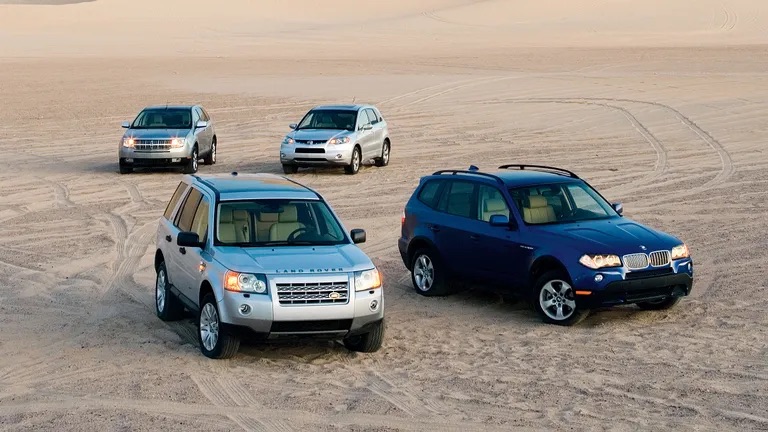
Before luxury crossovers became nearly indistinguishable, four manufacturers offered four very different answers to the same question: what should a premium SUV actually do? The 2007 Acura RDX brought turbocharged performance and advanced all-wheel drive, the BMW X3 chased sports-sedan handling, the Land Rover LR2 headed toward the dirt and the Lincoln MKX prioritized space and comfort. MotorTrend put them through roughly 1,000 miles of highways, mountain roads and desert terrain. Only one emerged as the most complete machine.
Four SUVs Entered the Same Battle—But They Were Built for Different Drivers
This comparison was interesting because these vehicles were competing for similar buyers while following completely different philosophies. All four offered the expected ingredients of a premium crossover: all-wheel drive, more than 200 horsepower, leather interiors and a long list of luxury equipment. But beyond that common starting point, their personalities diverged sharply.
The test took the vehicles through highways, winding mountain roads and the Dumont Dunes near the Mojave National Preserve. That combination exposed something modern comparisons sometimes struggle to reveal: the difference between a vehicle that is merely competent and one that has a clear identity. The Lincoln was the comfort-focused American, the BMW was the driver’s choice, the Land Rover carried the strongest off-road credentials and the Acura arrived as the technological disruptor.
Four SUVs. Four completely different personalities. From turbocharged performance and German handling to British off-road capability and American comfort, this showdown reveals why the Acura RDX ultimately came out on top.
Acura RDX: The Turbocharged Surprise
On paper, the 2007 Acura RDX appeared to be the underdog. It was the only four-cylinder vehicle in the comparison and used a five-speed automatic while several competitors had six-speed transmissions. But its 2.3-liter turbocharged engine produced 240 horsepower and 260 lb-ft of torque, while its SH-AWD system could actively distribute torque across the drivetrain—including between the rear wheels.
The numbers told the story. MotorTrend recorded a 0–60 mph time of 6.5 seconds, making the RDX the quickest vehicle in the group. It also produced the strongest lateral acceleration and the fastest figure-eight performance. The combination of turbo torque, relatively low weight and torque-vectoring all-wheel drive made the Acura feel less like a traditional SUV and more like a sports sedan that had been given extra ground clearance.
It was not perfect. The ride could be stiff, and its limited ground clearance meant it was more capable on loose surfaces than it was genuinely suited to serious off-road driving. But on highways and mountain roads, the RDX was the most entertaining machine in the comparison—and it was also the least expensive of the four test vehicles. MotorTrend placed it first.

BMW X3: The Oldest Fighter Still Knew How to Handle
The BMW X3 entered the contest as the veteran. Introduced several years earlier, it had nevertheless received important upgrades for 2007, including a 260-horsepower inline-six, a six-speed automatic and revised styling. Its xDrive all-wheel-drive system retained BMW’s familiar rear-drive bias, and the X3 continued to behave more like a tall sports wagon than a conventional SUV.
When the roads became demanding, the BMW remained composed and capable. Its chassis offered the kind of balance expected from the brand, and the X3 was still a rewarding vehicle for someone who valued steering, cornering and driver involvement. It also proved reasonably capable away from paved roads, making it more versatile than its sport-oriented reputation might suggest.
The problem was value. At nearly $50,000 as tested, the X3 was significantly more expensive than the Acura and Land Rover while beginning to feel dated inside. MotorTrend’s criticism was simple: the BMW remained athletic, but buyers were being asked to pay heavily for that ability. It finished third—not because it was a bad SUV, but because its competitors offered more convincing arguments for the money.

Land Rover LR2: The One That Didn’t Want to Stay on the Road
If the Acura was built to attack corners and the BMW wanted to behave like a sports car, the Land Rover LR2 had another priority: going where the road ended.
Despite being based on a car platform and sharing components with Volvo, the LR2 carried genuine Land Rover technology. Its Terrain Response system could adjust the behavior of the transmission, throttle, stability systems and hill-descent control for conditions including sand, mud and snow. It also had the greatest ground clearance and the most aggressive approach and departure angles in the group.
At the Dumont Dunes, the LR2 separated itself from the competition. MotorTrend found that its Terrain Response system allowed the vehicle to handle sand with an ease the others could not match. The RDX was quick and surprisingly capable, while the BMW and Lincoln could manage more than their luxury image suggested, but the Land Rover was simply the most convincing off-road machine.
Its weakness was straight-line performance. The 3.2-liter inline-six and six-speed automatic pushed a relatively heavy vehicle, resulting in the slowest 0–60 mph time of the group at 9.0 seconds. Yet the LR2’s blend of genuine off-road ability, respectable road manners and lower price made it difficult to dismiss. It finished second and arguably possessed the strongest personality of the four.

Lincoln MKX: The Comfortable American That Couldn’t Keep Up
The Lincoln MKX represented the traditional American luxury approach: make it large, comfortable and powerful enough that nobody cares too much about what happens in a tight corner.
Its 3.5-liter V6 produced 265 horsepower, giving the MKX respectable acceleration despite being by far the heaviest vehicle in the comparison. It reached 60 mph in 7.7 seconds and offered the smoothest ride of the group. Its rear seat was the most accommodating, its cargo area was the largest, and heated and cooled front seats reinforced its focus on comfort.
The problem emerged when the road became interesting. MotorTrend criticized the MKX for its excessive weight, vague steering, soft body control and pronounced understeer. It was designed to float over highways rather than attack mountain roads, and in a comparison built around versatility and driving enjoyment, that personality became a disadvantage.
The MKX therefore finished fourth. But that result does not mean it was useless. For buyers who valued a quiet highway ride, generous interior space and traditional American comfort, the Lincoln had genuine strengths. It simply happened to be competing in a test where agility and versatility mattered more.

The Real Winner Was a New Idea of What a Luxury SUV Could Be
The final ranking was clear: Acura RDX first, Land Rover LR2 second, BMW X3 third and Lincoln MKX fourth. But the more interesting result was what the comparison revealed about the luxury SUV market in the late 2000s.
Manufacturers were beginning to move away from the old assumption that an SUV had to be a large, truck-like machine. Buyers wanted leather and technology, but they also wanted speed. They wanted all-wheel drive, but not necessarily poor handling. They wanted cargo space without driving something that felt like a full-size truck.
The Acura RDX captured that transition particularly well. Its turbocharged engine, paddle shifters and advanced SH-AWD system were aimed at drivers who wanted performance without giving up utility. MotorTrend even described the RDX as essentially “a sport sedan in crossover clothes.” The fact that it defeated a BMW on driving enjoyment and cost less than its rivals made the result especially significant.
This 2007 luxury SUV showdown was more than a comparison between four vehicles. It was a clash between four philosophies. The Acura RDX proved that a crossover could be quick and genuinely fun to drive. The Land Rover LR2 demonstrated that luxury did not have to eliminate off-road capability. The BMW X3 defended the importance of handling, while the Lincoln MKX represented comfort and space above everything else. The Acura won the test, but each vehicle answered the same question differently—and that may be what makes this old comparison more interesting today than many modern SUV battles.