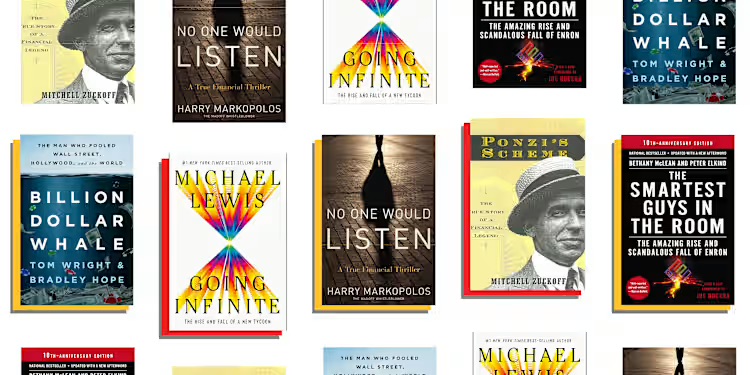
Some financial fraud stories are so extraordinary that they sound more like thrillers than real events. Yet the people, companies and billions of dollars involved were very real. From Charles Ponzi and Bernie Madoff to Enron, 1MDB and FTX, these five books take readers inside some of the most notorious financial scandals in modern history — revealing how deception worked, why people believed it and how these seemingly unstoppable empires eventually collapsed.
The Man Who Turned A Wild Promise Into A Fortune
Mitchell Zuckoff’s Ponzi’s Scheme: The True Story of a Financial Legend takes readers back to Boston in the 1920s, when Charles Ponzi became famous for promising investors extraordinary returns.
Ponzi claimed investors could earn 50 percent in just 45 days through a strategy involving international postal coupons. The numbers sounded almost unbelievable, yet thousands of people were willing to put their money behind him.
Nearly 30,000 people ultimately invested about $10 million before the operation collapsed. The basic mechanism was brutally simple: money from newer investors was used to pay earlier investors, creating the appearance that the promised returns were real.
What makes the story particularly interesting is that Ponzi did not operate in a vacuum. The public was hungry for quick wealth, the press helped amplify his reputation and regulators were slow to stop him.
His name eventually became synonymous with a type of financial fraud that continues to appear more than a century later.
The lesson is unsettling: sometimes a financial scam does not need to look believable to everyone. It only needs to look believable to enough people for the money to keep coming in.

Ever wondered how financial fraud can stay hidden for years? Watch this video for a closer look at the people, schemes and warning signs behind some of the most notorious financial scandals.
The Billionaire Who Built A World Around Other People’s Money
In Billion Dollar Whale, journalists Tom Wright and Bradley Hope examine the extraordinary rise of Malaysian financier Jho Low and the 1MDB scandal.
The book describes how more than $5 billion was allegedly diverted from Malaysia’s state-owned 1MDB fund through a complex network of bank accounts, shell companies and financial structures. The money was intended to support Malaysia’s economic development, but instead became associated with an extraordinary international spending spree.
Low cultivated relationships with wealthy and famous people while spending enormous amounts of money. Luxury properties, expensive parties, celebrity connections and extravagant purchases helped create the image of someone who belonged among the world’s richest people.
That image mattered.
Wealth can become its own form of credibility. Someone surrounded by expensive cars, famous friends and lavish events may appear successful long before anyone asks where the money actually came from.
That is one of the most fascinating aspects of the story. The deception was not based only on complicated financial transactions. It was also built around perception.
The more successful Low appeared, the easier it became for others to accept the idea that he really was successful.

The Crypto Empire That Collapsed Almost As Quickly As It Rose
Michael Lewis’s Going Infinite: The Rise and Fall of a New Tycoon takes the story into the world of cryptocurrency and follows the extraordinary rise of Sam Bankman-Fried.
Bankman-Fried went from an obscure young entrepreneur to the public face of a rapidly expanding crypto empire. FTX became one of the industry’s most recognizable companies before its spectacular collapse.
In 2023, Bankman-Fried was convicted of stealing $8 billion from FTX customers and was sentenced to 25 years in prison.
What makes Lewis’s book different is that it focuses heavily on the people and culture surrounding FTX rather than turning the story into a technical explanation of cryptocurrency.
That human element makes the rise and fall particularly revealing.
FTX existed in a world where enormous amounts of money could move quickly, companies could grow at extraordinary speed and traditional assumptions about financial institutions were being challenged.
The story raises an enduring question about financial bubbles:
How much of success is actually based on numbers — and how much depends on people believing that success will continue?

The Man Who Saw The Problem Before Almost Everyone Else
Harry Markopolos’s No One Would Listen: A True Financial Thriller tells a very different story.
This time, the central figure is not the person running the fraud.
It is the person who tried to expose it.
In 1999, Markopolos, a derivatives portfolio manager, examined the returns being reported by Bernie Madoff and concluded that the numbers did not make mathematical sense. According to HISTORY, he spent roughly nine years trying to convince regulators and others that something was seriously wrong.
Madoff’s operation eventually became one of the most notorious Ponzi schemes in financial history.
What makes Markopolos’s account so compelling is the question it raises about warning signs.
The problem was not necessarily that nobody could see anything unusual. Someone did.
The problem was that recognizing something is wrong and getting an entire system to act on that information are two very different things.
The story is therefore about more than fraud. It is about institutions, credibility and the difficulty of challenging a financial figure who has spent years building a reputation for success.
Sometimes the warning sign is already there.
The harder question is whether anyone is willing to listen.

When A Huge Corporation Became Too Complicated To Question
Bethany McLean and Peter Elkind’s The Smartest Guys in the Room examines the rise and collapse of Enron.
The company began as a relatively modest pipeline operation but grew into one of America’s most celebrated corporations before its collapse exposed serious accounting problems and a deeply troubled corporate culture.
McLean’s reporting famously began with a simple question: How exactly was Enron making its money?
That question became the starting point for a much larger investigation. The company’s eventual collapse wiped out roughly $70 billion in value, according to HISTORY.
The Enron story is particularly important because it shows that financial fraud does not always look like a lone con artist standing outside a bank.
It can exist inside a major corporation.
It can involve executives, accountants, analysts and investors.
And it can become so complicated that outsiders find it difficult to understand what is actually happening.
That complexity can become a shield. When financial structures are difficult to explain, people may rely more heavily on reputation, authority and confidence.
Enron shows what can happen when that confidence goes unchecked.

What These Five Scandals Have In Common
The five stories occurred in very different eras and involved very different kinds of financial schemes. Yet the same patterns appear again and again.
There is usually a compelling promise.
There is often an appearance of extraordinary success.
Complexity can make the underlying reality difficult to examine.
And perhaps most importantly, people want to believe the story.
Ponzi offered extraordinary returns. Jho Low appeared to have extraordinary wealth. FTX appeared to represent the future of finance. Madoff had a reputation that made people reluctant to question him. Enron surrounded itself with an aura of sophistication and corporate success.
The details changed.
Human psychology did not.
The Real Lesson Isn’t About Being Smarter
These books are fascinating because they do more than explain how financial fraud works. They show why fraud can survive even when warning signs exist.
The victims are not always careless or financially ignorant. Sometimes they are persuaded by reputation. Sometimes they are attracted by impressive returns. Sometimes they trust people who appear more knowledgeable than themselves.
And sometimes, as the Madoff story demonstrates, the information needed to uncover the truth is already available — but nobody acts on it.
That may be the most enduring lesson from these five financial scandals.
The next big fraud may not look exactly like Ponzi’s scheme, Enron or FTX. The technology, terminology and financial products may change.
But the ingredients can remain remarkably familiar:
A story that sounds too good to ignore.
A person who seems too successful to question.
A system that appears too complicated to understand.
And a group of people who desperately want the story to be true.
That is why these financial fraud stories remain worth reading long after the scandals themselves have disappeared from the headlines.
These five books show that financial fraud rarely depends on one clever lie. It often grows through trust, reputation, complexity and the desire to believe that extraordinary returns are possible. Ponzi, Madoff, Enron, 1MDB and FTX may belong to different eras, but their stories reveal surprisingly similar patterns. For anyone interested in money, business or human behavior, these books offer more than fascinating scandals — they provide a lasting lesson in how financial deception can take hold.