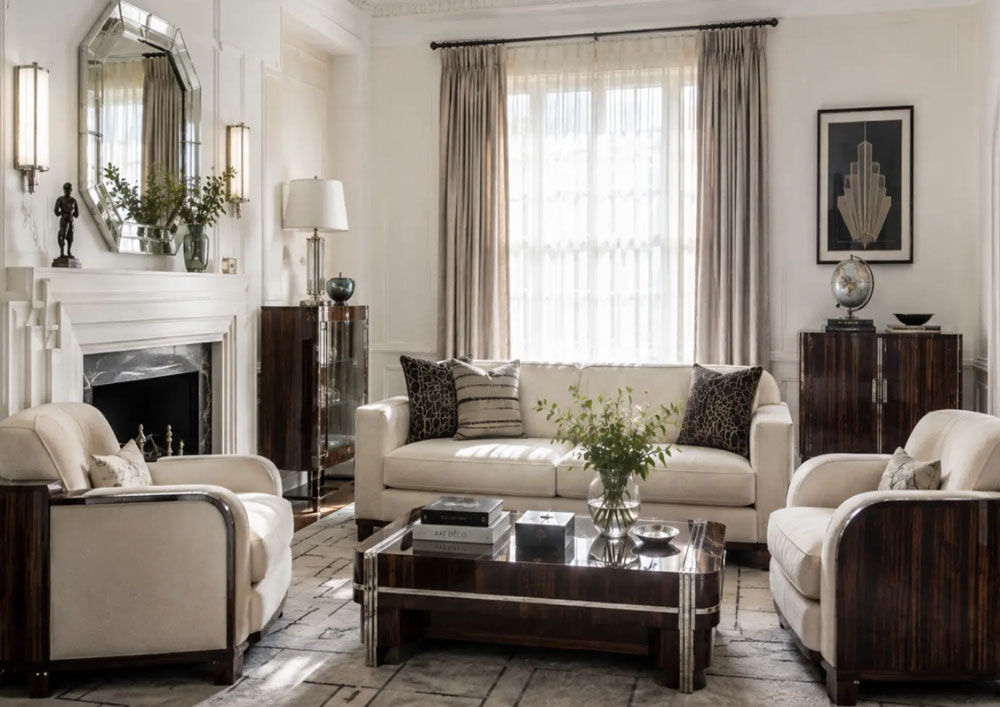
Art Deco may have emerged a century ago, but its combination of bold geometry, rich materials and carefully controlled luxury still works surprisingly well in modern homes. For homeowners looking beyond cold minimalism or short-lived design trends, the style offers another option: a house with stronger character, deeper textures and a sense of permanence. The key is knowing how to bring Art Deco into a contemporary home without turning it into a 1920s time capsule.
Art Deco Is Back—and It Might Be the Right Style for Your House
If you are designing a house in your 40s or 50s, you probably want something different from the interiors that dominate social media today. Minimalist rooms can look clean, but sometimes they feel too cold. Trend-driven interiors can look impressive for a few years, then quickly begin to feel dated. Art Deco offers another direction: a home built around strong geometry, rich materials, deliberate contrast and a sense of understated luxury.
Emerging in the 1920s and becoming influential through the 1930s, Art Deco was never simply about decoration. It represented a particular vision of modern life, combining craftsmanship with industrial materials, geometric forms and a confidence in new technology and design. In a house today, that same character can create rooms that feel sophisticated without having to follow every passing interior trend.
The key is knowing how much Art Deco to use. Done well, it can make a home feel substantial, elegant and distinctly personal. Done badly, it can turn a living room into something that looks more like a themed hotel. What if the right interior style isn’t the one that looks most modern, but the one that still looks impressive 20 years from now?

The Materials That Give Art Deco Its Character
Wood, Stone and Metal
One of the reasons Art Deco interiors can feel expensive is that the style places considerable emphasis on materials and finishes. Instead of relying on decoration alone, it creates visual richness through combinations of wood, stone, metal and glass.
Dark or richly finished wood works particularly well because it gives rooms visual weight. Walnut, for example, can bring warmth to cabinetry, desks and furniture while providing a strong contrast against lighter walls. Marble introduces another layer, particularly when used for coffee tables, countertops, fireplaces or bathroom surfaces. Brass, bronze and chrome can then add controlled areas of reflection without requiring an entire room to become metallic.
Glass also plays an important role, particularly in lighting, mirrors and decorative partitions. Geometric patterns and symmetrical arrangements reinforce the architecture of the room, giving the interior a sense of order rather than random decoration.
The important point is that luxury does not necessarily come from choosing the most expensive material available. A relatively simple room can feel considerably more refined when a few materials are selected carefully and repeated consistently throughout the space.
Watch the video for a practical guide to Art Deco interior design, from its history and differences from Art Nouveau to choosing bold colors, geometric patterns, symmetry and luxury materials for a modern home.
Don’t Make Everything Shine
This is where many attempts at Art Deco go wrong. Brass everywhere, polished marble on every surface and glossy black furniture can quickly become excessive. Instead of sophisticated, the room starts to feel theatrical.
The better approach is contrast. Pair polished surfaces with matte finishes, reflective metal with natural wood, and hard stone with softer upholstery. The room should have different textures that reveal themselves gradually rather than competing for attention. Art Deco works best when luxury feels deliberate rather than excessive.

The Colors That Make Art Deco Feel Expensive
Start With a Strong Base
Art Deco does not require every room to be black and gold. In fact, a restrained color foundation often makes the style feel considerably more contemporary.
Cream, ivory, charcoal, deep brown and black can provide a strong base. Dark green, navy and burgundy can then introduce more personality without overwhelming the room. These deeper tones work particularly well in dining rooms, studies, libraries and bedrooms where a more intimate atmosphere is desirable.
Metallic accents can be introduced through lighting, furniture hardware, mirrors and decorative details. Brass and bronze tend to work particularly well with warm woods, while chrome can create a sharper, more contemporary interpretation of the style.
The goal is not to fill the room with different colors. It is to establish a controlled palette and allow contrast to do the work.
Contrast Is the Secret
A successful Art Deco room often depends more on contrast than on decoration. Dark and light surfaces create depth. Matte and polished finishes prevent a room from feeling flat. Straight architectural lines can be balanced by curved furniture, while geometric patterns can be softened by upholstery and natural materials.
Imagine a living room with warm ivory walls, dark walnut furniture, a deep green sofa, a marble coffee table and a brass floor lamp. There is nothing particularly extravagant about any individual piece. Together, however, the combination creates the visual language of Art Deco.
The same principle can work in a home office. A walnut desk, dark leather chair, brass desk lamp and restrained geometric artwork can create a room that feels established and serious without looking old-fashioned. You don’t need more decoration. You need better contrast.

How to Bring Art Deco Into a Modern House
Don’t Recreate the 1920s
The biggest mistake would be treating Art Deco as a historical theme and attempting to reproduce an entire 1920s interior. A modern house does not need to look like it came from another century.
Instead, use Art Deco as a design language layered onto contemporary architecture. Keep the clean structure of the house and introduce the style through lighting, furniture, mirrors, cabinetry, hardware, artwork and selected architectural details.
This approach is particularly effective because it allows the house to feel contemporary while still having a recognizable personality.
A modern living room, for example, can remain relatively simple while incorporating a geometric mirror, sculptural armchair, marble table and distinctive chandelier. The architecture stays modern; the furnishings provide the historical reference.
Choose One Statement Piece
Another useful rule is to give each room a focal point rather than filling it with decorative objects.
A dramatic chandelier can become the defining feature of a dining room. A large geometric mirror can anchor a living room. A dark wood cabinet can establish the character of a hallway. A sculptural chair or carefully designed desk can completely change the atmosphere of a home office.
This restraint is particularly important in larger houses. When every room is competing for attention, expensive materials lose their impact.
Art Deco works better when the eye has somewhere to rest.
For a homeowner who wants a particularly masculine interpretation, the combination of walnut, leather, stone, brass and controlled lighting is especially effective. A home office, library or private lounge can take on the atmosphere of an executive study without relying on stereotypical “luxury” decoration. The goal isn’t to make your house look old. It’s to make modern design feel more substantial.
Is Art Deco the Right Style for Your House?
Art Deco is a strong choice if you want a home with personality, structure and a sense of permanence. It works particularly well for homeowners who appreciate craftsmanship, darker materials, architectural detail and interiors that feel deliberately designed rather than assembled from whatever happens to be fashionable.
It may be less suitable if your ideal home is extremely light, airy and minimal. Scandinavian and Japandi interiors, for example, generally emphasize simplicity and natural restraint, while Art Deco is more comfortable with contrast, richer finishes and stronger visual statements.
The good news is that you don’t have to commit to one style throughout the entire house.
A modern home can use Art Deco selectively. Keep roughly 80 percent of the interior contemporary and functional, then use the remaining 20 percent for the details that give the house its character: brass lighting, geometric patterns, marble surfaces, dark wood, sculptural furniture or a statement mirror.
That approach also makes the design easier to live with. If your tastes change in ten years, you can replace a lamp or chair without having to redesign the entire house.
Ultimately, Art Deco is less about making a house look luxurious than about making luxury feel intentional. It is a style built around proportion, materials, geometry and contrast, which is why it can still feel surprisingly modern a century after it first became popular.
For a homeowner looking for something more distinctive than another minimalist interior, that may be exactly the point.

Art Deco has lasted this long for a reason. Its appeal comes from more than brass, marble or geometric patterns; it is the balance between structure, craftsmanship and restraint that gives the style its staying power. For a modern homeowner, the goal is not to recreate the 1920s, but to borrow what made Art Deco distinctive and combine it with contemporary comfort. Done well, the result is a house that feels luxurious, masculine and confident without looking excessive or trapped in the past.