In the winter of 1896, a traveler arrived at a remote camp near Deep Creek and found that something was terribly wrong. Two young shepherds had vanished from sight, two exhausted dogs remained nearby, and a disturbing discovery inside a wagon raised questions that would outlive everyone connected to the case. One victim appeared to have left behind a final message and a mysterious symbol, but what happened at the isolated camp was never fully explained. More than a century later, the Deep Creek mystery still has no confirmed answer.
A Winter Discovery in the Idaho Wilderness
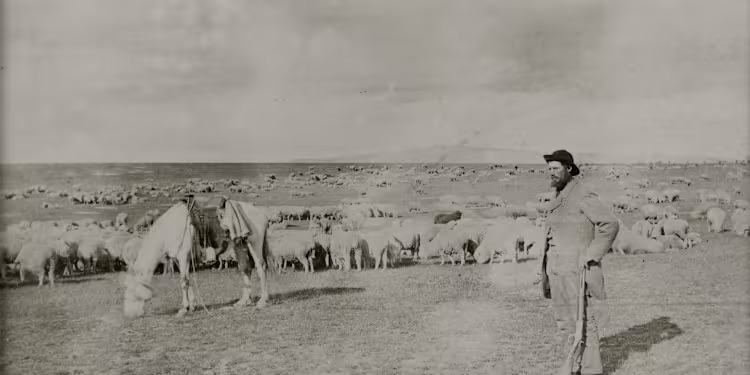
On a cold February day in 1896, sheepherder Ted Severe traveled through the wilderness near Deep Creek in Idaho toward the camp of two fellow shepherds, Daniel Cummings and John Wilson.
The camp should have shown ordinary signs of life. Instead, something was immediately wrong.
There were no voices. No movement. No one came out to greet Severe.
The only living creatures he could see were two weak, emaciated dogs tied to a wagon wheel. Their condition suggested that they had been left without proper food for an extended period.
Severe then looked inside the wagon and discovered the reason the camp had fallen silent.
Daniel Cummings and John Wilson were dead. Their bodies lay in a pile of bedding surrounded by blood.
What had happened in the isolated camp would become one of the most enduring unsolved murder mysteries of the American frontier.

The Only Survivors Were Two Starving Dogs
The two dogs were among the most haunting details of the discovery.
According to the historical account, they were so severely weakened by hunger that they had chewed on a leather harness for sustenance. Their presence showed that life had continued at the abandoned camp after the men had died—but only barely.
The image is difficult to forget: two animals still tied near the wagon while the people responsible for them were already dead inside.
Their condition also suggested the isolation of the crime scene. Deep Creek was far from the kind of populated environment where a murder would quickly be discovered. Days could pass before another person happened to travel through the area.
The source confirms that the dogs were alive when Severe found the camp. However, the available account does not clearly document their later fate, so the historical record does not provide a definitive answer about what happened to them afterward.
Watch the video to explore the Deep Creek mystery and uncover the strange events surrounding an isolated camp in the American West. A final message, unexplained clues and more than a century of unanswered questions make this one historical mystery worth discovering.
Inside the Wagon Were the Bodies of Two Young Shepherds
Investigators later determined that both men had been killed by gunfire.
Daniel Cummings had been shot once in the stomach. John Wilson had been shot once in the face and again in the back. A coroner’s investigation estimated that they had died around February 4 or 5, 1896.
The isolation of the camp made the crime especially difficult to investigate.
There were no modern forensic laboratories, security cameras or rapid communication systems. Investigators had to reconstruct events from the physical evidence available at the remote site, witness accounts and the movements of possible suspects.
But one discovery made the case even more mysterious.
Cummings had apparently survived long enough after being wounded to leave behind what appeared to be a final message.
One Victim Left a Final Message Before He Died
Before his death, Daniel Cummings scratched out a short message asking that, if he died, he be buried and referring to family members named Jerome and Ruthy.
He also left behind a strange diamond-shaped symbol drawn in blood on a piece of magazine paper.
The symbol immediately added another layer of mystery to the case.
Was it an attempt to identify the killer?
Was it connected to the nickname of a suspected gunman?
Or did it mean something entirely different?
The surviving evidence does not provide a definitive answer. That uncertainty is important because the temptation to connect the bloody symbol directly to Diamondfield Jack is understandable—but the symbol itself did not conclusively solve the case.
Instead, it became one of the many details that made the Deep Creek murders feel like a mystery from the darkest version of the Wild West: a dying message, an unexplained symbol and no certain killer.
The Range Wars Behind the Deep Creek Murders
The murders did not happen in a historical vacuum.
During the late nineteenth century, conflicts between cattlemen and sheepherders sometimes erupted across the American West. Both industries depended on access to land and water, and disputes over grazing territory could become bitter.
The Deep Creek area was connected to this wider struggle. Daniel Cummings and John Wilson had crossed into territory associated with a “deadline,” a boundary used to restrict sheep grazing in areas claimed by cattle interests. Historical accounts describe the killings as part of a broader cattle-and-sheep conflict along the Idaho-Nevada borderlands.
This context mattered because the murders were not immediately viewed as an ordinary personal dispute.
The victims were sheepherders.
They had entered a contested grazing region.
And a number of cattle interests had a history of hostility toward sheep operations.
That made the search for suspects inseparable from the larger range wars of the American frontier.

Why Did Suspicion Fall on Diamondfield Jack?
The most famous suspect was Jackson Lee Davis, better known as “Diamondfield Jack.”
Little about his early life was entirely clear, but he had developed a reputation as a rough and dangerous frontier figure. He had worked for cattle interests and had reportedly been involved in efforts to keep sheepherders away from disputed grazing areas.
According to A&E’s account of the case, Diamondfield Jack had previously shot and wounded a shepherd named Bill Tolman. When Cummings and Wilson were found dead near Deep Creek, suspicion quickly focused on Davis and his associate Jack Gleason. Davis was also said to have bragged about killing sheepherders.
The name “Diamondfield Jack” made the mystery surrounding Cummings’s final symbol even more intriguing.
But suspicion is not proof.
Davis may have fit the image of a likely Wild West killer, and his reputation certainly did not help him. Yet the central question remained whether investigators could actually prove that he had murdered Cummings and Wilson.
A Murder Trial, a Death Sentence and Two Confessions
Diamondfield Jack was eventually returned to Idaho to face trial.
He was convicted of the murders and sentenced to hang on June 4, 1897. His associate Jack Gleason was also arrested but was not charged with the killings because of insufficient evidence.
At first, the case appeared to be heading toward a final conclusion.
Then the story became even more complicated.
Two other men, James Bower and Jeff Gray, later confessed to the murders. Their accounts contained serious inconsistencies, and they were ultimately found not guilty. Nevertheless, the confessions created enough doubt to affect the legal process surrounding Diamondfield Jack’s execution.
This was a crucial turning point.
If Davis had really been the killer, why were other men confessing?
If Bower and Gray were lying, why had they made such detailed claims?
And if none of them were responsible, then who had actually attacked the two shepherds?
The legal case had produced more questions instead of fewer.
Diamondfield Jack Walked Free—But the Mystery Remained
Diamondfield Jack spent years fighting his conviction and death sentence.
His execution was repeatedly delayed as legal appeals and new developments continued to complicate the case. Eventually, his former employer John Sparks, who had become governor of Nevada, became involved in efforts that contributed to Davis receiving a pardon.
Diamondfield Jack was freed from prison in December 1902.
His release did not mean the Deep Creek murders had been solved.
It only meant that the case against him had failed to provide a final and unquestionable answer.
Davis later went on to prospect for minerals and became associated with Nevada’s mining boom. Yet the two men found dead at Deep Creek remained at the center of an unresolved historical mystery.
A man had been convicted.
He had faced execution.
He had spent years in prison.
And then he walked free.
But the identity of the killer was still uncertain.
Why the Deep Creek Murders Remain Unsolved
More than a century later, the Deep Creek murders remain difficult to resolve for several reasons.
First, the crime occurred in an isolated frontier environment where witnesses were scarce and physical evidence could easily disappear.
Second, the investigation took place in 1896, long before modern forensic science could analyze crime scenes using DNA, advanced ballistics or other technologies available today.
Third, the case became entangled with the wider conflict between cattlemen and sheepherders. That meant personal reputation, economic interests and regional loyalties could all influence the way people interpreted the evidence.
Finally, the case generated competing stories.
Diamondfield Jack was widely suspected and convicted, but later confessions raised doubts. Those confessions themselves were inconsistent. The legal system never produced a universally accepted explanation of what happened at Deep Creek.
That is why the case remains so compelling.
The murders are not mysterious because nobody was ever suspected.
On the contrary, there were suspects, a trial, a conviction, a death sentence and even confessions.
The mystery survived because none of those developments produced a definitive answer.

The Deep Creek murders contain nearly every element of a classic Wild West mystery: a remote wilderness, a deadly range conflict, two murdered shepherds and a notorious gunman accused of the crime. Yet the most haunting detail may still be the two starving dogs waiting beside the wagon, unaware that their owners would never return. A dying message and a strange symbol seemed as though they might reveal the killer, but instead became part of the mystery. Nearly 130 years later, Daniel Cummings and John Wilson’s deaths remain unsolved—and one of the Wild West’s darkest secrets still has no confirmed answer.