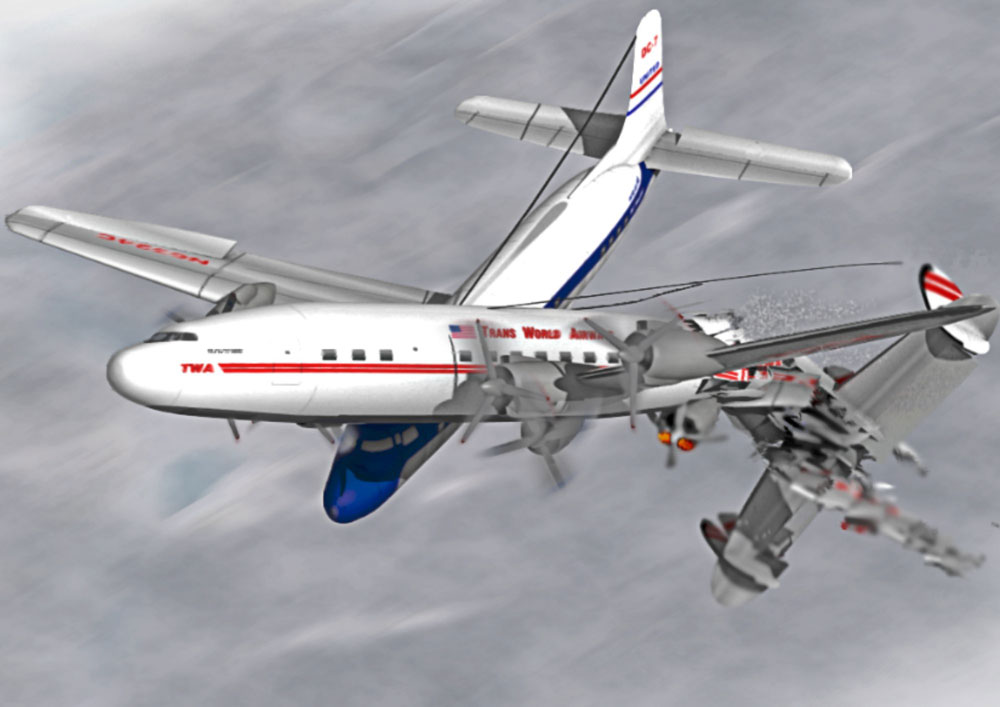
On June 30, 1956, two of America’s most advanced passenger aircraft—the TWA Lockheed Super Constellation and a United Airlines Douglas DC-7—collided at roughly 21,000 feet above the Grand Canyon. Both aircraft were flying in an era when commercial aviation was becoming faster, larger and more crowded, yet the system designed to keep them safely separated had not kept pace. The disaster would expose a dangerous weakness in American aviation—and help transform how the nation’s skies were controlled.
The Two Airliners That Collided Over the Grand Canyon
On the morning of June 30, 1956, two enormous passenger aircraft left Los Angeles only minutes apart. One was a TWA Lockheed Super Constellation, a four-engine airliner celebrated for its range and distinctive triple-tail design. The other was a United Airlines Douglas DC-7, one of the fastest and most advanced piston-engine airliners of its era.
They were headed in different directions. TWA Flight 2 was flying toward Kansas City, while United Flight 718 was bound for Chicago. Yet both aircraft eventually found themselves at roughly 21,000 feet above the Grand Canyon.
Then they collided. How could two giant passenger planes collide in a sky that seemed almost impossibly wide?
The question becomes even more unsettling when you consider what these aircraft represented. These were not small private planes wandering through the sky. They were massive commercial airliners carrying passengers across the country during an era when American aviation was rapidly becoming faster, larger and more sophisticated.
And the Grand Canyon seemed like the last place where two aircraft should have occupied the same piece of sky. There was an enormous expanse of open air around them, yet two advanced airliners ended up converging at the same altitude and nearly the same location.
The tragedy exposed something that had been easy to overlook during aviation’s rapid growth.
The aircraft were becoming remarkably capable, but the system responsible for keeping them separated had not evolved at the same pace. Air traffic was increasing, aircraft were flying faster and pilots were operating across enormous distances, while many aspects of traffic management still depended heavily on communication, procedures and the ability of pilots to see other aircraft.
The problem wasn’t that the sky was too small. It was that the system for keeping airplanes apart was not ready for the age of fast commercial aviation.

The Aircraft Were Engineering Giants of Their Time
The Lockheed Super Constellation
Before the Jet Age transformed commercial aviation, the Lockheed Super Constellation represented the height of piston-engine air travel. Operated by airlines such as TWA, the four-engine aircraft combined long-range capability with a pressurized cabin, allowing passengers to fly at higher altitudes and above much of the weather that had made earlier air travel less comfortable.
Its most recognizable feature was the distinctive triple-tail design, which gave the aircraft an appearance unlike almost anything flying today. But the Super Constellation was more than an unusual-looking airplane. It represented a period when engineers were pushing piston-powered aircraft to their limits, making long-distance commercial flight faster, smoother and more practical.
For passengers in the 1950s, flying aboard one of these aircraft could feel like a glimpse of the future. This wasn’t just an airplane. It was a symbol of what flying looked like before the Jet Age took over.
The Douglas DC-7
The Douglas DC-7 represented another major step forward. Powered by four piston engines, the aircraft was designed for long-range commercial service and became one of the fastest piston-engine airliners of its era.
That speed was part of the attraction. Airlines wanted aircraft that could carry more passengers farther and faster, reducing travel times and making coast-to-coast and international routes increasingly practical.
But there was an irony hidden inside this remarkable progress.
The Super Constellation and DC-7 were becoming faster and more capable at precisely the moment when America’s aviation system was dealing with rapidly increasing air traffic. The aircraft were advancing quickly, while the methods used to keep them separated in the sky were still catching up.
That created a dangerous combination: Better aircraft → Faster aircraft → More traffic → Greater risk
The problem was no longer simply building an airplane capable of crossing the country. It was figuring out how to safely manage hundreds of increasingly fast aircraft sharing the same sky.
Watch the story of the 1956 Grand Canyon air disaster. A routine flight from Los Angeles to Kansas City ended in tragedy—and changed American aviation forever.
They Were Supposed to Stay Apart
Two Flights, Two Destinations
On the morning of June 30, 1956, TWA Flight 2 and United Airlines Flight 718 departed Los Angeles International Airport only minutes apart. TWA Flight 2, operated by a Lockheed Super Constellation, was heading toward Kansas City. United Flight 718, flying a Douglas DC-7, was bound for Chicago.
TWA took off at approximately 9:01 a.m., followed by United about three minutes later. On paper, there was no reason for the two aircraft to end up occupying the same piece of sky. Their planned routes and altitudes were supposed to keep them separated as they continued eastward.
But flight plans are only plans.
Once an aircraft is in the air, its actual position can differ from what was originally expected because of routing decisions, weather, winds and other operational factors. And in 1956, there was no modern nationwide system continuously tracking every commercial aircraft with the precision we take for granted today.
The “See and Be Seen” Problem
The two aircraft were operating under conditions in which pilots carried much of the responsibility for avoiding other traffic. In areas outside controlled airspace, pilots relied heavily on visual observation, radio communication, flight plans and available traffic information.
That system had worked when aircraft were slower and commercial traffic was lighter.
But aviation was changing rapidly.
The Super Constellation and DC-7 could cover enormous distances at speeds that gave pilots much less time to recognize and avoid another aircraft. Even when pilots were actively looking for traffic, spotting another large aircraft against the sky could be extremely difficult until it was already dangerously close.
There was also a fundamental limitation: knowing approximately where another aircraft was supposed to be was not the same as knowing exactly where it was at that moment.
The technology of the aircraft had raced ahead. The system for managing them was struggling to keep up.
What happens when airplanes become faster than the system designed to keep them apart?

The Moment Two Giant Airliners Met in the Sky
Both Aircraft Were at 21,000 Feet
Somewhere above the Grand Canyon, the separation between two enormous passenger aircraft was disappearing.
Both the TWA Super Constellation and United DC-7 were flying at approximately 21,000 feet. Their actual positions had diverged from the routes originally expected, while strong winds and other conditions made it more difficult to predict exactly where each aircraft would be at any given moment.
There was no modern radar-based system continuously displaying their positions to controllers on the ground. The crews therefore did not have a complete picture of the traffic around them. From the ground, the sky seemed almost limitless. From inside two fast-moving aircraft, however, the available margin was shrinking by the second.
There Was Almost No Time to React
The two aircraft were approaching each other at high speed. At that altitude, even a brief delay in recognizing another aircraft could turn a manageable situation into an impossible one.
The pilots eventually saw the other aircraft, but by then there was almost no time or distance available to make a successful evasive maneuver.
The collision was catastrophic. The TWA aircraft suffered the loss of its tail section, while the United DC-7 sustained devastating damage to its wing and other structures. Both aircraft broke apart and crashed into the rugged terrain of the Grand Canyon.
The entire sequence unfolded in seconds.
There was no runway to land on. No shoulder to pull onto. No room for a last-second correction like there might be on a road.
Just two massive aircraft moving toward each other at cruising altitude. At 21,000 feet, there was nowhere to pull over.
The tragedy demonstrated one of aviation’s most unforgiving realities: when aircraft travel at enormous speeds, the difference between safely passing another airplane and colliding with it can be measured in seconds.
The Grand Canyon Made the Disaster Even Harder to Understand
Nobody Saw It Happen
One of the strangest aspects of the 1956 disaster was that almost nobody on the ground witnessed the collision itself. The two aircraft disappeared somewhere above one of the largest and most rugged landscapes in the United States, leaving little immediate indication of what had happened.
When the expected radio communications from the flights failed to arrive, concern quickly turned into a search operation. But finding a missing airliner in the Grand Canyon was nothing like searching over a flat landscape. The canyon stretched for miles, with enormous cliffs, deep ravines and remote terrain that made access extremely difficult.
There was no obvious crash site visible from a highway or airport. Investigators first had to determine where the aircraft had gone down before they could begin understanding what had happened.
Finding the Wreckage Was Its Own Challenge
The terrain made the recovery effort extraordinarily difficult. Wreckage from the two aircraft was scattered across rugged areas of the canyon, some of them accessible only by air or through difficult approaches on the ground.
Among those who helped locate the wreckage were Palen and Henry Hudgin, brothers who operated Grand Canyon Airlines. After observing smoke rising from the canyon, they helped direct attention toward one of the crash sites.
The discovery of the wreckage transformed the situation. What had initially been a terrifying disappearance could now be investigated through physical evidence.
But the Grand Canyon remained a formidable obstacle. Investigators and recovery crews had to work in steep, isolated terrain, dealing with the practical difficulties of reaching the wreckage while attempting to reconstruct a disaster that had occurred in seconds.
The landscape that had made the Grand Canyon one of America’s great natural wonders had also become part of the tragedy. Search → Recovery → Investigation.
Each step was made harder by the same enormous canyon that had witnessed the collision. The Grand Canyon was beautiful from above. Finding what had fallen into it was another story.

The Crash Changed American Aviation Forever
The Sky Could No Longer Be Managed the Old Way
The Grand Canyon collision exposed a problem that went far beyond two aircraft and their crews. American commercial aviation was growing at extraordinary speed. Airliners were becoming larger, faster and capable of carrying more people across longer distances, while the number of aircraft sharing the nation’s airspace was increasing rapidly.
The system designed to manage that traffic had not evolved at the same pace.
The 1956 disaster became a powerful demonstration of the limitations of the existing air traffic control system. Pilots and controllers were working with procedures and technology that could not provide the kind of continuous picture of aircraft positions that modern aviation would eventually take for granted.
The lesson was difficult to ignore: simply building safer and faster aircraft was not enough. The entire system around them had to become safer too.
From Tragedy to a New Era of Air Traffic Control
The crash helped accelerate a broader transformation in American aviation. Greater attention was given to modernizing the nation’s airways and improving the ability to monitor and separate aircraft.
Radar-based surveillance became increasingly important. Air traffic control procedures were strengthened, and the federal government began investing more heavily in the infrastructure needed to manage America’s rapidly expanding skies.
In 1958, the Federal Aviation Agency was established, marking a major step toward a more centralized and modern system of aviation oversight. The agency was later renamed the Federal Aviation Administration, or FAA, which continues to oversee America’s civil aviation system today.
The significance of the Grand Canyon disaster therefore extends far beyond the accident itself. It became part of a turning point in which the United States recognized that aviation safety depended not only on the machines flying through the sky, but also on the invisible system coordinating them.
The aircraft had already entered the future. Now the system controlling them had to catch up. The aircraft were already entering the future. The system controlling them had to catch up.

The Planes Were Advanced. The System Wasn’t
The two aircraft that collided over the Grand Canyon represented the cutting edge of American aviation in the 1950s. The TWA Super Constellation was instantly recognizable with its distinctive triple tail and four engines. The United DC-7 was another powerful, long-range airliner built for an industry that was rapidly transforming the way Americans traveled.
Both aircraft were products of an exciting new era. But their collision revealed a problem that went far beyond the machines themselves. Technology doesn’t advance one piece at a time.
An airplane can become faster, larger and capable of flying farther, but those improvements also create new demands on everything around it. Communication has to become more reliable. Navigation has to become more precise. Air traffic control has to handle more aircraft. Safety procedures have to account for speeds and traffic levels that previous generations never faced.
Otherwise, technological progress can create risks faster than a system can adapt to them.
That is perhaps the most important lesson of the 1956 Grand Canyon collision. The disaster was not simply about two pilots failing to see each other. It exposed the limits of an aviation system that had been designed for an earlier era while the aircraft flying through it were already becoming dramatically more capable.
The solution was not to stop building better airplanes. It was to build a better system around them.
The modern aviation network—with radar, sophisticated navigation, controlled airspace and increasingly precise separation procedures—grew from decades of technological development and hard lessons such as this one.
The 1956 Grand Canyon collision wasn’t simply a story about two airplanes that failed to see each other. It was the moment America realized that the sky itself needed a new system.

The 1956 Grand Canyon collision was more than a tragedy involving two remarkable aircraft. It exposed the limits of an aviation system struggling to keep pace with faster planes, heavier traffic and a rapidly changing industry. The Super Constellation and DC-7 represented the future of air travel, but the disaster showed that advanced machines also required advanced systems around them. In the years that followed, America transformed air traffic control, helping make the skies far safer for the generations of aviation that came next.