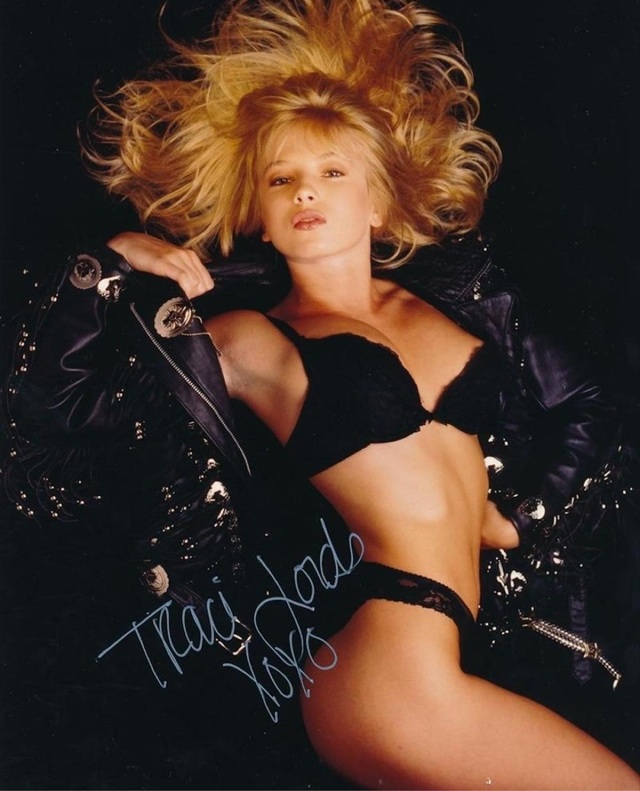
Hollywood has a long memory. For many performers, an early chapter can become a permanent label—repeated in headlines long after they have moved on. Few careers illustrate the struggle to escape that kind of public perception more vividly than Traci Lords’.
By 1990, Lords was attempting to build a completely different future for herself. That opportunity arrived in an unexpected form: John Waters’ Cry-Baby, a wildly stylized musical comedy that transformed 1950s teenage rebellion into colorful satire.
For Lords, playing Wanda Woodward was more than another acting credit. It gave audiences an opportunity to see her in a conventional feature-film performance and demonstrated that she could inhabit a character within an established cinematic world. The role did not erase everything that had come before. But it became an important part of the story she was beginning to write for herself.
A Career at a Crossroads
When Cry-Baby entered production, Traci Lords was already a highly recognizable name, although her earlier public notoriety presented a significant obstacle to establishing herself as a mainstream actress.
The challenge was not simply finding another role. It was convincing audiences and filmmakers that there was more to her than the headlines surrounding her early life and career. That distinction would become crucial.
Instead of attempting to hide from her past, Lords pursued opportunities that allowed her to build a new professional identity. Acting offered a different framework—one in which preparation, character work, timing, and collaboration could become the focus.
Then came John Waters. Waters had built his career around outsiders, unconventional characters, exaggerated worlds, and performers who did not necessarily fit traditional Hollywood expectations. His films frequently transformed misfits into the center of the story.
That sensibility made Cry-Baby an unusually fitting project for Lords. Rather than asking audiences to forget that she had a past, the film allowed them to encounter her in an entirely different context.

Welcome to the World of the Drapes
Cry-Baby takes place in a heightened version of 1950s Baltimore, where teenage culture is divided between the respectable “Squares” and rebellious “Drapes.” At the center is Wade “Cry-Baby” Walker, played by a young Johnny Depp.
The film is deliberately larger than life. Its characters are exaggerated, its humor is irreverent, and its version of teenage rebellion is filtered through John Waters’ distinctive comic sensibility. Traci Lords stepped into this world as Wanda Woodward, one of the most memorable members of the Drapes.
Wanda was confident, rebellious, outspoken, and completely comfortable operating outside the rules imposed by the social world around her. That made the character an ideal vehicle for Lords.
She did not have to play the conventional Hollywood heroine. Instead, she was given a character with attitude, comic timing, loyalty, and a strong sense of individuality. The result was a performance that fit naturally into the film’s eccentric universe.
Wanda Woodward: More Than the Tough-Girl Stereotype
At first glance, Wanda could easily have been reduced to a familiar archetype: the rebellious teenage girl with a sharp tongue and an even sharper attitude. Lords gave the character more personality than that.
Her performance works because Wanda feels like a participant in the world rather than someone simply standing beside it. She reacts quickly, delivers dialogue with confidence, and contributes to the film’s comic rhythm. That timing was especially important.
John Waters’ movies often depend on performers understanding exactly how far to push a joke without destroying the character underneath it. Lords proved capable of playing directly into the heightened style while maintaining Wanda’s personality. There is also a sense of sincerity beneath the exaggeration.
Wanda may be loud and rebellious, but she is not simply a collection of jokes. Her loyalty to the Drapes gives the character an emotional center, while her confidence makes her feel like someone who has already decided exactly where she belongs.
Lords understood that balance. She could deliver the outrageous material required by the film while still making Wanda recognizable as a character rather than merely a caricature.
The Chemistry That Made the Drapes Memorable
One of Cry-Baby‘s greatest strengths is its ensemble. Johnny Depp’s Wade Walker provides the center of the story, but the world surrounding him is filled with colorful personalities. The Drapes function almost like their own miniature society, united by their rejection of the conventional world around them.
Lords’ Wanda became an important part of that dynamic. Her scenes with the other Drapes helped establish the sense that these characters had a life beyond the central romance. They were not simply supporting players waiting for the next plot development.
They were a group. And Wanda felt like one of its natural leaders. That ensemble chemistry is part of what gives Cry-Baby its enduring personality. The film’s appeal comes not only from its central story, but from the exaggerated universe surrounding it.
The Performance That Changed the Conversation
Cry-Baby was not a conventional Hollywood comeback story.
The film itself was too strange, too stylized, and too deliberately subversive for that.
Yet its importance to Lords’ career is difficult to ignore.
It gave her a mainstream feature-film credit and allowed her to be evaluated in a completely different professional context. Audiences could now encounter her as an actress performing a scripted character inside a John Waters production.
That distinction mattered.
A career is often rebuilt one opportunity at a time.
For Lords, Cry-Baby became one of those opportunities.
Rather than being defined exclusively by earlier headlines, she could point toward a body of acting work that was beginning to develop its own identity.
Beyond Wanda: Building a Second Act
The significance of Cry-Baby becomes clearer when viewed as part of the larger trajectory of Lords’ career.
She continued working in film and television, taking on roles that allowed her to explore different genres and gradually establish herself as a performer outside the circumstances of her early notoriety.
Her career would eventually include acting, music, writing, and other creative work.
That evolution is important because reinvention rarely happens through one project alone.
A single performance can open a door.
What happens afterward determines whether that door leads somewhere new.
For Lords, Wanda Woodward became one of the earliest and most recognizable steps in that longer process.
The Lasting Legacy of Wanda Woodward
More than three decades after Cry-Baby, Wanda Woodward remains one of the most recognizable characters in Traci Lords’ filmography.
The character endures partly because she perfectly captures the exaggerated spirit of John Waters’ world: rebellious without being entirely serious, outrageous without losing her humanity, and memorable without needing to dominate every scene.
But Wanda’s importance extends beyond the character herself. The role represents a moment when Lords was able to enter a different professional chapter and demonstrate another side of her abilities.
It did not magically erase her past. Instead, it became part of a much larger process of moving forward.
Final Thoughts: The Power of a Second Act
Traci Lords’ story is ultimately not about pretending the past never happened. It is about what happens when a person refuses to let an earlier chapter become the entire story.
In Cry-Baby, Lords found a role that suited her natural screen presence while placing her inside one of the most distinctive cinematic worlds of the era. As Wanda Woodward, she was funny, confident, rebellious, and unmistakably part of the film’s strange and colorful universe.
The movie did not define her entire career. But it helped demonstrate that there could be a career beyond the headlines.
And that may be the most enduring significance of Cry-Baby. Sometimes reinvention does not begin with erasing the past. It begins with giving the audience something new to remember.
The Multitalented Force: Building a Career Beyond the Screen
The significance of Cry-Baby was not simply that Traci Lords landed another film role. It was that the experience became part of a much larger transformation.
After establishing herself as an actress, Lords continued exploring different forms of creative expression. Her career gradually expanded beyond traditional screen acting, taking her into music, writing, television, and other creative projects.
Music became one of those new directions. Lords explored electronic and rock-influenced sounds, demonstrating that her ambitions were not limited to acting. The transition also reinforced an important theme in her career: the desire to define herself through her own creative choices rather than through the expectations attached to her past.
But perhaps the most significant extension of that process came through writing.
Taking Back the Narrative: The Story Behind the Memoir
With her memoir Underneath It All, Lords took on a role no director or casting executive could control: that of the author of her own story.
A memoir gives its writer something fundamentally different from an interview or acting role. Instead of allowing other people to interpret a life through headlines, performances, or public appearances, the author can establish the context in her own words.
For Lords, that opportunity carried particular significance.
Her life had been discussed publicly for years, often through sensationalized coverage. Writing allowed her to address her experiences from her own perspective and place them within a broader story of hardship, ambition, survival, and professional reinvention.
The book therefore became another chapter in her attempt to define herself on her own terms.
It also demonstrated that reinvention does not necessarily mean becoming someone entirely different.
Sometimes it means finally being able to show the parts of yourself that the public never saw.
A Career Defined by Reinvention
Looking at Lords’ career as a whole reveals a pattern.
Acting provided one avenue of expression. Music opened another. Writing gave her a direct way to communicate her experiences. Television and later creative projects continued to expand the range of identities she could occupy professionally.
None of these pursuits erased the earlier chapters of her life.
Instead, they placed those chapters inside a much larger narrative.
That distinction is important.
Celebrity culture often reduces complicated lives to a single defining image. Lords’ subsequent career demonstrates how difficult—and how meaningful—it can be to build something more complicated than that.
Her professional identity became broader with every new medium she explored.
Why Wanda Woodward Still Matters
It would be easy to look back at Cry-Baby simply as a cult movie from the early 1990s.
But for Traci Lords, Wanda Woodward represents something more personal.
The character gave audiences a chance to encounter her as part of a fictional world rather than through the controversy surrounding her earlier life. Wanda was loud, rebellious, funny, and completely comfortable being different.
That made the role memorable.
More importantly, it gave Lords a piece of screen history that belonged to her as an actress.
Decades later, Cry-Baby remains an important entry in her filmography because it captures a performer at a crucial crossroads.
The woman who entered the film had already lived through intense public scrutiny.
The actress who emerged from it had another professional chapter to build.
Final Thoughts: The Enduring Power of a Second Act
Traci Lords’ legacy cannot be reduced to a single movie or a single character.
Cry-Baby was an important milestone, but its deeper significance lies in what came afterward. Lords continued searching for new ways to work, create, and communicate, gradually constructing a career that extended far beyond the circumstances of her early fame.
Wanda Woodward remains one of the most recognizable characters she played, but the character is only one piece of the larger story.
The more interesting story is the evolution of the woman behind the role.
Her journey illustrates an uncomfortable truth about celebrity: the public may remember the beginning of a story long after the person involved has moved somewhere else.
Reinvention, then, is not about making the past disappear.
It is about adding enough new chapters that the past is no longer the only chapter people can see.
For Traci Lords, Cry-Baby became one of those chapters.
And Wanda Woodward became a lasting reminder that a career can take an unexpected turn—and that sometimes the most important role is the one that opens the door to everything that comes next.