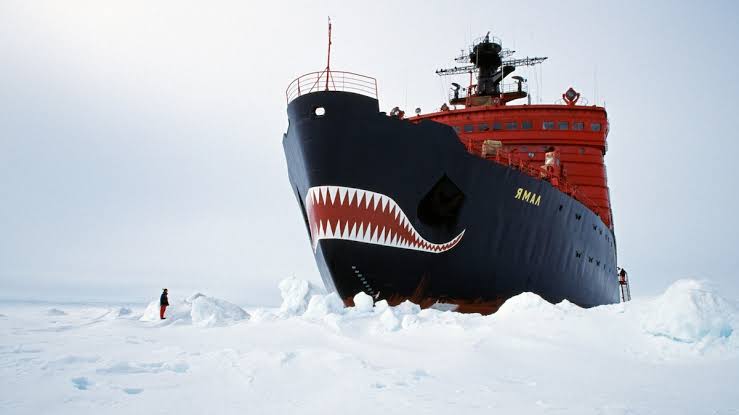
Imagine a ship pushing through the Arctic, surrounded by ice thick enough to stop ordinary vessels in their tracks. Now add two nuclear reactors, three propellers and a reinforced bow designed to climb onto the ice before crushing it under more than 20,000 tons of steel. That is Yamal, one of Russia’s nuclear-powered icebreakers. Built during the final years of the Soviet Union, it was designed for a simple but extraordinary purpose: keep vital Arctic sea routes open when almost nothing else could.
Why Would an Icebreaker Need Nuclear Power?
The Arctic is not a normal shipping environment. During winter, enormous fields of sea ice can block conventional vessels, while the extreme distance from ports makes frequent refueling difficult and expensive. For the Soviet Union, keeping ships moving along the Northern Sea Route was both an economic necessity and a strategic priority, creating a strong incentive to build icebreakers that could operate for long periods without constantly returning to port.
That was where nuclear propulsion offered a remarkable advantage. Instead of carrying huge quantities of conventional fuel, a nuclear-powered icebreaker can generate propulsion energy from a compact reactor system and remain operational for extended periods. Russia’s nuclear icebreaker fleet grew from the first nuclear-powered icebreaker, Lenin, commissioned in 1959, into increasingly powerful ships such as the Arktika class to serve the country’s Arctic routes.
Yamal became part of that next generation. It belongs to the Arktika class, a family of large nuclear icebreakers designed for deep Arctic waters, and it was commissioned in 1992. The ship was conceived as a machine that could do something ordinary cargo ships simply could not: enter heavily frozen waters and keep moving.
In the Arctic, that capability is not a luxury. It is infrastructure.
Experience the raw power of the world’s largest nuclear icebreaker crushing through thick Arctic ice. Featuring breathtaking aerial footage, unbelievable 75,000 horsepower strength, and frozen landscapes, this video takes you on an unforgettable journey to the edge of the earth. Click the link to watch this incredible masterpiece now!
The Ship Designed to Climb Onto Ice
At first glance, Yamal looks like a giant steel ship with an unusually tall superstructure. Its real strength is concentrated much lower, in the hull and bow that have to absorb the forces created when thousands of tons of ship meet solid ice.
The Arktika-class design uses a reinforced double hull, with the outer hull built specifically for contact with ice. Technical documentation describes specially strengthened steel in the areas that encounter the heaviest ice loads, while the double-hull arrangement provides additional protection and structural strength.
Yamal does not simply ram straight into the thickest ice like a battering ram. Its spoon-shaped bow allows the ship to ride up onto the ice, using the vessel’s enormous weight to crush the ice beneath it. That is a fundamentally different approach from trying to smash through a frozen barrier head-on, and it is one reason the ship can continue advancing through ice that would stop ordinary vessels.
The ship also has three propellers and an air-bubbling system designed to reduce friction between the hull and surrounding ice. Air is released beneath the hull, helping loosen and lubricate the contact between steel and ice as the ship advances. It is a deceptively simple addition to a vessel that otherwise looks like a giant piece of brute force.
Yamal’s published technical data puts its length at roughly 148–160 meters depending on the reference standard used, with a beam of about 30 meters and displacement around 23,000 tons. Its designed icebreaking capability is roughly 2.7–2.9 meters of level ice, while open-water speed is around 20 knots.
The numbers matter because they reveal what Yamal really is. It is not simply a ship with a powerful engine. It is a purpose-built machine for fighting an environment.

Two Nuclear Reactors Under the Deck
The most astonishing part of Yamal is hidden from view.
The ship carries two OK-900A pressurized-water reactors. Each reactor has a thermal power of about 171 megawatts, while the nuclear plant provides roughly 63 megawatts of propulsion power through the vessel’s turbo-electric system.
The reactors do not turn the propellers directly. Instead, nuclear heat produces steam, the steam drives generators and turbine equipment, and the resulting electrical power drives the ship’s propulsion motors. That arrangement gives engineers precise control over the enormous thrust required when the ship is working through ice.
This is also why nuclear power makes particular sense for an icebreaker. Yamal does not have to spend its limited fuel capacity worrying about every mile of an Arctic voyage. Its reactor plant provides the sustained energy needed for propulsion and onboard systems during long missions, while the ship can remain away from conventional fuel infrastructure for extended periods.
But calling the ship “nuclear-powered” can make the technology sound more mysterious than it really is. At its core, the principle is still a steam power cycle: the reactors provide the heat, steam drives machinery, and electricity ultimately turns the propellers.
The extraordinary part is where that system is being used. A nuclear power plant has been placed inside a ship built to push through Arctic ice.

Built as the Soviet Union Was Disappearing
Yamal’s story is also tied to one of the most dramatic political transitions of the twentieth century.
Construction began at the Baltic Shipyard in Leningrad in 1986, and the vessel was launched in 1989. By the time it was completed and commissioned on October 28, 1992, the Soviet Union no longer existed; Yamal entered service under the flag of the newly formed Russian Federation.
That timing makes the vessel unusual even before it ever reached the Arctic. It was conceived inside a Soviet industrial system, constructed during its final years and delivered after that system had collapsed. Yet the enormous investment in the ship survived the political upheaval because the practical need for an Arctic icebreaker had not disappeared.
The route Yamal was built to support was the Northern Sea Route, which follows Russia’s Arctic coast between the European and Asian sides of the country. For decades, icebreakers have been essential to keeping portions of this route navigable, particularly during seasons when sea ice becomes a major obstacle.
That gives Yamal a much larger purpose than simply escorting individual ships.
It became part of the infrastructure that allowed Russia to treat the Arctic coastline as a working maritime corridor.
The Shark Mouth Has a Story of Its Own
There is another reason Yamal is instantly recognizable.
Its bow carries a giant painted shark mouth, complete with rows of white teeth. The design makes the enormous red-and-black ship look as though it is literally biting its way through the Arctic.
That image is more than a memorable paint job. Yamal’s shape and equipment are all built around the same fundamental idea: the ship has to enter an environment that resists movement and create a path where there was none.
Standing against a wall of ice, the shark-mouth bow gives the ship almost cartoonish personality. But behind the visual joke is a sophisticated combination of reinforced steel, nuclear propulsion, multiple propellers and ice-management technology. The intimidating appearance simply happens to match what the vessel was built to do.
The contrast is part of the appeal. A vessel powered by one of the most complex technologies ever developed is decorated like a giant predator. And then it goes out and does something surprisingly close to what the paint suggests. It bites into the ice.
What Yamal Can Actually Do
A ship designed for the Arctic has to do more than break ice once. It must maintain a navigable channel, escort other vessels and continue operating when conditions become increasingly difficult.
Yamal’s design gives it the ability to operate through substantial level ice, with the IAEA documenting an icebreaking capacity of approximately 2.7–2.9 meters for the vessel. Its three-shaft propulsion system provides the thrust needed to maneuver and maintain progress through heavy ice conditions.
The ship was also designed for long endurance. Published technical data gives an operational endurance of roughly 7.5 months, illustrating the advantage of having a nuclear power plant in a region where conventional refueling points are sparse.
That endurance does not mean Yamal can simply ignore the Arctic. Ice conditions remain unpredictable, and safe navigation still depends on weather information, ice reconnaissance, communications, trained crews and careful route planning. Nuclear power provides the energy; it does not eliminate the environment’s dangers.
This distinction is important. Yamal is not a machine that defeats the Arctic. It is a machine designed to negotiate with it.

Why Yamal Still Matters
More than three decades after entering service, Yamal remains part of Russia’s nuclear icebreaker fleet. The ship’s reactor life has been extended through a major service-life program, and Rosatomflot announced in 2020 that the reactor installation’s authorized resource had been extended to 200,000 operating hours. The World Nuclear Association reports that the extended service program allowed Yamal to continue operating into the late 2020s.
Meanwhile, Russia has continued developing newer generations of nuclear icebreakers. The newer LK-60Ya vessels are larger and more powerful, reflecting the continuing importance Moscow places on maintaining reliable Arctic shipping infrastructure.
That progression says something important about Yamal. It was not a technological dead end. It was part of a continuing experiment in how far nuclear propulsion and heavy icebreaking could be pushed.
The ship’s basic concept has proved durable enough that later designs have continued building upon the same fundamental idea: enormous power, reinforced hulls and the ability to remain in remote polar waters for long periods.
The Machine Behind the Myth
From a distance, Yamal can look almost absurd. It is bright red against a landscape of white ice, with a shark’s mouth painted across its bow. But behind that dramatic appearance is a carefully engineered vessel created for one of the least forgiving environments on Earth.
Its two nuclear reactors supply the energy. Its reinforced hull absorbs the punishment. Its spoon-shaped bow climbs onto the ice, its weight crushes it, and its propellers keep pushing the ship forward. The air-bubbling system helps reduce friction, while a long-endurance nuclear plant allows the vessel to spend months operating far from conventional fuel infrastructure.
The remarkable part is not simply that a nuclear reactor can power a ship.
It is that engineers took that technology and built a vessel around a very specific problem: a frozen sea that refuses to let ships pass.
That is why Yamal remains such a striking example of industrial engineering. It represents an era when governments were willing to build enormous machines for environments most people could barely imagine entering, and it shows how a technology developed decades ago can remain useful when the problem itself has not gone away.
The Arctic is still frozen. Yamal was built to keep moving through it.
Yamal is far more than a giant ship with a striking shark-mouth bow. Its nuclear reactors, reinforced hull and specialized icebreaking systems were designed around one relentless challenge: moving through Arctic waters where ordinary vessels can be stopped by ice. Built during the collapse of the Soviet Union, it went on to become part of Russia’s long-running effort to keep the Northern Sea Route open. More than three decades later, Yamal remains a remarkable example of how engineering can turn an almost impossible environment into a navigable one.
P.S. This story draws on SailorSpeaks’ overview of the Yamal nuclear icebreaker, with technical and historical details cross-checked against documentation from the International Atomic Energy Agency, Rosatomflot and the World Nuclear Association. Source: https://sailorspeaks.com/2024/12/06/yamal-icebreaker-the-marvel-in-arctic-waters/