Some American bridges are much older than the country itself. Built when horses and wagons dominated the roads, these structures helped connect early communities and support trade long before modern highways existed. Others came later, when steel, suspension cables and new engineering techniques transformed what a bridge could accomplish. From the 1697 Frankford Avenue Bridge to the massive George Washington Bridge, these eight structures reveal how American bridge building evolved from simple stone arches into some of the world’s most ambitious infrastructure.
Frankford Avenue Bridge Was Built in 1697
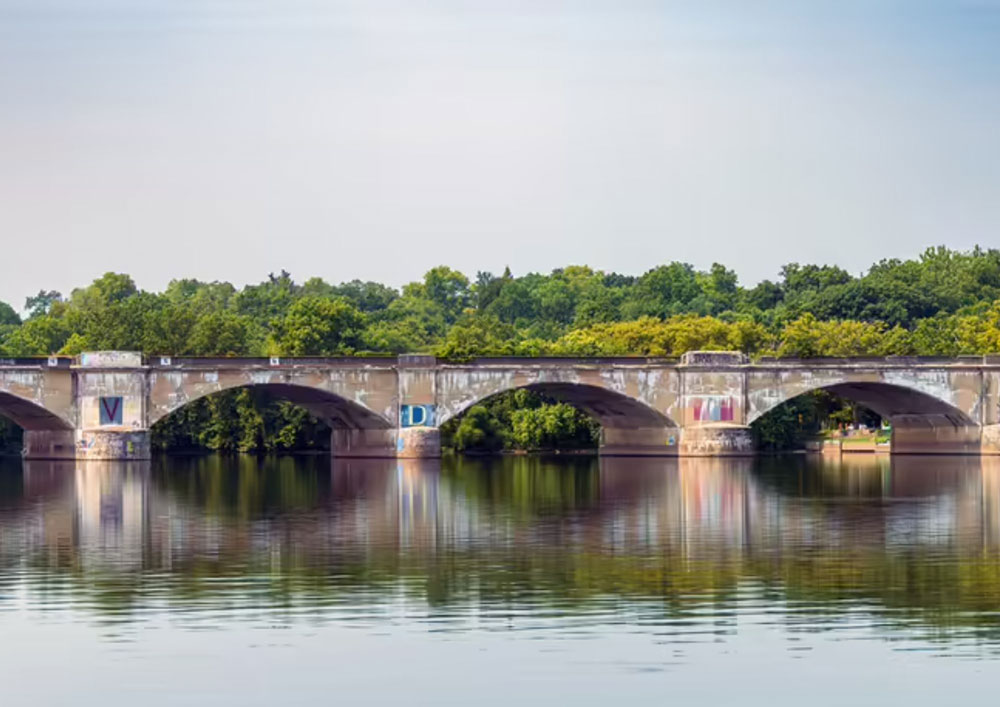
The Frankford Avenue Bridge in Philadelphia, Pennsylvania, dates to 1697, making it one of the most remarkable surviving pieces of America’s colonial infrastructure. The American Society of Civil Engineers describes it as the first known stone arch bridge built in the United States and probably the oldest bridge in the country. It crosses Pennypack Creek along what became an important route between Philadelphia and New York.
When the bridge was constructed, the United States did not exist. Philadelphia was part of a British colony, and transportation depended heavily on horses, wagons and stagecoaches. The original three-span bridge was only about 18 feet wide, leaving just enough room for two teams of horses to pass.
Its location made it more important than its modest size might suggest. The King’s Road, one of the early highways connecting Philadelphia with New York, crossed the bridge. Stagecoach service between Philadelphia and New York began using the route in 1756, and an express rider reportedly crossed the bridge in April 1775 while carrying news of the Battle of Lexington.
The bridge also adapted to changing transportation. It was widened in 1893 to accommodate trolley traffic and widened again in 1950 for automobiles. Despite those modifications and centuries of repairs, the stone structure remains in service today. It is one of the clearest examples of a colonial bridge that successfully adapted to the modern world.

Take a closer look at some of America’s most remarkable historic bridges and discover how these incredible structures have survived centuries of change. Watch the video to see the engineering, history and stories behind these iconic bridges.
Old Stone Arch Bridge Dates Back to the Colonial Era
The Old Stone Arch Bridge in Bound Brook, New Jersey, is another remarkable survivor from America’s colonial period. Its construction was authorized in 1730, although historical records do not establish the precise date construction began or whether an earlier structure stood at the same location. The National Park Service notes that some historians have suggested 1731 as the construction date.
The bridge carried the Raritan Road over Bound Brook, making it part of an important colonial transportation route. Stone bridges were expensive and time-consuming to construct during this period, so permanent masonry crossings were relatively uncommon.
The bridge also witnessed the American Revolution. On April 13, 1777, the area around the bridge became part of the Battle of Bound Brook, when Hessian troops were exposed to fire from American forces. The bridge therefore represents more than an early engineering project—it was also part of the landscape during one of the defining conflicts in American history.
Over time, the road moved elsewhere and the streambed beneath the bridge was eventually filled. The historic structure was buried rather than demolished, leaving the old stone bridge hidden beneath the modern landscape. Efforts have been made to preserve and expose it so that visitors can once again see the structure.

Sewall’s Bridge Introduced a New Way to Build Highway Bridges
Sewall’s Bridge in York, Maine, represents a very different approach to bridge construction. Completed in 1761, it crossed the York River and was designed and built by Major Samuel Sewall Jr.
The bridge was significant because it was the first pile structure for general highway traffic built according to an engineering plan based on a site survey. It is also the earliest pile-trestle bridge for which an authentic construction record survives and the oldest for which builder’s drawings are known to exist.
Its construction was a considerable engineering undertaking. The original bridge was about 270 feet long and supported by 13 braced bents, each consisting of four piles. The piles were driven through the soft river bottom until they reached stable ground. The bridge also included a drawspan, allowing vessels to pass along the York River.
The original structure remained in continuous use for 173 years. In 1934, it was replaced by a stronger wooden pile bridge that retained much of the original design. So while the 1761 structure itself no longer carries traffic, its engineering legacy survives in the replacement bridge.
Sewall’s Bridge is a reminder that early American bridge building was not limited to stone arches. Engineers were already developing sophisticated timber structures capable of carrying highway traffic across difficult waterways.

Choate Bridge Has Carried Traffic Since 1764
The Choate Bridge in Ipswich, Massachusetts, was completed in 1764 and is one of the most important surviving examples of early American masonry bridge construction. The American Society of Civil Engineers identifies it as the oldest documented two-span masonry arch bridge in the United States.
The bridge crosses the Ipswich River and was constructed to replace earlier timber bridges at the same location. By the 1760s, traffic along the road had increased enough that the town decided a more durable masonry structure was needed. Colonel John Choate supervised the construction, and the bridge was eventually named after him.
The original bridge measured about 80 feet 6 inches long and 20 feet 6 inches wide. Its two elliptical stone arches each span about 30 feet. The structure was built using granite blocks, demonstrating the skill of colonial-era masons who had to construct durable arches without modern machinery or materials.
The bridge was widened in 1838 to accommodate increasing traffic. Interestingly, the modification created a visible comparison between 18th-century and 19th-century construction techniques, including differences in the size and preparation of the stone blocks.
Despite periodic repairs, the Choate Bridge remains remarkably close to its historic form. It was listed on the National Register of Historic Places in 1972 and continues to represent an important chapter in the development of American roads and bridges.

Skippack Bridge Has Served Drivers Since 1792
The Skippack Bridge in Pennsylvania represents the next stage in the development of American transportation infrastructure. Built in 1792, the stone bridge crosses Skippack Creek on Germantown Pike in Lower Providence Township.
By the time it was constructed, the United States had already won its independence, but the young nation was still developing the roads and connections needed to support commerce and settlement.
The bridge consists of eight stone arches and is about 33 feet wide. A datestone on the structure records its 1792 construction and names Matthew Potts, John Mann and Conrad Boyer. The bridge was repaired in 1874, with another datestone recording the names of commissioners involved in that work.
One of the most interesting aspects of the project is that some of the money used to fund the bridge came from a lottery held in 1762. That reflects the difficulties early American communities faced when trying to finance major infrastructure projects. Roads and bridges were essential for transportation, but governments did not yet have the enormous infrastructure budgets that exist today.
The Skippack Bridge has continued to carry traffic since its completion, making it another example of a historic bridge that remained useful long after the world for which it was originally designed had disappeared.

Union Bridge Pushed Wooden Bridge Engineering Further
The Union Bridge in Waterford, New York, represented a major leap in American bridge engineering when it opened in 1804. Designed by Theodore Burr, it crossed the Hudson River between Waterford and Lansingburgh and was the first bridge to span the lower Hudson River north of New York Harbor.
The bridge was about 726 feet long and used an innovative combination of arches and trusses. Burr’s design combined the stiffness of a truss with the strength of an arch, creating a structure capable of spanning an enormous distance for its time. Burr later patented variations of this system.
The bridge was completed in only about seven months and opened to traffic in December 1804. It represented a major achievement for American engineers because large wooden bridges were still relatively new.
Unfortunately, the original Union Bridge did not survive permanently. After 105 years of service, it was destroyed by fire in 1909. The existing steel bridge was subsequently built on the same piers, allowing the crossing to continue serving the region.
The story of Union Bridge therefore illustrates both the possibilities and limitations of early American engineering. Its innovative design demonstrated how far bridge builders had progressed, but the vulnerability of large wooden structures eventually became impossible to ignore.

Brooklyn Bridge Changed What a Bridge Could Be
By the time the Brooklyn Bridge opened in 1883, American bridge engineering had entered an entirely different era.
Construction began in 1869, and the bridge was designed by John A. Roebling and completed under the direction of his son, Washington Roebling. It connected Manhattan and Brooklyn across the East River at a time when both communities were experiencing enormous population and economic growth.
The scale was extraordinary. The main span measured 1,595.5 feet, and when the bridge opened on May 24, 1883, it was the longest suspension bridge in the world.
The bridge also represented a major advancement in the use of steel wire and suspension technology. Its massive stone towers supported cables that carried the roadway high above the East River, allowing ships to pass underneath while providing a direct connection between Manhattan and Brooklyn.
The construction itself came at a considerable human cost. Historical records estimate that approximately 27 people died during the 13-year construction project.
Yet the completed bridge quickly became much more than an engineering project. It transformed transportation between Manhattan and Brooklyn and became one of New York City’s defining landmarks.
More than 140 years after its opening, the Brooklyn Bridge continues to carry vehicles, pedestrians and cyclists. The New York City Department of Transportation reports that more than 100,000 vehicles cross it on an average day.
The contrast with the bridges built a century earlier could hardly be greater. Early American engineers were building small stone and timber crossings for horses and wagons. The Brooklyn Bridge demonstrated that bridges could instead become enormous urban structures capable of reshaping entire cities.

George Washington Bridge Took Suspension Engineering to Another Level
The George Washington Bridge, which opened in 1931, represents another major leap forward. Spanning the Hudson River between upper Manhattan and Fort Lee, New Jersey, it was designed during an era when automobiles were rapidly transforming American cities.
Chief engineer Othmar Ammann developed a suspension bridge with a main span of 3,500 feet—almost twice the span of its largest predecessor at the time. The bridge’s steel towers rise roughly 600 feet above the river, while its four main cables contain thousands of individual wires.
The bridge was also designed with the future in mind. Its original upper deck could eventually be expanded, and the structure was engineered to accommodate a second lower deck. That lower level opened in 1962, transforming the bridge into a two-level transportation route.
The George Washington Bridge opened to traffic on October 25, 1931, ahead of schedule. The Port Authority’s contemporary report recorded that the bridge’s dedication took place the previous day and that vehicular traffic began at 5 a.m. on opening day.
The scale of the structure was extraordinary compared with the colonial bridges at the beginning of this list. A bridge that once needed only enough width for a pair of horse teams had evolved into a massive interstate crossing designed for modern vehicles and regional commerce.
Today, the George Washington Bridge remains one of the most important connections between New York and New Jersey. It is a powerful example of how American bridge engineering evolved from small local crossings into infrastructure capable of supporting an entire metropolitan economy.

These eight bridges show how dramatically American bridge engineering changed over more than two centuries. The earliest structures relied on stone arches and timber piles to carry horses and wagons, while later landmarks such as the Brooklyn Bridge and George Washington Bridge introduced enormous spans, steel cables and new engineering techniques. Some original structures remain in service, while others were replaced but preserved their engineering legacy. Together, they form a remarkable timeline of American infrastructure, showing how bridges evolved alongside the country itself—from colonial roads to the modern transportation networks that connect its largest cities.