The Apollo 11 astronauts made history when they became the first humans to walk on the Moon, but their journey was far more dangerous and unpredictable than the famous moonwalk suggests. From a landing that nearly went wrong to the strange smell of lunar dust and the unexpected quarantine that followed their return, the mission was filled with moments that remain largely unknown to the public. Behind those historic images was a risky journey that pushed technology, human endurance and space exploration further than ever before.
The Moon Had a Smell—and Astronauts Actually Noticed It
One of the strangest discoveries of Apollo 11 happened after Armstrong and Buzz Aldrin returned to the lunar module following their time outside. Moon dust had clung stubbornly to their spacesuits, and some of it entered the cabin when the astronauts returned and repressurized the spacecraft.
The astronauts noticed that the lunar dust seemed to have a distinct odor. They described it as resembling the smell of wet fireplace ashes or the air after fireworks. Scientists on Earth, however, never got the opportunity to investigate exactly what produced that smell. The lunar samples were transported in sealed containers, and by the time scientists opened them on Earth, the characteristic odor was gone.
The discovery was unexpected because scientists had spent years preparing for the physical challenges of landing on the Moon, but something as ordinary as the smell of the dust had remained impossible to predict.
The Moon had no familiar atmosphere, no forests, no oceans and no ordinary weather. Yet when astronauts finally brought pieces of its surface into their spacecraft, the material produced an unmistakable smell.
It was one of the many small discoveries that reminded the Apollo 11 crew that they were experiencing an environment humans had never encountered before.

Apollo 11 Was Also About Beating the Soviet Union
The Moon landing is often remembered primarily as a triumph of science and exploration, but the mission was also deeply connected to the Cold War.
President John F. Kennedy publicly challenged the United States to land a human on the Moon and return him safely to Earth before the end of the 1960s. But private recordings later revealed that Kennedy was also intensely concerned about America’s competition with the Soviet Union. The Soviets had already achieved several major milestones, including sending Yuri Gagarin into space in 1961.
Kennedy wanted the United States to achieve something spectacular enough to demonstrate technological superiority.
A crewed lunar landing offered exactly that opportunity.
The Soviet Union was pursuing its own lunar ambitions as well. According to HISTORY, Soviet efforts to reach the Moon with humans were kept secret after the United States succeeded first. The competition therefore extended far beyond scientific curiosity. Apollo 11 became one of the most visible victories of the broader space race.
The political pressure was enormous. Billions of dollars and years of work had been invested in the program, and failure would have been witnessed by the world.
That made the success of Apollo 11 about more than simply reaching another celestial body. It demonstrated what the United States believed it could accomplish at a moment when technological achievement had become closely tied to national power.
Want to see what really happened during humanity’s first journey to the Moon? Watch the video for a closer look at Apollo 11, the risks the astronauts faced and the extraordinary moments behind one of history’s greatest achievements.
Astronauts Trained in Some Very Strange Ways
Sending people to the Moon required NASA to prepare astronauts for experiences that had never been encountered before.
Armstrong and Aldrin practiced collecting lunar samples on artificial landscapes designed to resemble the Moon. Armstrong also trained with the Lunar Landing Training Vehicle, which allowed him to practice the difficult task of controlling a lunar lander.
Walking on the Moon required another unusual form of preparation.
The Moon has only about one-sixth of Earth’s gravity, meaning ordinary walking would not feel ordinary at all. To simulate the lower-gravity environment, astronauts were suspended sideways with straps and practiced walking along a tilted wall. NASA and the U.S. Geological Survey also created artificial craters at Cinder Lake, Arizona, to reproduce parts of the lunar terrain.
These exercises may look strange from a modern perspective, but they demonstrate how little room NASA had for improvisation.
There was no previous crew that could explain exactly how difficult it would be to move across the lunar surface. No astronaut had ever collected rocks there. No one had ever piloted a spacecraft toward a landing site on another world.
Every movement had to be practiced on Earth before the astronauts attempted it in space.

The Landing Was More Dangerous Than the Famous Footstep
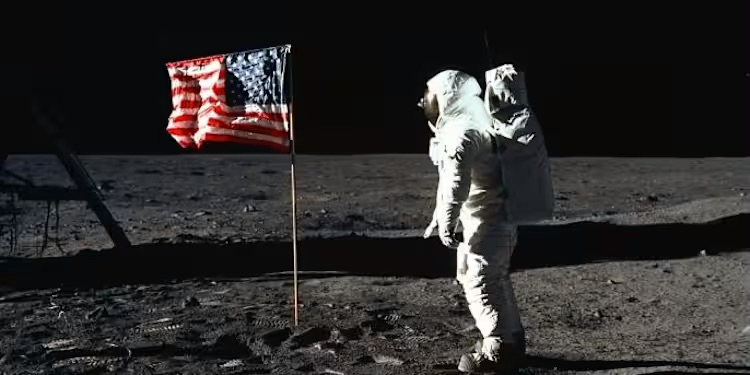
The moment Armstrong stepped onto the Moon became one of the most recognizable images in history, but reaching the surface safely was arguably one of the most dangerous parts of the mission.
On July 20, 1969, Armstrong and Aldrin entered the lunar module Eagle while Michael Collins remained in the command module Columbia, orbiting above them. Eagle began its descent toward the lunar surface and ultimately landed in the Sea of Tranquility.
The descent did not go perfectly according to plan.
The computer-guided landing was taking Eagle toward an area containing obstacles, so Armstrong took manual control and guided the spacecraft toward a safer location. The astronauts successfully touched down, and Armstrong transmitted the famous message confirming that the Eagle had landed.
Only afterward could the world fully appreciate how much had been riding on those final moments.
The Apollo spacecraft had traveled roughly 240,000 miles to reach the Moon. Armstrong and Aldrin then had to descend from lunar orbit, find a safe landing site and bring the spacecraft down without damaging the lander.
The famous first step came only after all of that had gone right.

Buzz Aldrin Took Communion on the Moon
While millions of people on Earth waited to watch Armstrong and Aldrin step onto the lunar surface, Aldrin spent some of the time before the moonwalk doing something few people would have expected.
He took Christian communion.
After Eagle landed, the astronauts had to wait before leaving the lunar module. During that pause, Aldrin privately took communion, making it the first Christian sacrament performed on the Moon.
The moment was deeply personal rather than part of the public spectacle surrounding the mission. While the world was focused on the technological achievement unfolding hundreds of thousands of miles away, Aldrin took a brief moment for his faith.
It was a remarkably human detail within an otherwise highly technical mission.
Apollo 11 involved computers, rockets, navigation systems, engineering calculations and communications networks, but the people inside the spacecraft still brought their individual beliefs and emotions with them.
The Moon landing was therefore not just a demonstration of technology. It was also a deeply personal experience for the three astronauts who made the journey.

NASA Worried the Astronauts Might Bring Something Back
Reaching the Moon was one challenge. Returning safely to Earth was another.
NASA had no way of knowing whether the lunar environment contained microorganisms or other biological hazards that could potentially harm humans on Earth. Since nobody had ever visited the Moon before, scientists could not completely rule out the possibility of an unknown biological threat.
As a result, Armstrong, Aldrin and Collins were placed under quarantine after returning to Earth.
Their spacecraft splashed down in the Pacific Ocean on July 24, 1969. Instead of immediately going home or meeting crowds of admirers, the astronauts were transferred to a mobile quarantine facility and eventually taken to the Lunar Receiving Laboratory at Johnson Space Center. They remained under quarantine until August 10.
Today, the idea of astronauts returning from the Moon with dangerous “space germs” may sound almost like science fiction.
But in 1969, nobody could be certain.
The Apollo 11 astronauts had entered an environment that had never been visited by humans. NASA therefore had to prepare for possibilities that had never been tested before.
The world’s first Moon explorers consequently became temporary prisoners of their own planet after returning home.

Apollo 11 is often remembered through one iconic image: Neil Armstrong taking his first step onto the Moon. But the story behind that moment was far more complicated. Astronauts trained in unusual ways, lunar dust produced a strange smell, Buzz Aldrin took communion before stepping outside, and NASA quarantined the crew after their return. The mission was also driven by an intense Cold War competition with the Soviet Union. These details reveal that Apollo 11 was not simply a historic moonwalk—it was a risky experiment that pushed human knowledge into territory nobody had explored before.