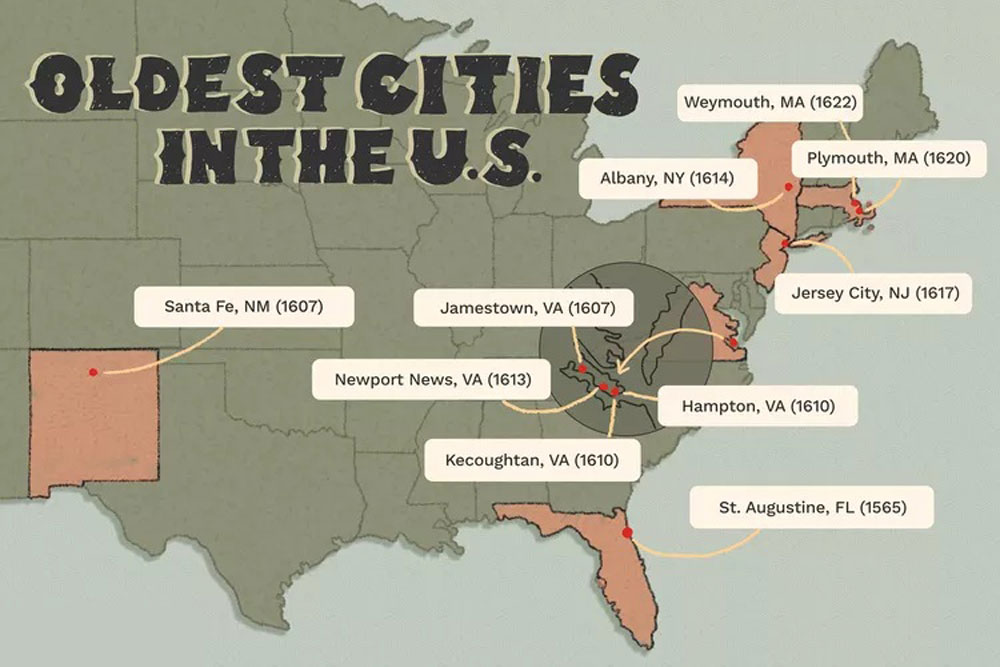
The United States may have been founded in 1776, but some of the cities within its borders are more than two centuries older than the nation itself. From Spanish Florida and English Virginia to Dutch settlements along the Hudson River, these communities were established during the earliest years of European colonization in North America. Their histories also began on lands already inhabited by Indigenous peoples for centuries, making the story of America’s oldest cities much older and more complicated than their founding dates suggest.
St. Augustine Was Founded More Than 200 Years Before the United States
If you’re looking for the oldest city on this list, the story begins in Florida.
St. Augustine was founded on September 8, 1565, by Spanish explorer Pedro Menéndez de Avilés. That puts its founding more than two centuries before the United States declared independence.
The city quickly became an important center of Spanish Florida. For more than 200 years, St. Augustine served as the capital of the Spanish territory.
But its history was far from stable.
Between 1763 and 1783, control of the region passed to Britain, and St. Augustine became the capital of British East Florida. Spanish control returned in 1783, and the city remained under Spanish rule until the territory was ceded to the United States in 1822.
St. Augustine continued as Florida’s territorial capital until 1824, when the capital was moved to Tallahassee.
The city later entered another important chapter in the 1880s, when developer Henry Flagler began purchasing local railroad lines and building hotels. His investment helped establish the tourism industry that would eventually become one of Florida’s defining economic forces.
Today, St. Augustine is known for its historic architecture and colonial character, but its significance goes far beyond being a picturesque tourist destination.
It is a reminder that the history of the United States began long before the country itself existed.

Jamestown Became the First Permanent English Colony
Founded on April 26, 1607, Jamestown, Virginia, became the site of the first permanent English colony in North America according to ThoughtCo’s list. The settlement was initially called James Fort, after King James I of England.
The early years were extremely difficult.
The settlement struggled to survive, and Jamestown was briefly abandoned in 1610. Yet it eventually developed into a small town and became the colonial capital of Virginia when the colony became a royal colony in 1624.
Jamestown remained the capital until 1698.
By the end of the Civil War in 1865, much of the original settlement had fallen into ruin. Preservation efforts began around the beginning of the 20th century, and the site was eventually designated a national park in 1936.
Four hundred years after its founding, Jamestown was once again in the international spotlight.
In 2007, Queen Elizabeth II attended celebrations marking the 400th anniversary of the settlement.
Jamestown’s importance is therefore not simply its age. It represents one of the earliest foundations of permanent English colonial rule in what would eventually become the United States.

Want to see how scientists have unraveled the mystery of the eels’ incredible Atlantic migration? Watch the video to explore their journey toward the Sargasso Sea and the unanswered questions surrounding where and how they reproduce.
Santa Fe Was Already Home to Indigenous Communities
Santa Fe, New Mexico, was founded by Spanish colonists in 1607, making it one of the oldest cities on the list.
But its history cannot be understood simply by looking at the Spanish arrival.
Indigenous peoples had occupied the area long before European colonists arrived. ThoughtCo notes that a Pueblo village located in what is now downtown Santa Fe was established around 900 A.D.
That makes the history of Santa Fe far older than its European founding date.
The relationship between Spanish colonists and Indigenous communities was also far from peaceful. In 1680, Indigenous groups successfully expelled the Spanish from the region. Spanish control was eventually restored in 1692.
Santa Fe remained under Spanish control until Mexico declared independence in 1810.
Later, the city became associated with the Republic of Texas after Texas separated from Mexico in 1836. Santa Fe and the surrounding territory eventually became part of the United States in 1848 following the Mexican-American War.
Today, Santa Fe is the oldest state capital in the United States and remains famous for its Spanish Territorial architectural style.
Its history shows why the phrase “oldest city” needs some qualification. A European settlement date does not mean the land itself was previously uninhabited.

Hampton Began as a Strategic Military Outpost
Hampton, Virginia, traces its beginnings to Point Comfort, an English outpost established around 1610 by people associated with the founding of Jamestown.
Its location made it valuable from the beginning.
Point Comfort stood near the mouth of the James River and the entrance to Chesapeake Bay. That gave the settlement strategic importance, particularly for controlling access to the region.
After American independence, Hampton became an important military location.
Its most remarkable military chapter came during the Civil War.
Although Virginia became the capital of the Confederacy, Fort Monroe in Hampton remained under Union control throughout the conflict.
That made Hampton an important Union stronghold inside Confederate Virginia.
Its military importance has continued into the modern era. Today, the city is home to Joint Base Langley–Eustis and is located across the river from Norfolk Naval Station.
What began as a small English outpost eventually became part of a major American military landscape.

Kecoughtan Has a Much Darker Colonial History
The story of Kecoughtan, Virginia, is one of the most difficult entries on the list.
When Jamestown’s founders arrived in the region in 1607, they encountered members of the Kikotan people at Kecoughtan. Initial relations were largely peaceful. But that relationship deteriorated rapidly.
By 1610, Indigenous communities had been driven from the town and killed by colonists.
The settlement was eventually incorporated into the larger town of Hampton in 1690. Today, Kecoughtan remains part of the Hampton municipality.
Its inclusion in a list of America’s oldest cities illustrates an important reality about early colonial history.
The establishment of European settlements did not happen in an empty landscape.
European colonists encountered established Indigenous societies with their own communities, territories and political relationships. In some places, those relationships eventually became violent and resulted in displacement and death.
That history is an essential part of understanding America’s earliest settlements.

Newport News Eventually Became an Industrial Powerhouse
Newport News, Virginia, traces its origins to an English settlement dating to 1613.
For much of its early history, however, there was little indication that it would eventually become one of Virginia’s major industrial centers.
The transformation came much later.
In the 1880s, new railroad lines began bringing coal from Appalachia to the area. At the same time, the shipbuilding industry was developing, creating the foundation for Newport News’s future as an industrial center.
The connection between coal, railroads and shipbuilding proved enormously important.
Newport News Shipbuilding eventually became one of Virginia’s largest industrial employers.
Its facilities have produced some of the most sophisticated vessels in the American military, including aircraft carriers and submarines.
The city’s story therefore stretches from a small English settlement to a major center of American industrial and military production.
Few things illustrate the transformation of the United States over several centuries better than that change.

Albany Was Founded by Dutch Traders
Albany, New York, has a different colonial origin. The area was first settled in 1614, when Dutch traders established Fort Nassau along the Hudson River. This is an important reminder that the early history of what became the United States was not exclusively English. Dutch traders established settlements throughout the region that became known as New Netherland.
English forces eventually took control of the area in 1664. The settlement was renamed Albany in honor of the Duke of Albany.
Albany eventually became the capital of New York State in 1797. For much of the following centuries, it remained an important economic and industrial center for the surrounding region.
Its political importance also shaped its architecture. Empire State Plaza, where many state government offices are located, is today considered a notable example of Brutalist and International Style architecture.
Albany therefore represents several different chapters of American history at once: Indigenous history, Dutch colonization, English expansion and the development of the American state system.

Jersey City Has Roots in Dutch New Netherland
Modern Jersey City may be dominated by skyscrapers and its proximity to New York City, but its history reaches back to the early 17th century.
Dutch traders established a settlement in the area around 1617, although some historians trace the city’s origins to a Dutch land grant from 1630.
Long before the Dutch arrived, however, the area was inhabited by the Lenape people.
The settlement’s population was already well established by the time of the American Revolution, but Jersey City did not become formally incorporated until 1820, when it was established as the City of Jersey. It was reincorporated as Jersey City in 1838.
That difference between a settlement’s origins and its formal incorporation is important.
A place can have centuries of continuous human history without being officially designated a “city” in the modern legal sense.
Today, Jersey City is one of the most populous cities in New Jersey, second only to Newark as of 2024.
Its modern skyline makes it easy to forget just how deep its roots extend.

Plymouth Became a Symbol of Early Colonial America
Few early American settlements are as famous as Plymouth, Massachusetts.
The Pilgrims arrived there on December 21, 1620, after crossing the Atlantic aboard the Mayflower. Plymouth became the capital of Plymouth Colony and is closely associated with the Thanksgiving story familiar to generations of Americans.
But, once again, the European arrival was not the beginning of the region’s history.
Indigenous peoples had occupied the area for centuries before the Pilgrims arrived.
The survival of the new settlement was also closely connected to Indigenous assistance. According to ThoughtCo, Squanto and other members of the Wampanoag community helped the Pilgrims during the difficult winter of 1620–1621.
Plymouth Colony continued to exist until 1691, when it merged with Massachusetts Bay Colony.
The settlement subsequently became one of the most powerful symbols of early American colonial history.
Yet its real history is more complicated than the familiar Thanksgiving story.
It is a story involving migration, survival, Indigenous communities, cultural encounters and eventually colonial expansion.

Weymouth Was an Early Settlement That Struggled to Survive
The final entry is Weymouth, Massachusetts, founded in 1622.
Today, Weymouth is part of the Boston metropolitan area, but its origins were much more modest.
When it was established, Weymouth was only the second permanent European settlement in Massachusetts, according to ThoughtCo. The settlement was backed by people associated with Plymouth Colony.
The problem was that the settlers were not adequately equipped to support themselves.
Maintaining one colony was already difficult. Creating another permanent outpost required resources, supplies and people that were not readily available.
Weymouth eventually became part of the Massachusetts Bay Colony.
Its history demonstrates that not every early settlement became a major independent city.
Some survived by being absorbed into larger political and economic systems.
Today, it may be part of the Boston metropolitan area, but its roots reach back to the earliest decades of European settlement in New England.

These Cities Reveal a Much Older American History
Looking at these ten cities together reveals something important about the history of the United States.
Their founding dates stretch from 1565 to 1622—more than 150 years before the Declaration of Independence.
They also span eight states, from Florida and New Mexico to New York and Massachusetts.
But perhaps the most important detail is that these cities did not emerge from empty land.
The earliest European settlements were established in places where Indigenous peoples had already lived for generations or centuries.
Santa Fe provides one of the clearest examples, with evidence of a Pueblo community in the area dating to around 900 A.D. Plymouth and Jersey City likewise had established Indigenous populations before European colonization.
The cities also reveal how many different European powers shaped early North America.
St. Augustine came from Spanish colonization.
Jamestown, Hampton, Kecoughtan, Newport News, Plymouth and Weymouth were associated with English settlement.
Albany and Jersey City have important Dutch origins.
Over time, control of these places changed repeatedly.
Spanish territories became American territories.
Dutch settlements were taken by the English.
British colonies became part of an independent United States.
And small colonial settlements eventually developed into modern cities with completely different economies and identities.
That is what makes these places so fascinating.
They are not simply old buildings or preserved colonial districts.
They are living cities whose histories stretch across several different versions of North America.
America may have declared independence in 1776, but some of its oldest cities had already been making history for more than a century. From St. Augustine and Jamestown to Santa Fe and Plymouth, these communities survived changing empires, wars and the birth of a new nation. Their stories also remind us that European founding dates are only one part of a much older history shaped by Indigenous peoples who lived on these lands long before the United States existed.