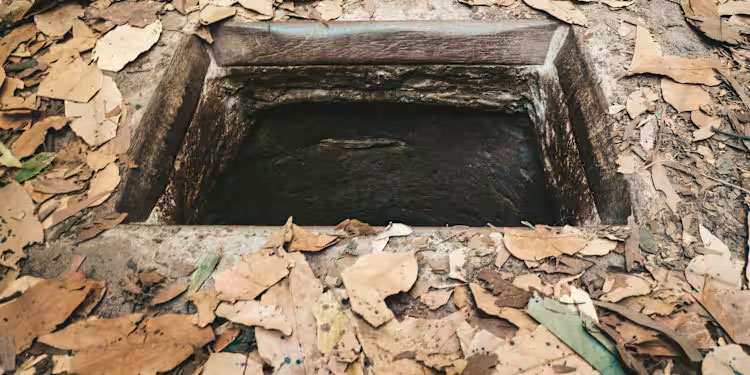
During the Vietnam War, American forces had aircraft, artillery, tanks and overwhelming firepower. Yet beneath the countryside around Cu Chi, opposing forces had created something those weapons struggled to eliminate: a vast underground network where soldiers could hide, move supplies, treat the wounded and prepare attacks. The tunnels eventually stretched for roughly 250 kilometers, turning the ground beneath the jungle into a hidden military world. When American troops finally went searching underground, they discovered a battlefield unlike anything they had faced above it.
It Started With Hand-Dug Passages
The origins of the Cu Chi tunnels date back to the late 1940s, during the war against French colonial rule. At first, the tunnels were relatively simple passages dug by hand to hide people, weapons and important documents.
As the conflict expanded, the network grew with it. During the 1960s, Communist forces connected and expanded sections of the tunnels as American military involvement in South Vietnam increased.
Eventually, the network around Cu Chi extended for roughly 250 kilometers. What appeared from the surface to be ordinary jungle and farmland concealed a complex system of underground routes connecting different positions.
The tunnels offered one crucial advantage: an enemy searching from above could control the surface without necessarily controlling what was happening below.
Ever wondered how Viet Cong soldiers survived underground? Discover the brilliant design of the Vietnam War Tunnels that outsmarted the U.S. military. This gripping story reveals the brutality and clever tactics used in the jungle. Don’t miss this intense journey into history—click the link to watch the full video now!
This Was An Underground Military World
The Cu Chi tunnels were far more than hiding places.
According to HISTORY, parts of the network contained living quarters, kitchens, hospitals, bomb shelters and weapons workshops. Some sections even included theaters and music halls, reflecting how extensively underground life had developed.
The tunnels allowed Communist forces to remain active while reducing their exposure to bombing and other attacks from above. Troops and supplies could move through the network while much of that activity remained invisible to forces operating on the surface.
The system could also support offensive operations. Fighters could emerge, attack positions around Saigon and then withdraw through routes that were difficult for their opponents to trace.
The battlefield therefore had two levels. American forces dominated much of the world above ground, while their opponents had created another world beneath it.

American Forces Tried To Destroy The Tunnels
The United States and its allies eventually mounted major operations specifically aimed at eliminating the Cu Chi stronghold.
In early 1966, Operation Crimp sent roughly 8,000 American and Australian troops into the area. Heavy bombing was used before ground forces moved in, but many Communist fighters were able to disappear into the tunnels.
Finding an entrance was one problem. Clearing an interconnected underground network was another.
In 1967, American forces launched the much larger Operation Cedar Falls, involving roughly 30,000 troops in the broader Iron Triangle area. The operation combined bombing with ground troops, tanks, bulldozers and herbicides in an attempt to destroy the Communist base.
The effort inflicted damage, but it did not permanently eliminate the underground network. Communist forces were able to return to areas after American units withdrew, and the tunnels remained important during the Tet Offensive of 1968.
The campaigns demonstrated the limits of simply bringing more firepower to the problem. A bomb could destroy what it could reach. It could not easily destroy a hidden system that had been deliberately built to survive underground.
Then The “Tunnel Rats” Went Below
Eventually, American forces needed troops who could enter the enemy’s underground world directly.
They became known as “tunnel rats.” These soldiers were tasked with entering narrow passages, searching for enemy personnel and weapons, and investigating what lay beneath the surface.
The conditions were unlike ordinary combat. The tunnels were dark, cramped and difficult to navigate, and some contained booby traps. A soldier entering one had little room to maneuver and could not rely on the visibility, firepower or equipment normally available above ground.
The experience was so distinctive that tunnel rats used the expression “black echo” to describe fighting underground.
Their role illustrated just how unusual the Cu Chi battlefield had become. American forces could deploy aircraft and armored vehicles across the countryside, but some soldiers were ultimately required to fight in spaces where they could barely move.
The Tunnels Changed What Control Of Territory Meant
The importance of Cu Chi went beyond the length of its tunnels.
The network helped Communist forces preserve personnel, supplies and communications despite sustained pressure from a much better-equipped military. It provided shelter during attacks, but it also allowed fighters to remain organized and emerge where they were least expected.
That created a frustrating problem for American commanders. Occupying an area on the surface did not necessarily mean the opposing forces had been removed from it.
The tunnels therefore became part of a much broader guerrilla strategy in which mobility, concealment and endurance could compensate for enormous differences in conventional firepower.
The United States could dominate the battlefield when the enemy chose to fight in the open. But when the enemy disappeared underground, the advantages of conventional military technology became much harder to use.

What Remains Of The Underground War
After the fall of Saigon in 1975, sections of the Cu Chi tunnels were preserved as historical sites. Parts of the network are now open to visitors, offering a glimpse of the confined underground environment that became such an important part of the Vietnam War.
The sites visitors see today have been preserved and adapted, so they do not necessarily represent the exact wartime conditions. But they still provide a sense of the physical contrast that defined Cu Chi.
Above ground, the war was fought with aircraft, artillery, armored vehicles and large military formations. Below ground, an extensive network built largely by hand allowed people to shelter, move, organize and continue fighting.
That contrast is what makes Cu Chi so remarkable. The tunnels were not simply a collection of holes beneath the jungle. They were an entire military infrastructure hidden in a place where the most powerful weapons of the war could not easily reach.
The Cu Chi tunnels became one of the clearest examples of how warfare can change when an enemy refuses to fight on conventional terms. Beneath the jungle, Communist forces developed a network of roughly 250 kilometers containing shelters, living areas, medical facilities, workshops and command spaces. American forces responded with major operations, heavy bombing and the specialized tunnel rats, but the underground system proved remarkably resilient. Cu Chi did not decide the Vietnam War by itself, yet it showed that superior firepower does not always translate into control—especially when the battlefield extends beneath the ground.
P.S. This article is based primarily on HISTORY’s account of the Cu Chi tunnels and their role during the Vietnam War, including Operation Crimp, Operation Cedar Falls and the tunnel rats who entered the underground network. Source: https://www.history.com/articles/cu-chi-tunnels