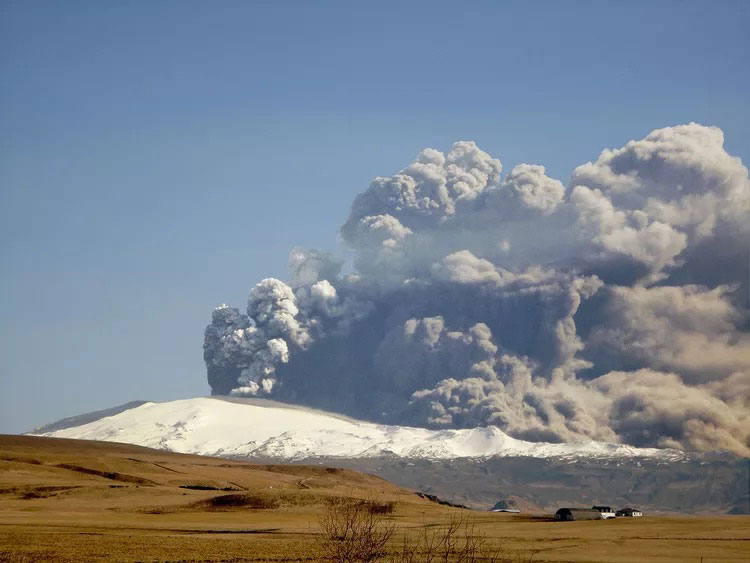
Volcanoes are among the most powerful forces shaping planets and moons. On Earth, they have built entire islands and mountain ranges, while elsewhere in the solar system they have created landscapes on a scale that is difficult to imagine. The largest known volcano is not even on Earth: Olympus Mons on Mars rises about 27 kilometers above the Martian surface. But Earth has its own giants, including mountains whose true size becomes apparent only when their enormous bases beneath the ocean are taken into account.
Olympus Mons Is the Giant of the Solar System
Olympus Mons on Mars is the largest known volcano in the solar system, rising roughly 27 kilometers above the surrounding surface. That makes it nearly three times as tall as Mount Everest when the two are compared by elevation above their respective surrounding surfaces. Olympus Mons is a shield volcano, meaning it was built gradually by repeated eruptions of relatively fluid lava rather than by a series of explosive eruptions that created a steep volcanic cone.
The volcano sits near the edge of the enormous Tharsis region, an area of Mars containing several major volcanoes. Olympus Mons became so large because lava continued to accumulate over an immense period of time. According to ThoughtCo, volcanic activity that built the mountain began around 115 million years ago and continued until roughly 2 million years ago. Today, Olympus Mons is considered dormant, although scientists cannot completely rule out the possibility of activity deep beneath the Martian surface.
Its extraordinary size is also connected to Mars itself. Unlike Earth, Mars does not have the same kind of active plate tectonics that continually moves volcanic regions across the planet’s surface. A persistent source of magma could therefore continue building a volcano in roughly the same location for a very long time. The result was a mountain so enormous that it dominates the surrounding Martian landscape.

Take a closer look at the enormous Olympus Mons on Mars and discover what makes this colossal volcano unlike anything found on Earth. Watch the video to explore its incredible scale and the forces that shaped one of the solar system’s most remarkable mountains.
Mauna Kea Is Taller Than Everest—If You Measure It Differently
Earth’s volcanoes may not reach the height of Olympus Mons above sea level, but some become enormous when measured from their true geological bases. Mauna Kea, on Hawaii’s Big Island, is the classic example.
The summit of Mauna Kea stands nearly 4,267 meters above sea level. But most of the volcano is hidden beneath the Pacific Ocean. Its base extends roughly 6,000 meters below the surface, meaning that its total height from its underwater base to its summit is around 10,058 meters. By that measurement, Mauna Kea is taller than Mount Everest.
Mauna Kea formed over a volcanic hotspot, where hot material from Earth’s interior rises toward the surface and produces magma. Repeated eruptions gradually built the volcano and helped create the Hawaiian island chain. The volcano is currently dormant and has not erupted for more than 4,000 years, although dormant does not necessarily mean permanently extinct.
The summit is also famous for another reason. Its high elevation, dry atmosphere and relatively low light pollution make Mauna Kea an important location for astronomical observatories. Thirteen facilities operate there, allowing scientists to study objects far beyond Earth from one of the planet’s most remarkable volcanic mountains.

Ojos del Salado Is the Highest Volcano Above Sea Level
If the question is which volcano has the highest summit above sea level, the answer changes again. That title belongs to Ojos del Salado, located on the border between Argentina and Chile in the Andes.
The volcano rises to about 6,893 meters above sea level according to the ThoughtCo source, while the Smithsonian Global Volcanism Program currently lists its elevation at about 6,879 meters. Either measurement makes it the world’s highest volcano above sea level.
Ojos del Salado is therefore a good example of why there is no single answer to the question of which volcano is “largest.” Mauna Kea can claim an extraordinary height when measured from its underwater base, while Ojos del Salado has the highest summit elevation among Earth’s volcanoes.
Unlike Mauna Kea, Ojos del Salado is not considered simply dormant. The volcano has experienced relatively recent activity, with its last known significant eruption occurring in 1993 according to the ThoughtCo article.
Its location also makes it one of the most spectacular volcanic landscapes on the planet. Rising from the high Andes, Ojos del Salado stands in an environment that is dramatically different from the tropical setting of Hawaii.

Tamu Massif Is a Giant Hidden Beneath the Pacific
One of Earth’s largest volcanic structures spent most of its existence hidden beneath the ocean. Tamu Massif lies deep beneath the Pacific, roughly 1,000 miles from Japan, and was not recognized as a massive volcanic structure until the early 21st century.
The volcano rises about four kilometers from the ocean floor, but its real distinction is its enormous footprint. ThoughtCo gives its area as approximately 191,511 square kilometers, making it vastly wider than most familiar volcanic mountains. It last erupted roughly 144 million years ago during the Cretaceous and is now extinct.
The name Tamu comes from Texas A&M University, reflecting the institution associated with researchers who studied the structure. Its enormous size is partly a consequence of its extremely gradual slopes. Rather than forming a sharply rising mountain, Tamu Massif spreads across a huge portion of the seafloor.
That makes it almost impossible to appreciate its scale from the surface. A person standing on the ocean above it would have no obvious indication that one of Earth’s largest volcanic structures lies thousands of meters below.
Tamu Massif demonstrates just how much of Earth’s volcanic history remains hidden beneath the oceans. The planet’s most spectacular geological features are not always the ones visible from land.

Mauna Loa Is Earth’s Largest Active Volcano
Hawaii is home to another giant: Mauna Loa. Like Mauna Kea, it is a shield volcano built from repeated layers of relatively fluid lava. But unlike Mauna Kea, Mauna Loa remains active.
The summit rises more than four kilometers above sea level, while its enormous underwater flanks extend several kilometers farther down to the seafloor. The USGS estimates that when the depression of the oceanic crust beneath the volcano is taken into account, the summit stands roughly 17 kilometers above its true geological base.
Mauna Loa is currently recognized by the USGS as the largest active volcano on Earth. Its enormous mass and volume make it one of the planet’s defining volcanic structures.
The volcano has been building for hundreds of thousands of years, and its eruptions have repeatedly added new layers of lava to the mountain. Unlike a conventional steep-sided volcano, Mauna Loa spreads broadly across the island, giving it the enormous, gently sloping profile characteristic of Hawaiian shield volcanoes.
Its activity also demonstrates that these enormous volcanic mountains are not merely relics of the distant past. Mauna Loa continues to be monitored closely because future eruptions remain possible.

Kilimanjaro Is Africa’s Massive Volcanic Landmark
Mount Kilimanjaro offers another example of how volcanic mountains can take dramatically different forms. Located in Tanzania, the mountain rises to nearly 5,000 meters above sea level and is one of the most recognizable peaks in Africa.
Unlike the broad shield volcanoes of Hawaii, Kilimanjaro is a volcanic complex made up of three major cones: Kibo, Mawenzi and Shira. Kibo is the highest of the three and is considered dormant rather than completely extinct. Geological evidence indicates that the volcanic complex began forming around 2.5 million years ago.
Kilimanjaro’s enormous size and distinctive landscape have made it one of the world’s most famous climbing destinations. Unlike many volcanic mountains that are recognized primarily for their eruptions, Kilimanjaro is also celebrated for the extraordinary journey from its lower slopes to its high summit.
The mountain demonstrates that volcanic giants do not all follow the same geological blueprint. Some spread outward over enormous areas, while others build taller, more complex structures from multiple volcanic centers.

Volcanoes Are Still Shaping Worlds Today
The enormous volcanoes of Earth and Mars are reminders that volcanism is not simply an ancient process. It remains one of the most important forces shaping planets and moons throughout the solar system.
Earth continues to experience volcanic eruptions, while other worlds show evidence of extraordinary volcanic activity. Jupiter’s moon Io is covered by active volcanic features, while icy worlds such as Europa and Enceladus may have forms of cryovolcanism in which water or other volatile materials replace the molten rock found in terrestrial volcanoes.
Even on Earth, volcanic activity can transform landscapes with remarkable speed. The 1883 eruption of Krakatoa had effects that reached far beyond the volcano itself, while the later activity of Anak Krakatau continued to reshape the region. A December 2018 eruption and collapse of part of Anak Krakatau triggered a deadly tsunami in Indonesia.
These events reveal why volcanoes matter beyond their size. They are geological engines capable of building mountains, creating islands, changing coastlines and altering the atmosphere.
The biggest volcanoes simply demonstrate that power on a much larger scale.

From Olympus Mons on Mars to Mauna Loa and the enormous volcanoes hidden beneath Earth’s oceans, these giants reveal just how powerful volcanic activity can be. Their size also depends on how we measure them—by height, volume or area—making each one remarkable in a different way. Together, they show that volcanoes are not simply mountains built by eruptions, but powerful geological forces that have shaped worlds across the solar system for millions of years.