During the Cold War, the United States and Soviet Union spent decades trying to outdo each other in military technology. One of the most striking results was the Tupolev Tu-160, a massive supersonic bomber designed to counter advances in American strategic aviation. Known in the West as the Blackjack, the Tu-160 was enormous, fast and powered by four engines capable of producing tremendous thrust. But its story became even stranger after the Soviet Union collapsed, when 19 of these bombers suddenly found themselves in the newly independent nation of Ukraine.
The Tu-160 Was Built to Counter America’s B-1
The story of the Tu-160 began during one of the most intense periods of the Cold War. Both the United States and the Soviet Union were developing strategic bombers capable of delivering advanced weapons over enormous distances.
American work on the Rockwell B-1 Lancer was particularly significant. The Soviet Union was also concerned about the North American XB-70 Valkyrie, an experimental American bomber that first flew in 1964. Moscow wanted a new strategic aircraft capable of flying at supersonic speeds and carrying weapons deep into an opponent’s territory.
Several Soviet design bureaus submitted proposals. Some concepts looked remarkably similar to the XB-70, but the Tupolev design bureau ultimately received responsibility for developing the aircraft that would become the Tu-160.
Tupolev engineers soon settled on an important feature: variable-geometry wings.
The wings could sweep backward or extend outward depending on the aircraft’s speed and phase of flight. This allowed the Tu-160 to optimize its aerodynamic performance during takeoff, climbing, high-speed flight and landing.
The design presented difficult engineering challenges. The tail had to be thin enough to work effectively at very high speeds, eventually leading Tupolev engineers to adopt a distinctive cruciform tail with a divided rudder.
Power came from four Kuznetsov NK-32 turbofan engines. Each engine could generate approximately 55,000 pounds of thrust with its afterburner operating.
The result was not simply another Soviet bomber.
It was an enormous machine designed to combine long range with supersonic speed.

The Blackjack Was an Enormous Supersonic Bomber
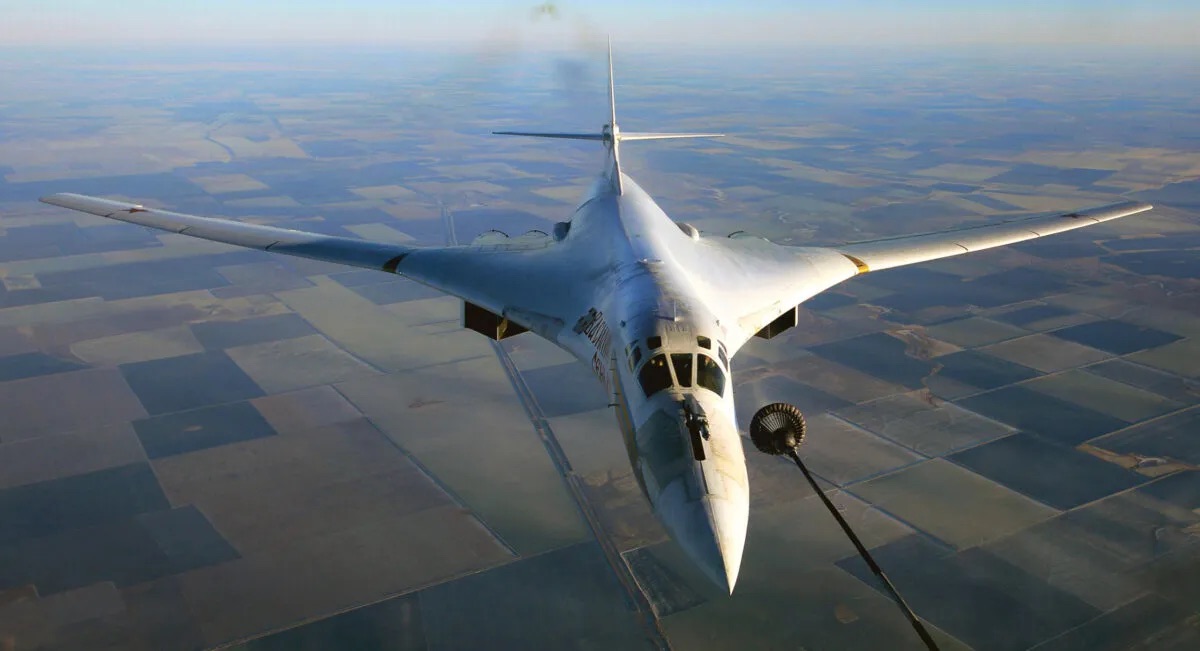
The finished Tu-160 was visually similar to the American B-1, but its dimensions were striking.
The Tu-160 measures nearly 178 feet in length, compared with roughly 146 feet for the B-1. Its wing area is more than twice that of the American aircraft, while its total thrust is nearly twice as great.
The numbers help explain why the aircraft earned a reputation for being exceptionally large.
Despite its size, the Tu-160 was capable of reaching slightly above Mach 2. That was comparable to the speed of the original B-1A, although the later B-1B was limited to about Mach 1.25.
The Soviet aircraft also had a higher rate of climb.
Its crew consisted of four people, and its weapons were carried internally rather than on external hardpoints. The bomber could carry either twelve Raduga Kh-15 missiles or six Kh-55 nuclear-capable cruise missiles in each of its two internal weapon bays, using rotating launchers.
That did not mean the Tu-160 was superior to the B-1 in every respect.
The American B-1 had three internal weapons bays and six external hardpoints, giving it greater flexibility for carrying different types of conventional and nuclear weapons. Modern B-1Bs also received substantial avionics upgrades.
The two aircraft eventually developed into somewhat different machines.
The Tu-160 emphasized speed and range, while the B-1B became a low-level penetrator designed around a different operational role. The B-1 was also more maneuverable and harder to detect on radar, although neither aircraft was designed with modern stealth technology.
The result was a fascinating Cold War contrast.
America had the B-1.
The Soviet Union responded with a bomber that was, in several important respects, even larger and faster.
Want to see the Soviet Tu-160 in action? Watch the video for a closer look at the massive supersonic bomber, its incredible size and the engineering that made it one of the most powerful aircraft of the Cold War.
The Soviets Had Even Bigger Plans for the Blackjack
The Tu-160 was designed as a strategic bomber, but Soviet engineers considered using its enormous size and performance for purposes far beyond conventional bombing missions.
One of the most unusual ideas was Burlak, an air-launch system intended to use the Tu-160 as a platform for putting satellites into orbit.
The concept involved carrying a satellite weighing up to about 850 kilograms together with a three-stage liquid-fueled rocket. The rocket and payload would be attached to the aircraft in the country requesting the launch service. The Tu-160 would then carry the system to altitude and release it for the journey into orbit.
There was even a strategic reason for launching the system from a foreign country.
Because the rocket would be assembled inside the host nation, Soviet planners hoped to avoid the attention of other governments that might object to transporting a conventional rocket through their territory.
The idea was ambitious.
Instead of launching a satellite from a fixed ground facility, the enormous bomber would essentially become a mobile launch platform.
But Burlak never became an operational system.
The project appears to have been abandoned before it was used, despite interest in the concept. Another proposal to use the Tu-160 as a launch platform for an aerial drone called Voron also failed to become reality.
These projects reveal something interesting about the aircraft.
The Tu-160 was not simply large because Soviet engineers wanted a bigger bomber. Its enormous airframe offered enough capacity and performance to make engineers wonder what else it might be capable of carrying.

Russia Had to Buy Back Its Own Bombers From Ukraine
Perhaps the strangest chapter in the Tu-160’s history came after the Soviet Union disappeared.
The aircraft formally entered service in 1987. Production eventually stopped in the 1990s, and only 37 Tu-160s were completed, including nine test aircraft.
Then the Soviet Union collapsed in 1991.
The political borders changed almost overnight, and 19 Tu-160 bombers, along with their nuclear armaments, were left on Ukrainian territory.
Ukraine suddenly possessed a fleet of some of the world’s most expensive strategic bombers.
But owning them was not necessarily an advantage.
The aircraft were extremely expensive to operate and maintain, and many remained largely unused at Ukrainian military airfields. Some were repainted in Ukrainian colors, but the new country had little practical use for such a specialized fleet.
Russia, meanwhile, faced the bizarre situation of watching strategic bombers originally built for the Soviet Union sit outside Russian control.
Negotiations followed.
In 1999, Ukraine agreed to return eight Tu-160s to Russia, together with their nuclear-capable cruise missiles, in exchange for debt relief. Russia selected the eight aircraft it considered to be in the best condition.
The fate of the remaining eleven was very different.
Ten were dismantled under the START II disarmament framework, including at least one destroyed during a public demonstration. One aircraft was preserved as a museum piece.
There was even a moment when three Ukrainian Tu-160s appeared likely to be sold to an American company.
Platforms International Corp. wanted to use them for a private satellite-launch venture. The possibility alarmed Russian officials, who strongly opposed the prospect of the bombers being transferred to the West. The proposed deal ultimately collapsed.
For a machine created as a symbol of Soviet military power, the post-Cold War fate of the Tu-160 was extraordinary.
Some were returned to Russia.
Others were dismantled.
One became a museum exhibit.
And for a brief period, some nearly became American-owned commercial launch aircraft.
The Blackjack Became a Relic That Refused to Disappear
The Tu-160 saw relatively limited operational use during much of its early service life. It was primarily used for patrols and military exercises, although several aircraft were deployed to Venezuela in 2008 and again in 2013 as demonstrations of Russian military power.
The aircraft first saw combat use in 2015 during the Syrian civil war.
Its role in later conflicts has remained limited compared with the enormous expectations attached to the bomber during the Cold War.
Yet the aircraft itself has refused to become simply a museum piece.
Some Tu-160s have undergone extensive modernization, while a small number of upgraded Tu-160M aircraft have entered production again after a long interruption.
That gives the bomber an unusual place in aviation history.
The Tu-160 was born from a Cold War competition in which the United States and Soviet Union were constantly responding to each other’s technological advances. It was designed decades ago, yet its enormous airframe and supersonic performance remain impressive even by modern standards.
More than that, its history reflects the extraordinary political changes that followed the end of the Soviet Union.
A bomber built in the Soviet era ended up scattered across national borders, with Russia eventually negotiating to recover some of its own aircraft from Ukraine.
The Tu-160 therefore became more than a weapons system.
It became a surviving piece of the Cold War itself.

The Tu-160 was created to answer an American challenge, but its story became much stranger than a simple contest between two bombers. It was larger and faster than the B-1 in important respects, inspired ambitious plans for launching satellites and eventually became a symbol of the complicated aftermath of the Soviet collapse. Nineteen aircraft ended up in Ukraine, forcing Russia to negotiate their return. Some survived, others were dismantled, and upgraded versions are still being produced. Few Cold War aircraft have had such an unusual journey from superpower rivalry to post-Soviet history.