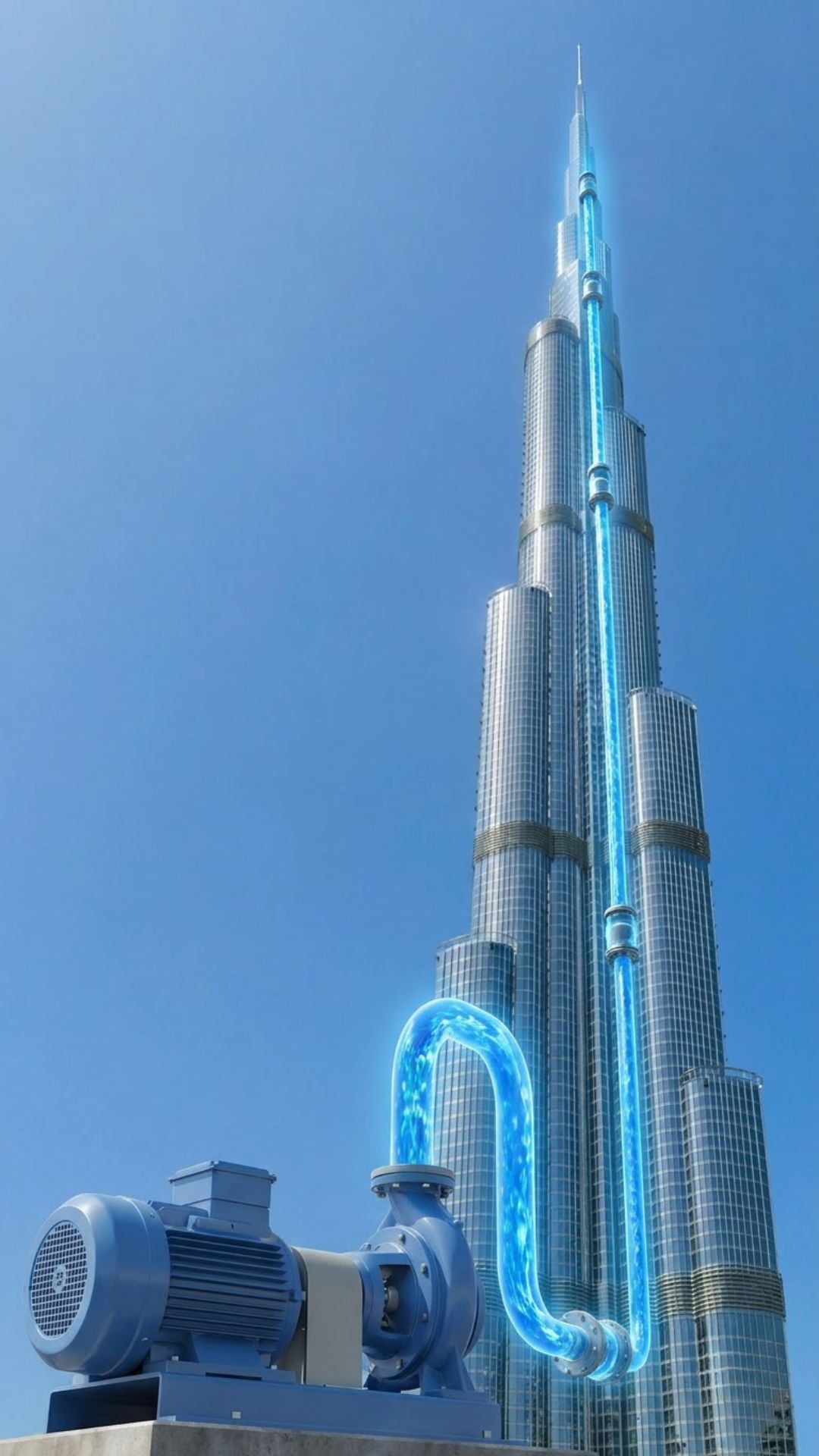
The Burj Khalifa is so tall that even something as ordinary as taking a shower becomes an engineering challenge. Every day, roughly 250,000 gallons of water must travel through about 62 miles of pipes inside the world’s tallest building. But engineers could not simply install one enormous pump at the bottom and force all that water toward the top. The pressure would become dangerously high. Instead, they divided the tower’s water system into stages, using tanks and equipment hidden inside mechanical floors scattered throughout the skyscraper.
The Problem Starts With Gravity
From the outside, Burj Khalifa looks like one enormous tower rising nearly 830 meters above Dubai. Inside, however, it has to function as a complete vertical city, with apartments, hotel rooms, offices, restaurants and thousands of people relying on the same ordinary services found in any other building. That includes something most people rarely think about: getting clean water to every floor.
The scale is difficult to appreciate. Burj Khalifa’s water system supplies an average of about 946,000 litres, or 250,000 gallons, every day, with the water traveling through roughly 100 kilometres, or 62 miles, of piping. The challenge becomes much greater as the water moves higher because gravity is constantly pulling that enormous column of water back toward the ground.
That creates a problem engineers cannot simply solve by adding a bigger pump. The higher the water has to travel, the more pressure is required, and the lower sections of the system would have to withstand enormous forces. Instead of fighting gravity with one gigantic machine, engineers designed the system so that the water could make its journey upward in stages.
Ever wonder how the Burj Khalifa delivers water to the 163rd floor without exploding? Discover the incredible engineering secrets behind the world’s tallest building. From complex pumping zones to cooling massive towers with ice, this video explores the genius behind this desert skyscraper. Watch now to see how it works!
Why One Giant Pump Would Not Work
Imagine filling a pipe that stretches hundreds of metres into the sky. At the bottom, the weight of all that water is pressing downward, creating increasing pressure as the height of the water column grows. In a building as tall as Burj Khalifa, that pressure becomes a serious engineering consideration, which is why the tower does not depend on one pump at ground level to supply every floor.
Instead, water is pumped upward to a series of tanks positioned at different heights throughout the building. From these points, it can be distributed to the floors around each section of the tower without requiring one system to overcome the entire height at once. The approach essentially breaks one enormous vertical challenge into several smaller and more manageable ones.
The equipment needed for this arrangement is hidden inside seven two-story mechanical floors distributed throughout the building. These floors contain water tanks and pumps alongside other critical equipment, including electrical substations and air-handling systems. To someone walking through the finished building, these mechanical spaces are almost invisible, yet they play a crucial role in making everyday life possible hundreds of metres above the ground.

The Water Has A Long Journey
Once you understand how much infrastructure is hidden behind an ordinary faucet, the numbers become remarkable. Burj Khalifa has about 62 miles of piping dedicated to its water system, but that is only one part of the building’s plumbing infrastructure. Another 132 miles of piping serves the fire-emergency system, while another 21 miles is used for chilled water associated with air conditioning.
The scale reflects a simple reality: a skyscraper needs far more than drinking water. It needs systems for sanitation, fire protection and climate control, all operating continuously inside a structure that is exposed to Dubai’s extreme heat. Every one of those systems has to be carefully planned around the building’s unusual height.
From a visitor’s perspective, almost none of this infrastructure is visible. A person turns on a faucet, takes a shower or flushes a toilet without ever having to think about the network of pumps, tanks and pipes hidden behind the walls. Yet those ordinary moments depend on an enormous vertical system working quietly in the background.
That is perhaps what makes the engineering so interesting. The goal was never to make people think about the plumbing. The goal was to make the plumbing so reliable that nobody had to think about it at all.
Then The Building Has To Deal With All That Water Again
Getting water into the building is only half of the problem. Once thousands of people have used it, the tower has to remove the wastewater as well. Here, engineers can take advantage of the same force that created the original challenge: gravity. Wastewater from plumbing fixtures and drains can travel downward through the building, using gravity rather than requiring the same kind of pumping system needed to push clean water upward.
There is another surprising source of water inside the tower as well. Dubai’s hot and humid climate creates an enormous demand for air conditioning, and as the system cools the building, moisture from the surrounding air condenses into water. Instead of allowing all of that condensation to go to waste, the Burj Khalifa’s systems can collect it.
The cooling system can produce millions of gallons of condensation water over the course of a year. That water can then be collected and put to use, turning what would otherwise be a by-product of keeping the building cool into another resource. Even the humid air surrounding the skyscraper therefore becomes part of the building’s water story.
The Tower Is Really A Stack Of Smaller Buildings
This may be the most important idea behind Burj Khalifa’s infrastructure. A skyscraper looks like one enormous object when viewed from the ground, but engineers cannot necessarily treat it as one enormous system. As a building becomes taller, water pressure changes, mechanical equipment has to be distributed, electrical systems require dedicated spaces and air conditioning becomes increasingly complicated.
Burj Khalifa addresses many of these problems by dividing the tower into zones. The mechanical floors act almost like hidden service stations inside the skyscraper, providing space for tanks, pumps and other equipment while breaking the tower’s enormous vertical journey into manageable sections.
The same principle appears in other parts of the building. Even its elevators are divided into zones, with sky lobbies allowing passengers to transfer between elevator systems rather than having every elevator serve every floor directly. The building may look like a single needle reaching into the sky, but operationally it behaves more like a collection of interconnected sections stacked on top of one another.
That approach is what allows the tower to function without requiring every system to overcome its entire height at once. Instead of trying to make one machine do everything, engineers divided the problems into smaller pieces and connected them into one enormous working system.

The Most Impressive Part Is What You Never Notice
This is what makes Burj Khalifa’s water system so fascinating. Nobody visiting the building sees the 62 miles of water pipes, and nobody living inside it needs to think about the pressure required to move water hundreds of metres above the ground. The complicated machinery remains hidden while the results appear completely ordinary.
You turn on a faucet and water comes out. You flush a toilet and the system carries the wastewater away. You enter a room on one of the tower’s upper floors and expect the air conditioning to work just as it would in a much smaller building. All of those everyday experiences depend on infrastructure designed specifically for the extraordinary scale of the structure.
This is often what successful engineering looks like. The complicated machinery disappears from everyday life because it has been designed to work quietly and reliably in the background. In Burj Khalifa, the engineering achievement is not simply that the building reaches almost 830 metres into the sky. It is that people inside can live almost as normally as if they were standing on the ground.
A Skyscraper Is More Than What You Can See
Burj Khalifa is famous because of its height, but height is only the most visible part of the achievement. The real challenge was making a building that tall behave like a normal place to live, work and visit, with all the mundane services that people expect from any modern building.
People still need water, toilets, electricity and air conditioning. They still need elevators, fire protection and drainage. The difference is that every one of those systems must operate inside a structure where ordinary distances have become extraordinary.
That is why the question of how water reaches the top of Burj Khalifa is more interesting than it first appears. The answer is not one enormous pump pushing water nearly 830 metres upward. It is a carefully staged network of tanks, pumps, mechanical floors and pipes designed around one of the oldest forces on Earth. Gravity.
And perhaps that is the strangest thing about the world’s tallest building: the higher humans managed to build, the more carefully they had to design around something as simple as water falling downward.
The Burj Khalifa’s water system reveals a side of skyscraper engineering that most people never see. The challenge was not simply building nearly 830 metres into the sky, but making everyday life work at that height. Around 250,000 gallons of water move through roughly 62 miles of piping each day, while tanks and pumps distributed through mechanical floors help manage the enormous pressures created by gravity. The result is almost invisible to everyone inside the tower. And that may be the greatest achievement of all: an extraordinary engineering system that makes an extraordinary building feel completely ordinary.
The story is based on technical information and reporting about the Burj Khalifa’s water and mechanical systems. Source: https://www.theurbandeveloper.com/articles/how-water-works-worlds-tallest-skyscraper