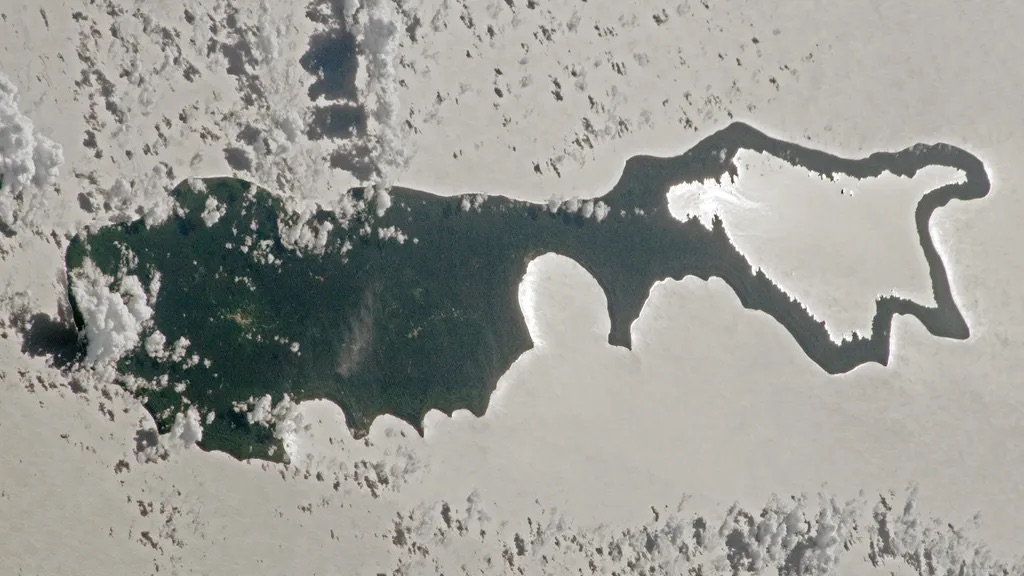
From space, this remote Pacific island looked as if someone had poured liquid metal across the ocean. The water around Rennell Island had turned silver. So had a huge lake hidden inside it. Nothing had exploded, leaked or changed color. The entire scene was created by sunlight striking the water at exactly the right angle. For a brief moment, an astronaut looking down from hundreds of miles above Earth saw an ordinary island transformed into something almost unrecognizable. So what created this giant silver mirror?
The Moment Rennell Island Seemed to Turn to Metal
In January 2023, an astronaut aboard the International Space Station captured a remarkable image of Rennell Island in the Solomon Islands.
At first glance, the photograph barely looks real.
Much of the Pacific Ocean surrounding the island appears bright silver, while Lake Tegano—an enormous inland lake—reflects light so intensely that it looks almost metallic. The effect makes the island seem surrounded by a strange, shining substance rather than ordinary seawater.
But the ocean had not changed.
The lake had not changed.
Only the light had.
The phenomenon is known as sunglint: a powerful reflection created when sunlight bounces off water and travels directly toward an observer. In this case, the observer happened to be hundreds of miles above Earth.
What if the ocean could turn an entire island into silver? Watch the video to see the strange sunlight phenomenon that made Rennell Island look like a giant mirror from space.
How Sunlight Created a Giant Mirror
Water does not always look blue.
Its appearance depends heavily on light, depth, particles in the water and, perhaps most importantly in this case, the angle from which it is being viewed.
When sunlight strikes a relatively smooth surface, some of that light can reflect outward much like it does from a mirror. If an observer is positioned in exactly the right direction, the reflected sunlight can become extraordinarily bright.
From the International Space Station, that reflection can cover an enormous area.
Instead of seeing the familiar colors of the Pacific, the astronaut was looking directly into reflected sunlight. The result was a vast silver glow stretching across the water.
But sunglint does something even stranger.
It does not illuminate every part of the ocean equally.
Some areas become brilliant. Others remain comparatively dark. Tiny differences in waves, wind and surface texture can change the way sunlight is reflected.
The ocean suddenly becomes a giant map of invisible motion.
And Rennell Island happened to be sitting in the middle of it.

Why the Island’s Lake Shone So Brightly
The surrounding Pacific was already glowing, but Lake Tegano made the image especially remarkable.
The enormous lake occupies part of Rennell Island’s ancient coral landscape. Compared with the open ocean, inland water can have different surface conditions, including calmer areas that are capable of producing a more concentrated reflection.
From space, Lake Tegano therefore appeared as another intensely bright silver shape.
That created the illusion of an island containing its own giant mirror.
The effect was almost too perfect.
The open ocean reflected sunlight around Rennell.
The lake reflected sunlight inside it.
Between them sat the island itself, appearing like a dark fragment surrounded by polished metal.
What makes the image so fascinating is that nothing extraordinary had to happen on the ground.
No rare weather event. No volcanic eruption. No human activity. The entire transformation occurred because the Sun, the water and the astronaut briefly lined up in precisely the right geometry.
The Strange Island Beneath the Reflection
Rennell Island is remarkable even without the silver glow.
It is part of the Solomon Islands and is associated with one of the world’s most distinctive coral landscapes. The eastern portion of the island and Lake Tegano form the UNESCO-listed East Rennell World Heritage Site, an area known for its exceptional natural environment and unique ecosystems.
Lake Tegano itself occupies what was once part of a lagoon within an ancient coral atoll.
That history makes the astronaut photograph even more intriguing.
The bright silver shape visible from space was not simply a lake. It was part of an enormous geological story.
A landscape that had once been shaped by coral reefs and ocean water was lifted and transformed over time into the island seen today.
From the ground, Rennell is a remote landscape of forest, limestone and inland water.
From space, under the right conditions, it can look almost extraterrestrial.
The photograph captures both versions at once.
The real island—and the illusion created by light.

Sunglint Is More Than a Beautiful Accident
Scientists do not view sunglint only as a strange visual effect.
The reflection can reveal subtle details about the ocean’s surface that may otherwise be difficult to see.
Changes in waves, currents and surface texture can alter the way sunlight reflects. Under the right conditions, sunglint can therefore help reveal patterns across the water.
But the phenomenon can also create problems.
The same intense reflection that reveals surface features can obscure other details in satellite imagery. Scientists sometimes need to account for or remove sunglint when studying the ocean from space.
That makes it both useful and inconvenient. A natural spotlight. And a visual obstruction.
The image of Rennell Island is a perfect reminder that the ocean’s appearance is never fixed. From the ground, we may see blue water and waves. From space, under a precise alignment of sunlight and geometry, the same water can suddenly look like a sheet of molten silver.
Rennell Island never actually turned silver. The Pacific did not become metal, and Lake Tegano did not transform into a mirror. For a brief moment, sunlight simply struck the water at exactly the right angle and reflected directly toward an astronaut in orbit. Yet that was enough to make an ordinary island look almost alien. Perhaps that is what makes the image so captivating: Earth did not need to change at all. We only needed to see it from a different place—and wait for the light to hit it just right.