On September 11, 2001, nearly 3,000 people were killed in the deadliest terrorist attack on U.S. soil. For those who lived through that morning, the memories remain intensely personal: a television suddenly filled with smoke, a phone call that never came, an airplane appearing where no airplane should have been. But 25 years later, the meaning of September 11 extends far beyond the morning itself. The attacks reshaped American security, foreign policy, public life and even the health of people who survived. For a generation born afterward, 9/11 is becoming history. For millions who remember it, it is still part of everyday life.
A Morning That Divided American History Into Before And After
The attacks began when four commercial airplanes were hijacked. Two struck the World Trade Center towers in New York, one hit the Pentagon in Virginia and a fourth crashed near Shanksville, Pennsylvania, after passengers and crew resisted the hijackers. Almost 3,000 people died that day, including passengers, office workers, firefighters, police officers and other emergency personnel.
For Americans who experienced the attacks firsthand, one of the most striking memories was how quickly an ordinary Tuesday disappeared. People watched the towers burn from offices, sidewalks and television screens, while families struggled to find out whether loved ones were safe. In New York, the attacks were followed by the collapse of both towers and a massive rescue and recovery operation that continued for months.
The physical destruction was concentrated in a few locations, but the psychological shock spread across the entire country. Airports closed, schools and businesses changed their routines, and Americans suddenly found themselves living through an event that would influence nearly every conversation about security for years to come.
Ever wonder what it takes to maintain one of the world’s most iconic landmarks? Go behind the scenes at the 9/11 Memorial to see how dedicated teams deep clean the reflecting pools and restore the bronze name panels. Watch this fascinating journey of preservation and respect. Click to watch now!
For A While, America Felt Remarkably United
One of the strongest memories many Americans have of the period immediately after 9/11 is not fear but solidarity.
Flags appeared everywhere. Strangers checked on strangers. Donations poured into New York, Washington and Pennsylvania, while firefighters, police officers, medical workers and volunteers traveled toward Ground Zero rather than away from it. The 9/11 Memorial & Museum describes that period as one marked by bravery, compassion, unity and service.
That feeling of unity has become one of the most complicated parts of the national memory. For many people, it represented one of the few moments in modern American life when political disagreements seemed temporarily less important than a shared sense of vulnerability.
But the unity did not last.
The country soon moved from mourning toward questions of retaliation, national security and war. What began as an attack that most Americans experienced as a single terrible day gradually became the beginning of a much larger historical period.
The Meaning Of Security Changed Forever
Before 9/11, airport security was a routine inconvenience for most Americans. Afterward, it became part of everyday life.
New security procedures, expanded screening and new government powers changed how Americans traveled and how they thought about threats. The USA PATRIOT Act, passed shortly after the attacks, expanded the federal government’s ability to conduct surveillance and investigate suspected terrorism.
For supporters, the changes were necessary responses to an unprecedented attack. Critics argued that some measures went too far and weakened privacy and civil liberties. Those arguments never really disappeared; they became part of the larger legacy of 9/11.
The airport line became one of the most visible symbols of this transformation. A traveler born after 2001 may never have known a world in which boarding a commercial flight felt fundamentally different. For older Americans, the contrast is much easier to remember.
9/11 changed not only what Americans feared. It changed what they were willing to accept in the name of safety.

The Wars Outlasted The Towers
The attacks also set the United States on a military course that would last for decades.
The U.S. invaded Afghanistan in October 2001 after the Taliban refused to hand over Osama bin Laden and al-Qaida leadership. Two years later, the United States invaded Iraq, although Iraq’s government was not responsible for the September 11 attacks.
The wars became one of the most consequential and controversial parts of the post-9/11 era. American service members spent years overseas, families endured repeated deployments, and the country committed enormous resources to military operations far from the places where most Americans experienced the original attacks.
For some people, the wars represented necessary action against terrorism. For others, they became an example of how the fear and anger of 2001 could lead the country into conflicts whose consequences were far more complicated than the original response had suggested.
Twenty-five years later, Americans can remember the unity of September 2001 while holding radically different views about what the country did afterward. That tension is part of the story itself.
The People Who Were There Did Not Simply “Move On”
Perhaps the least visible legacy of 9/11 is the one carried by survivors and first responders.
The rescue and recovery workers who spent months at Ground Zero were exposed to dust, smoke, debris and other hazardous materials. People who lived, worked or attended school in Lower Manhattan were exposed as well. The federal World Trade Center Health Program now provides medical monitoring and treatment for responders and survivors with conditions associated with those exposures.
The scale is enormous. The CDC says an estimated 400,000 people were exposed to toxic contaminants, injury risks and severe physical or emotional stress in the days, weeks and months following the attacks. Its current exhibition says that more than 96,000 people have been diagnosed with physical or mental health conditions connected to 9/11 exposures and trauma.
That is why the story of 9/11 cannot end with photographs of the towers collapsing.
For thousands of people, the consequences continued through years of cancer diagnoses, respiratory illness, mental-health problems and other conditions. In 2026, the 9/11 Memorial & Museum added a seventh moment of silence to its anniversary ceremony specifically to honor people who later died from health effects related to the attacks. The disaster ended on September 11. Its health consequences did not.
Not Everyone Experienced The Aftermath In The Same Way
The post-9/11 period also changed how many Muslim Americans and people perceived to be Muslim were treated.
Some Americans remember the immediate aftermath as a period when expressions of solidarity extended across religious and ethnic lines. Others remember harassment, suspicion and discrimination directed toward Muslim communities. The Guardian’s 2026 collection of reader reflections includes personal accounts describing Islamophobia and concern about the long-term consequences of fear and surveillance after the attacks.
These experiences became part of a broader argument over what the United States should learn from 9/11. One side emphasizes vigilance and the need to prevent another attack. Another worries that fear can transform innocent people into targets and cause a country to sacrifice some of the principles it believes it is defending.
Neither perspective erases the other.
The complicated legacy of 9/11 is precisely that a single event could produce both a powerful sense of national solidarity and years of disagreement over what America should become afterward.
The Missing Posters Became A Memorial Of Their Own
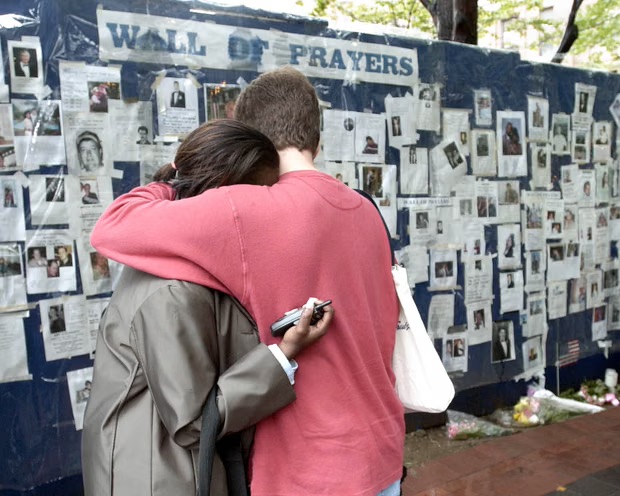
In the weeks after the attacks, New York was covered with photographs of missing people. Families, friends and strangers posted notices asking for information about husbands, wives, parents, children and co-workers.
Many of those posters began as desperate attempts to find someone alive. As the days passed, they increasingly became memorials.
Photographer Phil Buehler documented more than 500 of these posters, and 144 are being displayed in Brooklyn in 2026 for the 25th anniversary. The images capture something that official monuments cannot fully express: how ordinary families experienced the disaster one missing face at a time.
The World Trade Center Memorial later created a permanent place for those individual stories. The names of the victims are inscribed around the two reflecting pools where the towers once stood, turning an enormous national tragedy back into something personal.
That may be one reason the memorial remains so powerful. It does not ask visitors to remember an abstract number. It asks them to remember people.
And Now A Generation Is Growing Up Without The Memory
Perhaps the strangest development of the 25th anniversary is that millions of Americans are now too young to remember the attacks at all.
The 9/11 Memorial & Museum estimates that about 100 million Americans are either too young to remember September 11 or were born after it. For them, the towers are photographs, the emergency calls are recordings and the stories of survivors are something learned from parents, teachers and documentaries rather than remembered personally. That creates a new challenge for memory.
Older Americans remember where they were. Younger Americans have to learn why the day mattered. The Memorial & Museum has responded by expanding educational programs aimed specifically at this generation. Its 2026 anniversary programming includes new material designed to teach people who have no lived memory of the attacks about the loss, the response and the decades that followed.
That transition is inevitable. Every historic event eventually moves from living memory into history. But 9/11 is still in an unusual middle ground. The people who were children that morning are now raising children of their own.
What Does “Never Forget” Mean 25 Years Later?
The phrase “Never Forget” has appeared on memorials, bumper stickers, uniforms and public ceremonies for a quarter century. But remembering can mean more than recalling the images of airplanes, smoke and collapsing buildings.
It can mean remembering the firefighters who ran upward while everyone else ran down. It can mean remembering the families who waited for phone calls that never came. It can mean remembering survivors who still carry physical and emotional consequences, and the volunteers and recovery workers who spent months at Ground Zero.
It can also mean remembering what came afterward: the wars, the expanded security state, the changes in American public life and the mistakes that remain subjects of debate.
The 25th anniversary therefore arrives at a turning point. The generation with direct memories is aging, while a new generation is learning about September 11 through history rather than experience.
The challenge is not simply to preserve the memory of one terrible morning. It is to understand everything that morning set in motion.
Twenty-five years after September 11, 2001, the attacks remain more than a memory of nearly 3,000 people killed in one morning. They changed how Americans traveled, thought about national security, viewed war and understood the lasting effects of trauma and toxic exposure. The country experienced extraordinary unity after the attacks, followed by years of debate over surveillance, discrimination, military intervention and civil liberties. Millions who were too young to remember 9/11 are now learning its history from those who lived it. The challenge of “Never Forget” is becoming the challenge of understanding.
P.S. This article draws on The Guardian’s 25th-anniversary reporting and reader reflections, alongside the 9/11 Memorial & Museum and CDC’s World Trade Center Health Program for historical and health-related context. The sources document both the immediate human response and the consequences that continued for decades afterward, including the growing effort to teach 9/11 to Americans who have no personal memory of the attacks. Sources: https://www.theguardian.com/us-news/2026/sep/10/september-11-attacks-remembering-quotes