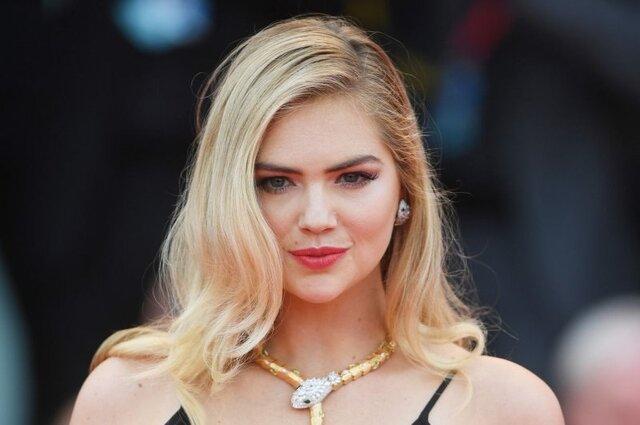
Kate Upton became famous as a model, but her Hollywood story began with a decision that many people never saw coming: she took acting seriously before the film industry had decided to take her seriously. After becoming a Sports Illustrated Swimsuit sensation, Upton spent two years taking acting classes before landing a substantial role in The Other Woman. Working opposite Cameron Diaz and Leslie Mann, she discovered that comedy gave her something modeling could not—the chance to reveal personality, timing, and a different kind of screen presence.
From Equestrian Competition to the Modeling World
Kate Upton’s early life did not begin with an obvious path toward Hollywood. Born in St. Joseph, Michigan, she grew up as a competitive equestrian and achieved national-level success in American Paint Horse Association competitions before entering the modeling business. That athletic background would later fit naturally with the physical confidence that became part of her public image.
Her modeling career began moving quickly in 2008, when she attended a casting call for Elite Model Management in Miami and was signed. She later moved to New York and joined IMG Models, beginning a professional journey that included campaigns for brands such as Garage, Dooney & Bourke, and Guess.
This period was important because Upton was not initially positioned as a Hollywood personality. She was building credibility as a commercial and editorial model, learning how to work with photographers, brands, stylists, and major media outlets. The modeling industry gave her visibility, but the next stage of her career would come from understanding how to turn that visibility into a recognizable personality.
Sports Illustrated Changed Everything
The major acceleration came in 2011, when Upton appeared in the Sports Illustrated Swimsuit Issue and was named the magazine’s Rookie of the Year. The achievement gave her a platform far beyond conventional fashion modeling and helped establish her as one of the most recognizable new faces in American popular culture. Sports Illustrated itself later described her as the 2011 Swimsuit Rookie of the Year and a repeat cover model.
Her popularity also benefited from the way she behaved outside traditional photo shoots. Videos of Upton dancing, joking, and appearing relaxed in front of cameras helped audiences see a personality rather than simply a model in photographs. GQ’s 2011 profile, for example, focused as much on her humor and personality as on her appearance, reflecting why she stood out from many conventional fashion personalities of the period.
By 2012, Upton had gone from rookie to Sports Illustrated cover star. She returned for another cover in 2013, and the magazine’s later retrospective records her 2017 cover as well, confirming that the relationship became one of the defining partnerships of her modeling career.
The significance of Sports Illustrated was larger than one magazine cover. It transformed Upton into a mainstream celebrity whose name could generate attention across television, advertising, entertainment, and eventually film.

The Viral Personality Behind the Model
One reason Upton’s transition worked differently from the traditional model-to-actress story was her willingness to be playful with her own image.
The internet was becoming increasingly influential in the early 2010s, and Upton was particularly well suited to that environment. Her personality came through in viral videos and appearances, allowing audiences to encounter her as funny, energetic, and self-aware rather than as a distant fashion figure.
That distinction mattered in Hollywood. A model can be visually striking in a still photograph, but acting requires timing, reactions, dialogue, physical movement, and the ability to sustain a character across an entire scene.
Upton’s growing public profile created an opportunity, but it did not automatically prove that she could act. That was a challenge she appears to have understood herself.

She Did Something Many People Never Knew About
Before taking on her first major film role, Upton did not simply assume that her existing fame would be enough.
In a 2014 interview with British Vogue, she revealed that she had taken acting classes for two years before accepting the role in The Other Woman. Her explanation was revealing: she wanted to put real effort into the new profession rather than simply arrive on set because she was already famous.
That preparation became particularly important because her first screen appearances had been relatively small. Upton made a cameo in Tower Heist in 2011 and then appeared as Sister Bernice in The Three Stooges in 2012. Those credits established her interest in acting, but neither represented the kind of substantial role that could truly answer the question of whether she could make the transition.
The Other Woman was different. It gave Upton a recurring presence within a mainstream studio comedy and placed her alongside established performers Cameron Diaz and Leslie Mann.
When a simple beach stakeout goes completely out of control! Watch the full video to catch Cameron Diaz and Leslie Mann’s hilarious reaction as Kate Upton makes her iconic entrance. Hit play now to see how this chaotic plan unfolds—you definitely don’t want to miss the ending!!
The Other Woman Became the Real Test
Released in 2014, The Other Woman followed three women who discover that they are all involved with the same man and eventually form an alliance against him. Diaz played lawyer Carly, Mann played the man’s wife, and Upton played Amber, another woman involved with him.
The role was carefully suited to Upton’s existing public image, but it also required her to demonstrate something different. Amber is bubbly and seemingly carefree, yet the character becomes part of the film’s central emotional and comedic dynamic rather than remaining a decorative supporting figure.
Upton’s performance received an important endorsement from Cameron Diaz, who told British Vogue that she was impressed by Upton’s improvisational instincts and ability to respond to a scene rather than simply recite lines. That observation is significant because improvisation is very different from posing for a camera; it requires listening, reacting, and understanding how a character fits into the rhythm of a scene.
Upton also spoke positively about working with Diaz and Mann. In an interview around the film’s release, she described the two experienced actresses as supportive colleagues and contrasted that experience with the relative lack of guidance she had experienced when she first entered modeling.
The film ultimately became a substantial commercial success, earning about $196.7 million worldwide against a reported $40 million production budget. That result gave Upton something more valuable than another modeling campaign: proof that her name could function within a major theatrical comedy.

Why the Beach Scene Was So Memorable
One of the most recognizable images from The Other Woman was Upton’s beach sequence. The scene played directly into the audience’s expectations of a famous swimsuit model, but within the context of the comedy, the image was also deliberately self-aware.
That distinction is important. Upton had already spent years being photographed in swimwear, so the scene did not introduce a new visual identity. Instead, it allowed her to bring the persona audiences already knew into a scripted comedy and interact with the other characters rather than existing only as an image.
The film therefore worked on two levels for her career. It capitalized on the reason she was already famous while simultaneously giving her an opportunity to demonstrate comedic timing and personality. In Hollywood, that can be a more practical route for a newcomer than attempting to immediately reinvent herself as a dramatic actor.
The result was not a complete transformation overnight, but it did change how Upton could be marketed. She was no longer simply a model who happened to appear in films; she had become a recognizable entertainment personality with genuine acting credits.

Hollywood Was Only One Part of the Reinvention
Upton did not turn into a conventional full-time movie star after The Other Woman, and that is part of what makes her career interesting.
She continued working in modeling while taking additional entertainment opportunities. In 2017, she starred opposite Alexandra Daddario in William H. Macy’s comedy The Layover, playing Meg, one of two friends competing for the attention of the same man during a disrupted trip.
Her film career remained relatively selective rather than becoming a constant stream of major theatrical releases. That limited filmography arguably makes the original transition more interesting: Upton did not need to abandon modeling completely in order to prove that she could move into another part of entertainment.
She also continued to expand her television and media presence. In 2024, Hulu launched Dress My Tour, a competition series hosted by Upton in which 11 aspiring fashion designers competed to create stagewear for major music performers, with a $100,000 prize. The role placed her in a position that combined her fashion background with hosting and television skills.
That later career move suggests that her strongest asset was never acting alone. It was the ability to move between fashion, entertainment, television, and personal branding.

Discover the hilarious revenge plot in The Other Woman! Watch as three women unite to take down the man who betrayed them. It’s an empowering, witty, and heartwarming celebration of female friendship you don’t want to miss. Click now to see how they pull off the perfect plan! Enjoy the chaos!
The Career Came Full Circle
Perhaps the clearest indication of Upton’s lasting cultural relevance came in 2024, when she returned to the Sports Illustrated Swimsuit franchise for its 60th anniversary issue.
The return was more than nostalgia. Upton appeared on an individual cover and also participated in a group celebration of the brand’s history alongside other notable former cover models. Reuters described it as her fourth individual Sports Illustrated Swimsuit cover, while the magazine itself included her among its brand legends for the anniversary edition.
That moment connected two versions of her career: the young model who became Rookie of the Year in 2011 and the established public figure who had spent more than a decade moving through modeling, film, television, and fashion.
It also demonstrated something important about longevity. Upton’s public identity was never restricted to one photograph, one movie, or one period of internet fame. She repeatedly returned to the industries where she had first become successful while adding new roles to her professional profile.

What Kate Upton’s Hollywood Story Really Reveals
The most interesting part of Kate Upton’s Hollywood breakthrough is not that a famous model received a movie role. That happens frequently.
What distinguishes her story is the preparation behind the transition. She had already built enormous visibility before entering film, but she still spent two years studying acting, took smaller screen roles before a substantial part, and then stepped into a comedy alongside established actresses.
Her success with The Other Woman also demonstrates the importance of choosing a role that fits an existing public persona while allowing room for growth. Amber was believable for Upton because audiences already associated her with a playful, glamorous personality, but the film gave her the opportunity to demonstrate timing, dialogue, improvisation, and chemistry with other performers.
That formula did not turn Upton into the next generation’s dominant film actress, and there is no reason to rewrite her career as something it was not. Instead, it gave her something arguably more useful: the freedom to become a multifaceted entertainment personality.

Kate Upton’s journey from modeling sensation to Hollywood performer was never simply about being discovered by a film studio. Her rise began with competitive ambition, accelerated through Sports Illustrated, and gained another dimension when she deliberately prepared for acting rather than relying entirely on fame. The Other Woman gave her a major opportunity to work alongside established stars and prove she could contribute more than a famous face. Her later work in film, television, fashion, and hosting shows that the real achievement was not becoming a movie star overnight—it was learning how to turn one successful career into several.