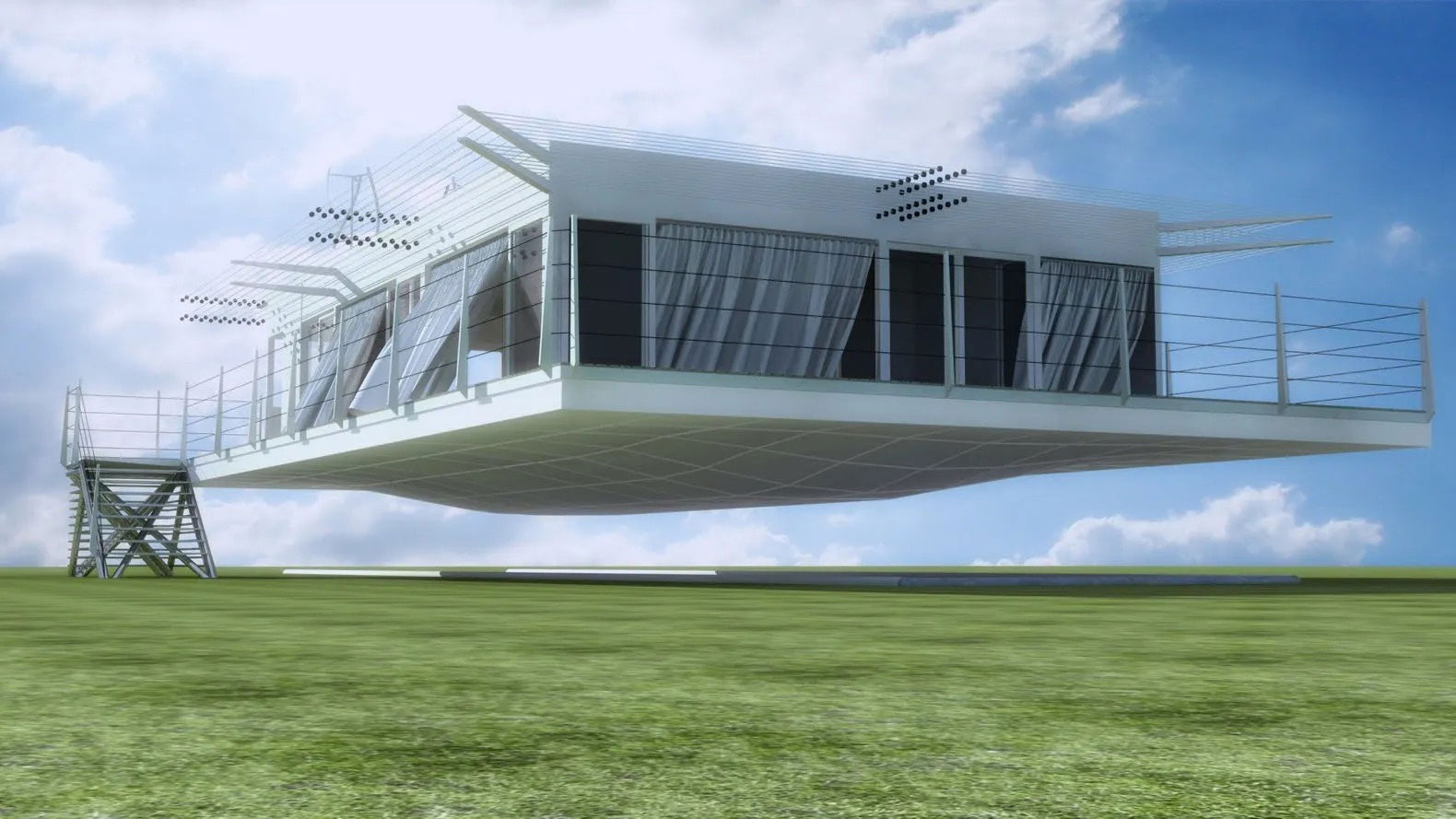
Japan is no stranger to earthquakes, so protecting homes from violent ground movement has become a major engineering challenge. But one Japanese technology takes an unusual approach: instead of forcing a house to remain rigidly connected to the ground, it temporarily lifts the entire structure above its foundation. Developed by Air Danshin, the system uses seismic sensors and compressed air to raise a home by about 3 centimeters when an earthquake is detected. The result is a house that appears to “float” just when the ground beneath it begins to move.
Japan Built a House That Can “Float” During an Earthquake
The idea sounds almost like science fiction.
Imagine sitting inside your home when an earthquake begins. Instead of simply shaking with the ground, the house detects the tremors and responds automatically. Within a fraction of a second, a system beneath the structure begins operating, using compressed air to lift the building slightly away from its foundation.
That is the basic concept behind Air Danshin’s floating-house technology, which was introduced in 2005.
The term “floating house” can be misleading, however.
The house does not rise several feet into the air, and it does not hover freely above the ground. The system lifts the structure by only about 3 centimeters.
That tiny separation is the key.
Under normal conditions, the house remains firmly supported by its foundation. But when an earthquake occurs, the system attempts to reduce the direct transfer of seismic movement from the ground into the building.
Rather than simply making the structure stronger and forcing it to absorb the shaking, the technology takes a different approach.
It temporarily separates the house from the source of the movement.

Sensors Detect the Earthquake Before the House Starts Moving
The system depends on speed.
A house cannot wait for someone inside to recognize an earthquake, find a control panel and activate a protection system. By then, the strongest shaking may already be underway.
Air Danshin’s system therefore uses sensitive seismic sensors to detect ground motion automatically. Once an earthquake is detected, the sensors trigger air compressors within fractions of a second.
Those compressors inflate airbags positioned beneath the structure.
As the airbags fill with compressed air, they lift the house approximately 3 centimeters above its foundation.
The entire process is automatic.
This is what makes the concept particularly interesting. The house itself effectively becomes part of the earthquake-response system.
There is no need for the occupants to activate it manually.
The sensors detect the movement.
The compressors respond.
The airbags inflate.
And the structure is lifted away from its foundation.
The objective is not to stop the earthquake.
That would obviously be impossible.
Instead, the technology attempts to reduce how much of the earthquake’s movement reaches the building.
Watch the video to see how Japan’s innovative “floating house” technology works and how a home can automatically rise above its foundation when an earthquake strikes.
The House Rises Only a Few Centimeters—But That Can Make a Difference
Three centimeters may not sound like much.
For an ordinary building, that distance would barely be noticeable.
During an earthquake, however, even a small separation can be important because the objective is to reduce direct contact between the moving ground and the structure.
When a conventional building is firmly connected to the ground, seismic movement is transmitted through the foundation and into the structure. Engineers can reduce the resulting damage through structural design, flexible materials and seismic isolation systems.
The floating-house concept takes that principle in another direction.
The house temporarily moves away from its foundation.
According to The Mind Circle, the system is designed to isolate the building from seismic waves by creating this small gap, thereby reducing structural damage.
And the system does not leave the house floating permanently.
Once the earthquake has passed, the airbags gradually deflate. The house then settles back onto its foundation.
In other words, the home essentially has two states.
During normal conditions, it behaves like an ordinary house.
During an earthquake, it temporarily becomes a partially separated structure.
After the danger passes, it returns to its original position.
That simplicity is one of the most interesting aspects of the design.
The Technology Shows How Japan Approaches Earthquake Safety
Japan’s interest in earthquake-resistant architecture comes from necessity.
The country experiences frequent seismic activity, meaning buildings have to be designed with the possibility of major earthquakes in mind.
But there is no single solution that can eliminate earthquake damage.
Different technologies attack the problem from different directions.
Some buildings use seismic isolation bearings to separate the main structure from ground movement. Others rely on flexible structural systems and specialized materials that allow buildings to move without collapsing.
Air Danshin’s system adds another approach to that collection of technologies.
Instead of simply making a building stronger, it temporarily reduces the building’s connection to the shaking ground.
That distinction is important.
A stronger building still has to absorb some of the energy produced by an earthquake.
A floating system attempts to reduce the amount of that energy transmitted into the building in the first place.
The Mind Circle reports that homes equipped with the technology experienced minimal to no damage during major seismic events, including the devastating 2011 Tōhoku earthquake.
That makes the concept particularly compelling in a country where earthquake preparedness is part of everyday life.
Could “Floating Houses” Become a Bigger Part of Earthquake Protection?
The technology is impressive, but it comes with a significant financial consideration.
According to The Mind Circle, retrofitting an existing house with the system costs approximately $37,000.
That is a substantial upfront investment for a homeowner.
The calculation, however, is not simply about the cost of installing the system.
A major earthquake can cause enormous damage to a building, destroy belongings and force residents to undertake expensive repairs or reconstruction.
From that perspective, spending money on prevention can potentially make sense in areas where severe seismic activity is a realistic threat.
The technology also illustrates an important principle in engineering.
Sometimes the best way to protect something from a powerful force is not to fight that force directly.
Instead, engineers can design systems that allow the object to respond to the force.
That is essentially what the floating-house concept attempts to do.
The ground moves.
The sensors detect it.
The house rises.
The airbags create separation.
And when the shaking ends, the house returns to its foundation.
It is an unusually simple sequence for a problem as complicated as an earthquake.
Japan’s floating houses therefore represent more than an unusual architectural curiosity. They demonstrate how engineers can rethink the relationship between a building and the ground beneath it.
Rather than demanding that a house remain completely rigid while the Earth moves violently underneath, the system allows the building to temporarily disengage from that movement.
That small change in philosophy could be just as important as the machinery itself.Japan’s “floating houses” offer a fascinating alternative approach to earthquake protection. Instead of relying solely on stronger construction, Air Danshin’s system detects seismic activity and uses compressed air to lift a home about 3 centimeters above its foundation. The airbags then deflate after the earthquake, allowing the structure to settle back into place. The technology is not inexpensive, with retrofitting reported at around $37,000, but its underlying idea is remarkable: sometimes the best way to protect a building from nature is not to resist the force completely, but to temporarily separate the building from it.