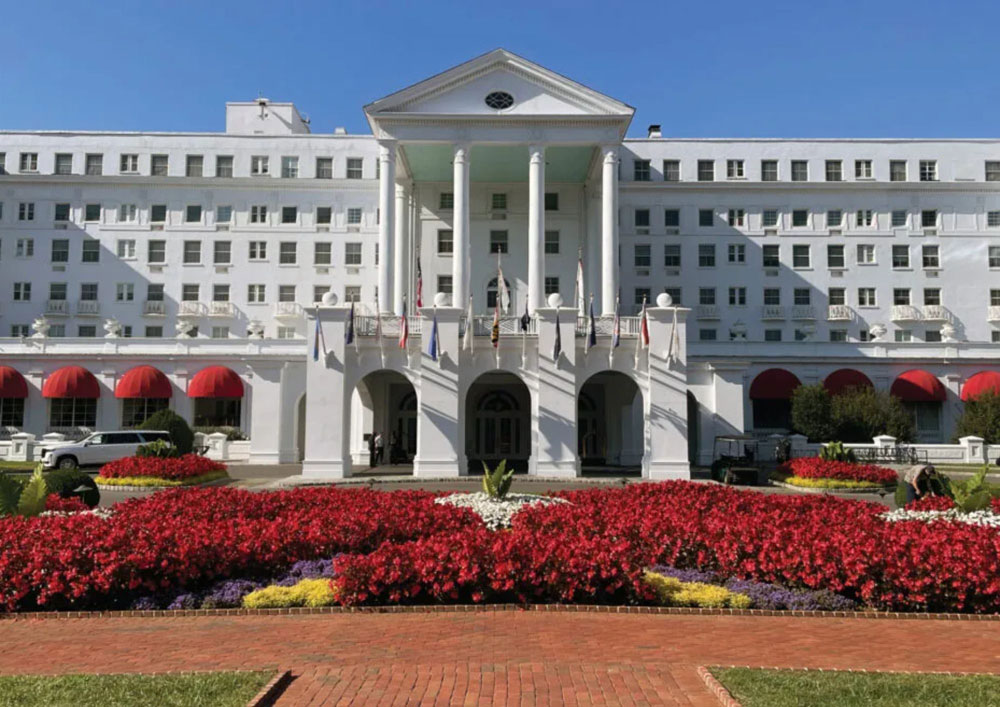
The Greenbrier was once a glamorous resort where presidents, industrialists and wealthy families came to relax among its sprawling grounds in White Sulphur Springs, West Virginia. But after the United States entered World War II, the resort was given two extraordinary wartime roles. First, it became a holding center for diplomats from enemy Axis countries. Then, after they left, the U.S. Army transformed the luxury hotel into Ashford General Hospital, a 2,000-bed medical facility that treated more than 24,000 American soldiers.
The Greenbrier Was Built for America’s Elite
Long before the war, The Greenbrier had established itself as one of America’s most prestigious resorts. Its history began with the natural mineral springs at White Sulphur Springs, where the first recorded guest came to “take the waters” in 1778. The resort eventually grew into a vast estate covering roughly 7,000 acres.
The main hotel building was constructed in 1858 and expanded over the years. By the early 20th century, The Greenbrier had become a destination for wealthy and influential Americans. Five U.S. presidents had stayed there before the Civil War, while later guests included John F. Kennedy and Jackie Kennedy, Prince Rainier and Princess Grace of Monaco, and members of prominent families such as the Vanderbilts, Fords and du Ponts.
The property was designed for leisure rather than conflict. Its grounds included cottages, golf courses, tennis facilities, hiking trails and bridle paths. The resort’s enormous main building offered the kind of elegant surroundings associated with America’s upper class.
That peaceful image would soon be turned upside down.
The Greenbrier was about to become part of the American war effort.

Pearl Harbor Suddenly Changed the Hotel’s Purpose
Everything changed after Japan attacked Pearl Harbor on December 7, 1941.
At the time, the United States still had functioning Japanese, German and Italian diplomatic missions in Washington, D.C. Once those nations became enemies of the United States, the government needed to move their diplomats and families away from the capital for security reasons. President Franklin D. Roosevelt demanded that the hostile diplomats leave Washington within 48 hours.
The government needed somewhere suitable to hold them while negotiations took place.
The Greenbrier quickly emerged as an ideal location.
Its location was important. The resort was connected to the railroad, making it possible to travel there directly from Washington. At the same time, it was isolated enough to make security easier. Perhaps equally important, it was a first-class resort.
That last detail mattered because American diplomats were being held overseas as well. The United States wanted its treatment of enemy diplomats to encourage reciprocal treatment of American officials. Sending foreign diplomats to a comfortable resort was therefore partly a practical security decision and partly a diplomatic calculation.
On December 17, 1941, the State Department approached Greenbrier management about leasing the resort.
Within two days, the hotel closed to the public.
The transformation had begun.
Want to see how this luxurious resort was transformed during World War II? Watch the video to explore The Greenbrier’s remarkable wartime history, from an internment center for enemy diplomats to a military hospital for thousands of wounded American soldiers.
The Luxury Resort Became an Internment Center
The first group arrived by a secretly scheduled Pullman train from Washington. It consisted of 159 German and Hungarian diplomats and their families. Eventually, 1,697 people from five countries would be interned at The Greenbrier.
The original plan was relatively short-term. Officials expected the diplomats to remain at the resort for up to eight weeks while negotiations for prisoner exchanges took place.
But life at The Greenbrier was unlike what most people would imagine when they hear the word “internment.”
The diplomats were monitored by about 50 U.S. Border Control guards, but the resort’s regular staff continued working. The hotel’s management instructed employees to provide the internees with the same high standard of service that ordinary guests would have received.
The diplomats could move around much of the property. They could use the indoor swimming pool, play ping-pong in the lobby and visit shops in the lower levels. The golf course and riding trails were restricted because of security concerns.
In other words, the resort retained much of its original character.
There was even an unusual amount of shopping.
The German internees purchased so many goods during their stay that they reportedly required two additional railroad cars to transport their belongings when they eventually left.
But the atmosphere was not always peaceful.
The Germans and Italians had serious tensions, and the situation became increasingly difficult for staff. In April 1942, the Italian diplomats were moved to the Grove Park Inn in Asheville, North Carolina. Japanese diplomats who had previously been held at the Homestead in Hot Springs, Virginia, were then transferred to The Greenbrier.
The change did not necessarily make things easier.
German-Japanese tensions created new conflicts, illustrating the complicated political relationships among the Axis powers themselves.
The resort had become an unusual wartime microcosm: diplomats from enemy nations were living under American supervision inside one of the country’s most luxurious hotels.

The Enemy Diplomats Eventually Left
The unusual arrangement lasted for approximately seven months.
Behind the scenes, American officials negotiated with the governments of the countries involved. Neutral nations, including Mozambique, Portugal and Sweden, played roles in the eventual prisoner exchanges.
On July 9, 1942, the last diplomat left The Greenbrier.
The resort could finally reopen to the public.
But its return to civilian life would be extremely brief.
Even before the last internees departed, the U.S. Army had begun discussing another possible use for the property.
The government needed hospitals.
The United States was mobilizing millions of people for war, and military planners understood that existing medical facilities would not be sufficient to handle the number of wounded soldiers expected to return from overseas. Large hotels offered an attractive solution because they already had hundreds of rooms, kitchens, dining areas and other facilities that could potentially be converted into hospitals.
The Greenbrier was an almost perfect candidate.
The resort’s peaceful days were over once again.
The Resort Was Transformed Into a Military Hospital
The U.S. Army purchased The Greenbrier and its surrounding property for $3.3 million in 1942. The resort closed again on August 31, just weeks after briefly reopening, and a massive conversion project began. About $2.2 million was spent transforming the property into a military hospital.
The challenge was enormous.
The Army needed to create a facility capable of treating thousands of wounded service members while preserving enough of the building’s structure that it could potentially become a hotel again after the war.
Rather than completely destroying the interior, planners found ways to use the existing architecture.
The hotel’s roughly 500 guest rooms were converted into patient rooms capable of accommodating about 2,000 beds. Some walls were removed to create surgical areas, while other portions of the elegant building remained remarkably recognizable. An elevator shaft was added near the ballroom to accommodate wheelchairs and hospital gurneys.
The transformation was extraordinary.
The same rooms that had once accommodated wealthy vacationers were now filled with wounded soldiers.
The elegant dining facilities also received a new purpose. Soldiers were sometimes served meals in surroundings that looked more like a resort than a conventional Army hospital.
The hospital was formally named Ashford General Hospital, after Colonel Bailey K. Ashford, an Army physician known for his medical research and work on tropical medicine.
The first patients arrived on November 14, 1942.
The resort had officially become a hospital.
Thousands of Soldiers Came to Recover
Ashford General Hospital treated service members returning from battlefields around the world.
Patients arrived from Europe, North Africa, the Aleutian Islands, the Philippines and other areas of the Pacific. The hospital developed capabilities in areas including vascular surgery, neurosurgery and rehabilitation.
Between 1942 and 1946, 24,148 soldiers were admitted to Ashford General, and 11,346 operations were performed.
For many soldiers, arriving at The Greenbrier must have been a striking experience.
They were coming from a world of battlefields, military camps and damaged cities, only to find themselves in a building famous for luxury and elegance.
The surroundings were still recognizable as those of a resort.
The carpets remained.
The decorative interiors remained in many areas.
The grounds remained.
And soldiers could use parts of the resort’s recreational facilities while recovering. The hospital even gained the nickname “Shangri-La for Wounded Soldiers” because of its unusually comfortable surroundings.
One of the most famous visitors was General Dwight D. Eisenhower. He visited recovering soldiers at Ashford General and was himself admitted as a patient in late 1945, reportedly for pneumonia.
The Greenbrier had once welcomed presidents and wealthy vacationers.
Now it was helping American soldiers recover from a global war.

The Army Even Built a POW Camp Nearby
Running a hospital of this size during wartime created another problem: labor.
The United States was experiencing a major workforce shortage because so many Americans were serving in the armed forces or working in industries supporting the war effort.
The Army found an unusual solution.
A prisoner-of-war camp was established nearby at a former Civilian Conservation Corps camp. The facility eventually housed around 1,000 German and Italian prisoners of war in 72 Quonset huts.
The POWs performed a variety of support tasks.
They helped prepare food, maintain the grounds, handle laundry and perform other jobs necessary to keep such a large facility operating.
This created another remarkable layer to The Greenbrier’s wartime story.
Inside the former luxury resort were wounded American soldiers.
Nearby were prisoners of war captured overseas.
And surrounding them was a medical facility that had only a short time earlier been a resort and an internment center for enemy diplomats.
The property had become a small wartime community with several completely different populations connected by the same enormous complex.
The Greenbrier Eventually Returned to Civilian Life
The war finally came to an end, and the military’s need for Ashford General Hospital declined.
The last patients left in 1946, and the POWs also departed. With the wartime operation winding down, the Army sold the property back to the Chesapeake & Ohio Railway, its former owner.
The Greenbrier could once again become a resort.
But it was not simply a matter of reopening the doors and returning to normal.
Years of wartime use had dramatically changed the property. The resort needed restoration and redesign before it could return to its former role.
Eventually, the Greenbrier underwent a major postwar transformation, including a celebrated redesign by interior decorator Dorothy Draper. The resort reopened to guests in 1948 and resumed its place among America’s famous luxury destinations.
Yet the building’s military history did not end there.
A decade later, during the Cold War, the federal government became interested in the property again. The location was selected for an underground emergency relocation facility intended to house members of Congress in the event of a nuclear attack. The project, known as Project Greek Island, remained operational for decades.
That later chapter makes The Greenbrier’s history even more remarkable.
The resort did not simply serve the wealthy.
It became part of America’s preparations for some of the most dangerous moments of the 20th century.
The Greenbrier’s wartime history is almost impossible to guess from its elegant appearance today. During World War II, the famous resort became an internment center for enemy diplomats before being transformed into Ashford General Hospital, where more than 24,000 American soldiers were treated. Its story is a remarkable reminder that even the most peaceful places can take on unexpected roles when history demands it.