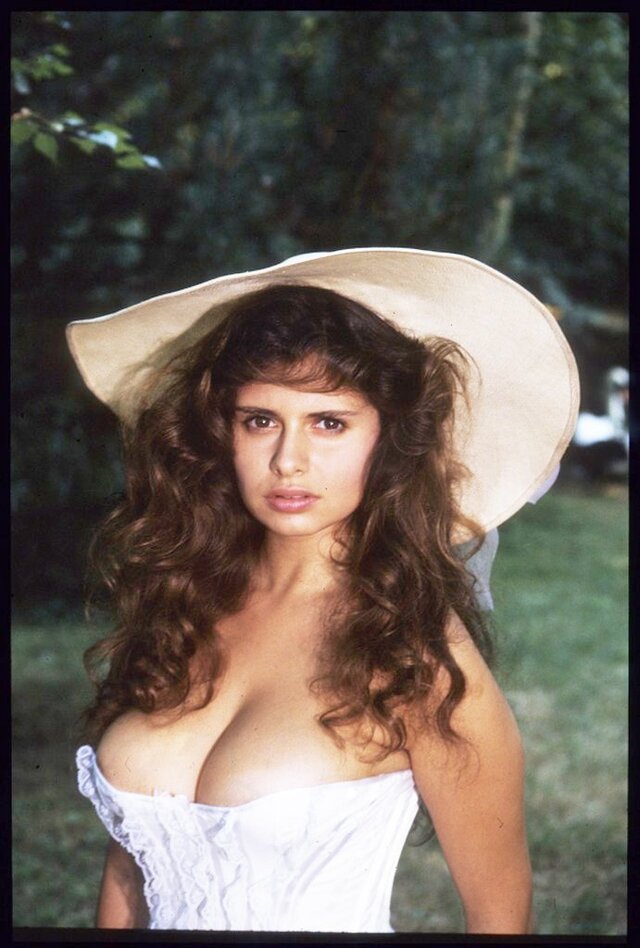
In the early 1990s, Debora Caprioglio became one of the most recognizable young actresses in Italian cinema. With her dark hair, expressive features and unmistakable screen presence, she quickly became associated with the glamorous style of the era, particularly after her leading role in Tinto Brass’s 1991 film Paprika. But her career did not remain defined by the image that first made her famous. Over the following decades, Caprioglio moved through television and, increasingly, theater, building a second chapter that placed performance itself at the center of her career.
She Came From The Venice Area And Entered Show Business Young
Debora Caprioglio was born on May 3, 1968, in Mestre, on the mainland side of the Venice metropolitan area. Her professional path began unusually early, and she first attracted attention through a beauty and talent competition before entering the entertainment industry as a young performer.
The image that emerged around her fit the aesthetics of late-1980s and early-1990s Italian cinema: polished, glamorous and immediately recognizable on screen. But recognition came before she had the chance to define exactly what kind of actress she wanted to become.
Her early career included work with Klaus Kinski, Lamberto Bava and other filmmakers. According to Caprioglio herself, she made her film debut with Kinski before working with Tinto Brass, an encounter that would become one of the defining moments of her early career.
Check out this incredible clip featuring Debora Caprioglio! You won’t want to miss a single second of this. Watch now, hit the like button, and let us know your favorite part in the comments below!
Paprika Made Her One Of The Faces Of 1990s Italian Cinema
The turning point came with Paprika, released in 1991 and directed by Tinto Brass. Caprioglio played the title character, a young woman who enters the world of a brothel in postwar Italy. The film became closely associated with the visual style of Brass, and Caprioglio’s performance made her widely known beyond Italy.
Her beauty was an important part of the film’s publicity and her public image, but the role also placed her at the center of a very particular moment in European cinema. She quickly became recognizable not simply as another young actress, but as a screen presence strongly associated with the sensual, visually elaborate style of Italian film of the period.
The attention was enormous, however, and that kind of recognition can become limiting. Caprioglio later found herself needing to demonstrate that her career could extend beyond the image established during those early years. That transition would become the most important part of her professional story.

She Refused To Remain Defined By One Image
Caprioglio continued working in cinema after Paprika, collaborating with directors including Francesca Archibugi and Ugo Chiti and appearing in television productions as well. In a 2019 interview, she described her career as a long progression through different forms of acting rather than a single uninterrupted film path.
The mid-1990s were an important turning point. As Italian cinema changed and opportunities for actresses shifted, Caprioglio increasingly moved toward television and live performance. Another interview records her explaining that she turned toward television and theater partly because cinema was going through a difficult period and roles had become more limited.
That change mattered because it altered the way audiences encountered her.
Film had introduced Caprioglio through carefully constructed images, close-ups and the distinctive visual language of the director. Theater demanded something different. There were no retakes, no editing and no camera deciding where the audience should look. She had to hold the room herself.

You won’t believe what happens next! Check out the full video now.
Theater Became Her Second Career
Caprioglio’s move toward theater eventually became one of the defining features of her career.
She has said that she began performing regularly on stage in the 1990s, including a 1997 production associated with Mario Monicelli, and by 2018 she counted roughly 50 theatrical productions to her credit. In the same interview, she described theater as the work that had become essential to her life and emphasized the direct relationship with an audience.
Her stage career also demonstrated a different range from the image associated with her early films. She appeared in comedies and dramatic productions, often working with established Italian performers and directors.
One notable long-running partnership was with Corrado Tedeschi in Notte di follia, a theatrical adaptation of Josiane Balasko’s Nuit d’ivresse. The production toured Italian theaters, pairing Caprioglio and Tedeschi in a comedy built around two strangers whose increasingly chaotic night gradually reveals their personal vulnerabilities.
The stage gave Caprioglio something film had not always offered: continuity. A role could be developed over an entire run, and the reaction of the audience became part of the performance itself.

Her Screen Image Became Part Of A Longer Artistic Identity
This is what makes Caprioglio’s career more interesting than a simple story about a beautiful actress from the 1990s.
Her appearance helped make her instantly recognizable, but it did not ultimately define the limits of her career. Over time, the glamorous young image became only one chapter in a much longer professional story.
By the 2000s and 2010s, her work extended across television and theater, while her connection to audiences increasingly came through live performance and interviews as well as screen appearances. Rai’s 2022 program Generazione Z, for example, revisited her early career and her move into theater, showing how closely those two periods of her life remained connected.
Her later theatrical choices also show a willingness to move into roles built around character rather than simply appearance. In 2025, she performed Non fui gentile, fui Gentileschi, a stage piece centered on the life and work of painter Artemisia Gentileschi. The production placed Caprioglio in a historical and dramatic role far removed from the screen image associated with her early career.

The Beauty Of The 1990s Became A Veteran Of The Stage
Caprioglio’s lasting appeal comes partly from the contrast between where her career began and where it developed.
In the early 1990s, she represented a particular kind of Italian screen glamour: youthful, elegant and immediately memorable. Decades later, she had accumulated a much broader body of work, with theater becoming one of the most important parts of her professional identity.
Her story therefore is not simply about maintaining a familiar appearance over time. It is about what happens when an actress who becomes famous for her image decides that her career cannot end with that image.
The result is a longer and more interesting trajectory—from the Venice area to Italian cinema, from Paprika to television, and from screen celebrity to a mature stage career built around live performance.
For audiences who remember Italian cinema of the early 1990s, Debora Caprioglio remains one of the faces that defined that era. For anyone looking at her career as a whole, however, the more interesting story began after that fame arrived: she kept moving.

Debora Caprioglio became widely recognized as one of Italian cinema’s memorable faces in the early 1990s, but her career did not stop with the image that made her famous. From Paprika and early television work to decades of theater, she gradually built a broader identity as a performer. Her continued presence on stage shows how a career can evolve beyond its most recognizable chapter. What began with the glamour of 1990s Italian cinema eventually became a much longer artistic journey shaped by television, live performance and the direct connection between actress and audience.