In the summer of 1760, Britain was closing in on the last major French stronghold in North America. Between the British army and Montreal stood a tiny island in the Richelieu River, defended by roughly 1,500 French regulars and militia. Île aux Noix was small, heavily fortified and surrounded by difficult terrain, but its position controlled the river route south of Montreal. What followed was a hard-fought siege involving artillery, warships, swamps and Rangers—and when the island finally fell, the road to Montreal was effectively open.
The Last Road to Montreal
By 1760, New France was in serious trouble. British victories in 1759 had cut communications and left the French colony short of men, supplies and food. Quebec had fallen the previous year, and although François Gaston de Lévis managed to defeat a British force at Sainte-Foy in April 1760, he could not retake Quebec before British warships arrived.
That left Montreal as the last major French stronghold. Britain planned a three-pronged campaign: James Murray would advance from Quebec, Jeffery Amherst would approach from the west, and Brig. Gen. William Haviland would come from the south after capturing the French defenses along the Richelieu River. The three armies were intended to converge on Montreal almost simultaneously.
Haviland commanded about 3,400 Anglo-American troops, including colonial soldiers and Rangers under Major Robert Rogers. He was initially skeptical of those colonial troops, whom he considered inferior to regular British soldiers. Yet they were about to play an important role in a campaign where difficult terrain and close fighting mattered as much as formal battlefield formations.
Ever wondered how Canada evolved from Viking settlements to the modern nation it is today? Dive into our latest video for a fascinating 10-minute journey through Canadian history! Discover the key events, conflicts, and milestones that shaped this vast country. Click the link to watch and learn more now!
The Tiny Island Blocking the River
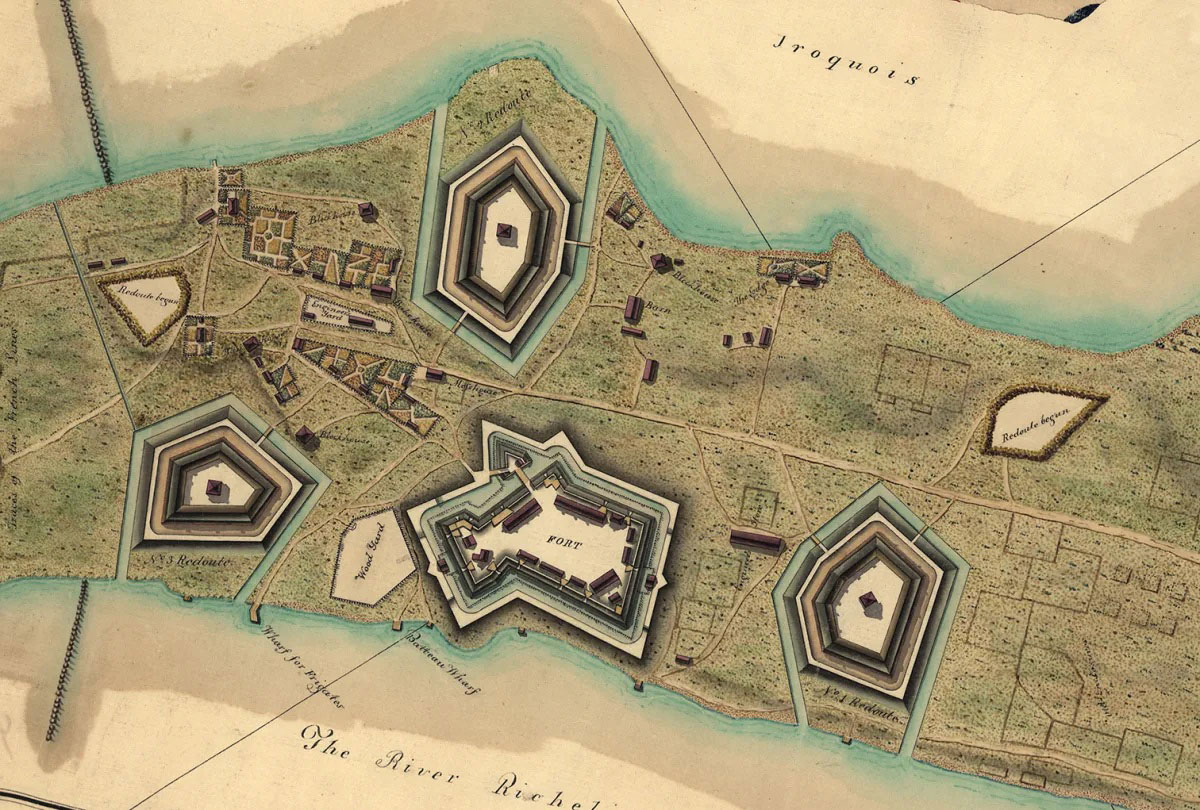
Île aux Noix was only a little more than three-quarters of a mile long and about a quarter-mile wide, but its position was exceptionally important. It sat in the middle of the Richelieu River roughly a dozen miles south of Fort Saint-Jean, controlling the waterways leading north toward Montreal. Heavy vessels had to use the narrower eastern channel because the western channel was too shallow.
Colonel Louis-Antoine de Bougainville commanded around 1,500 French regulars and militia on the island. His men had spent months constructing field fortifications, including a broad ditch, earthen ramparts, parapets and additional defensive works across the island. Yet Bougainville understood the basic weakness of his position: the swampy ground around the island was beginning to dry as summer progressed, making it increasingly possible for British troops to move around his defenses.
Bougainville also depended heavily on his small naval squadron. The French had a schooner called Vigilante, an armed sailing barge, several gunboats and two rowing galleys. As long as those vessels controlled the river below the island, the garrison could hope to maintain communications with Fort Saint-Jean. If the British destroyed that fleet, the island could become a trap.

The First Shots Were Almost a Bluff
Haviland’s force reached the Richelieu in August with thousands of soldiers packed aboard hundreds of small boats and several artillery-carrying radeaux, essentially floating gun batteries. A storm sank some of the smaller craft, but most of the force reached the area by August 16. About 3,000 men landed on the eastern bank while the French defenders remained strangely silent.
The silence created uncertainty. Had the French abandoned the island?
Haviland sent a small artillery radeau toward the fortifications to find out. The vessel crept within a few hundred yards and fired several rounds. Nothing happened. But when the boat turned and exposed its stern to the island, French guns finally opened fire. The first shot missed. The second, from a 12-pounder, slammed into the vessel’s quarterdeck, throwing its captain and four others around the deck before tearing through the boat.
Haviland had his answer. The island was occupied, and the guns were ready.

Rangers, Artillery and a River Full of Guns
The British now began the slow work of moving artillery through swampy ground. Crews cut roads, built firing platforms and erected defensive works along the eastern bank while French guns tried to disrupt them. On August 18, Rangers attempted to cut a wooden boom blocking the eastern channel, but French grapeshot drove them back.
Haviland brought his heavy radeaux into position. These ungainly vessels were designed to carry artillery and act as floating gun platforms. By August 23, the British had established several batteries with heavy cannons and mortars. When the signal to fire finally came, drums and fifes sounded before the guns opened together.
The bombardment became intense. One French round struck a British ammunition magazine, causing a major explosion that temporarily stopped the firing on both sides. British troops trying to extend their batteries were also hit by grapeshot and round shot, while heavy rain repeatedly turned the ground into mud.
The siege was becoming less a conventional assault than a contest of endurance. Then Haviland went after the French fleet.
The Battle That Broke the French Defense
Before dawn on August 25, Colonel John Darby’s grenadiers, light infantry and Rangers moved down the eastern bank dragging two 12-pounder cannons and two howitzers through the mud. Their objective was not the fort itself. It was the French squadron downstream.
At 10 a.m., Darby’s guns opened fire and caught the French vessels by surprise. The galley Diable tried to escape, but British artillery quickly found its range. Several shots struck the vessel, killing its commander and throwing its crew into confusion. Other French sailors abandoned or surrendered as their vessels drifted under fire.
The Vigilante, commanded by experienced mariner Joseph Payant dit Saint-Onge, attempted to escape downriver. But wind pushed the schooner onto the eastern bank, where it ran aground. A nearby sailing barge suffered the same fate.
Rogers and his Rangers were then ordered to cross the Rivière du Sud and attack the stranded vessels. Several Rangers armed with tomahawks actually swam out to the nearly deserted barge and boarded it. The Vigilante resisted longer, firing on the Rangers while its crew tried to free the ship. But once Diable, now flying the British flag, came into view with its guns trained on the schooner, Saint-Onge surrendered. The French had lost control of the river.

Once the River Was Lost, the Island Was Finished
The destruction of the French squadron changed the siege completely. Bougainville had always understood that his position depended on controlling the water below the island. Without the ships, communications with Fort Saint-Jean were effectively cut, while the British could move around the island and continue toward Montreal.
The next day, Bougainville and his officers concluded that the position could no longer be held. Their remaining option was retreat. While a small rear guard continued firing from the island, the main French force began crossing the western channel under cover of darkness. By midnight, most of the garrison had escaped into the marshy woods on the way toward Montreal.
At dawn on August 27, the French flag came down. The British captured 113 prisoners, 54 guns and a large quantity of ammunition and small arms. Both sides had suffered only a few dozen casualties during the siege. More importantly, the eastern channel was now open. The British immediately resumed their advance.
The Tiny Island Opened the Way to Canada
Haviland’s victory at Île aux Noix was not the final battle for Montreal. It was the move that made the final campaign possible.
By September 7, Haviland’s column had reached the south bank of the St. Lawrence opposite Montreal. Amherst’s army was already approaching from the west, while Murray’s force waited to the east. Within about 24 hours, all three British armies had converged on the city.
Governor General Pierre de Rigaud, Marquis de Vaudreuil, recognized the situation. Although Lévis wanted to continue fighting, Vaudreuil surrendered Montreal the following morning. The formal transfer of Canada to Britain under the 1763 peace treaty would come later, but the military outcome had effectively been decided.
That is why the fight for Île aux Noix matters.
The island was tiny. The siege itself produced relatively few casualties compared with the enormous wars surrounding it. Yet by removing the French naval barrier and opening the Richelieu route, the British eliminated one of the last obstacles between their armies and Montreal.

Île aux Noix was little more than a small island in the Richelieu River, but in 1760 it stood directly in the path of Britain’s campaign to capture Montreal. French defenders built fortifications and relied on a small naval squadron to keep the river open, but British artillery, Rangers and infantry gradually dismantled that defense. The decisive moment came when the French ships were captured, cutting the garrison’s lifeline and forcing a retreat. Days later, three British armies converged on Montreal and New France surrendered. A tiny island had helped unlock the fall of Canada.
P.S. This article is based on Michael G. Laramie’s account in HistoryNet, originally published in Military History magazine, with particular attention to the siege of Île aux Noix, the destruction of the French squadron and the subsequent British advance on Montreal. Source: https://historynet.com/french-indian-war-ile-aux-noix/