Four days after Pearl Harbor, when almost every piece of news reaching America seemed to be getting worse, newspapers suddenly had something different to print. On a tiny Pacific atoll called Wake Island, just 524 American servicemen had faced a Japanese invasion force—and forced it to retreat. Their victory lasted only days before Japan returned with overwhelming strength. But during those sixteen days, a small garrison of Marines, sailors, pilots and civilian workers turned an isolated island into one of the most stubborn defenses of the early Pacific War. And it began with a commander who ordered his men to wait while Japanese warships sailed closer and closer.
The Americans Were Already Waiting For An Attack
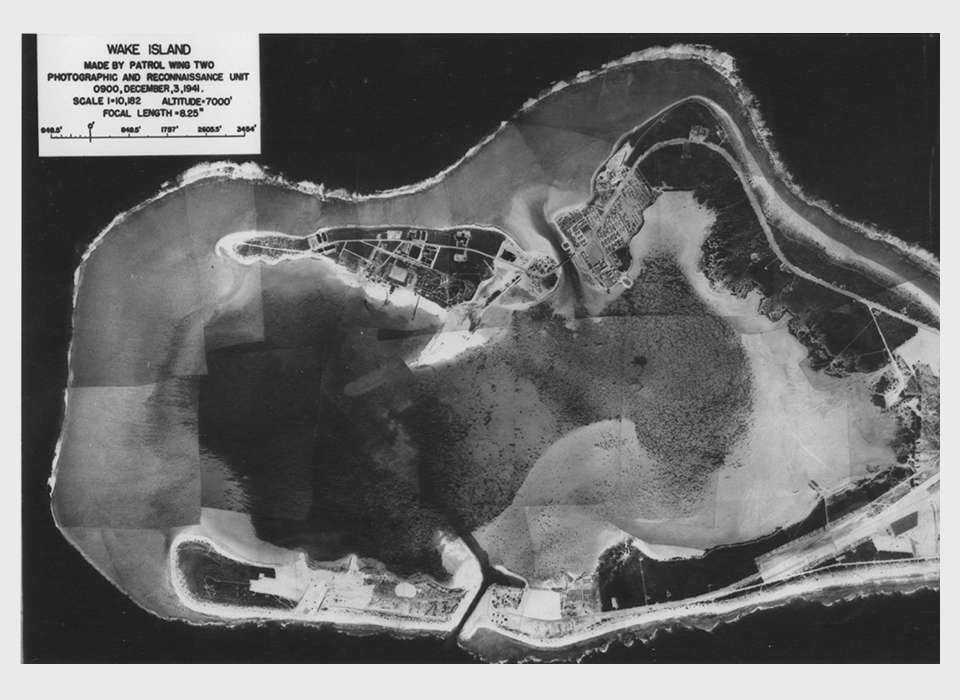
Wake Island hardly looked like a place worth fighting over. It was a tiny coral atoll roughly 2,000 miles west of Hawaii, made up of three low-lying islands surrounded by the Pacific. There was little fresh water and almost no natural protection, but its position made it strategically valuable. By 1941, the United States was building an airfield, roads, barracks and military facilities there because Wake could serve as an important outpost in the central Pacific.
The problem was that the defenses were nowhere near complete when war arrived. The Navy had originally envisioned a much larger garrison, but by December 4, 1941, only 524 American servicemen were on the atoll: 449 Marines, 69 sailors and six Army radio personnel. They were responsible for defending an island that contained twelve 3-inch antiaircraft guns, six 5-inch coastal guns, machine guns, searchlights and an airfield used by Marine fighter aircraft.
Among them was Major James Patrick Sinnott Devereux, the Marine officer responsible for the island’s defense battalion. His men did not particularly like him. In fact, they had given him a vicious nickname, and Devereux had earned a reputation for working his Marines relentlessly. He pushed them through 12- to 16-hour days, seven days a week, forcing them to carve gun positions and defensive installations out of Wake’s hard coral with little more than picks and shovels.
At the time, his men may have wondered why their commander was making their lives so miserable. Within weeks, they would understand.
Discover the incredible untold story of the Battle of Wake Island! Witness how a small group of brave U.S. Marines and civilians held their ground against a massive Japanese invasion force in 1941. It is a gripping tale of courage, strategic genius, and ultimate sacrifice. Watch the full video now to learn about this legendary last stand that shocked the world.
Then Pearl Harbor Happened
At about 6:40 a.m. on December 8, 1941, Wake’s radio operator received an emergency message from Hawaii. Because of the International Date Line, it was already December 8 on Wake, but the attack being reported had happened on December 7 in Hawaii. Pearl Harbor had been attacked.
The message was blunt: this was real, not a drill. Marines rushed toward their battle stations as the reality of war finally reached the tiny island. They had spent months preparing for the possibility of an attack, but nobody knew how quickly the Japanese would come.
They did not have to wait long. At 11:58 that morning, 27 Japanese medium bombers emerged from the clouds and attacked Wake’s airfield. The defenders briefly mistook them for American B-17s expected from Hawaii, giving the Japanese precious seconds. Seven of the twelve Marine Wildcat fighters were destroyed on the ground, and half of the fighter squadron’s personnel were killed or wounded.
The first attack had already stripped away much of Wake’s air power. But the Japanese made a mistake of their own. They assumed the island’s defenses had been effectively neutralized. They were wrong.

The Civilian Workers Picked Up Weapons
Wake’s military defenders were not alone. More than 1,100 civilian construction workers were living on the island, building the facilities that Washington had ordered there. When the bombing began, more than 400 of them volunteered to help defend the atoll. Some joined Marine gun crews, while others repaired aircraft, carried ammunition, filled sandbags, strengthened defensive positions and delivered food to isolated battle stations.
The distinction between soldier and civilian began to disappear. Everyone understood that the island was now a target, and everyone could see what would happen if its defenses collapsed.
The Japanese continued bombing Wake repeatedly between December 8 and 19. But the defenders were no longer caught by surprise. They dispersed their aircraft, strengthened their positions and learned to expect attacks from the sky. The Japanese, meanwhile, became increasingly confident that Wake was already finished. Then, before dawn on December 11, Japanese ships appeared offshore.
This time, they were not coming to bomb the island. They were coming to take it.

The Japanese Fleet Came In Close
Rear Admiral Sadamichi Kajioka approached Wake with a force that included three light cruisers, six destroyers, two transports, patrol boats and submarines, carrying about 450 troops from Japan’s Special Naval Landing Force. On paper, it was exactly the kind of force that should have overwhelmed a small island garrison.
Devereux knew his position was dangerous. His six 5-inch coastal guns were powerful, but the Japanese cruisers could fire from farther away. If the Americans opened fire too early, they would be engaging an enemy with a range advantage. Devereux therefore made a decision that drove his own gunners almost crazy. He told them to wait.
The Japanese ships continued approaching. The men operating the American guns watched helplessly as the range narrowed. One battery commander reportedly became so frustrated that he demanded to know what Devereux was waiting for. They had successfully fired at targets at Pearl Harbor from greater distances, yet here were Japanese warships moving closer and closer without the Americans firing a shot.
Devereux understood something his impatient gunners did not. He wanted the Japanese close enough that his guns could not miss.

Then Devereux Said Four Words
The Japanese light cruiser Yubari, the flagship of the invasion force, began its third firing run. The range had fallen to roughly 4,500 yards. Only then did Devereux give the order. “O.K. Open fire.”
The American guns suddenly erupted. One Japanese destroyer was sunk, while the Yubari and several other ships were hit. The Japanese invasion force turned away from the island and began retreating. But the Americans were not finished.
Only four Wildcat fighters remained operational, yet they went after the retreating Japanese ships. Marine pilots flew ten sorties, attacking with machine guns and 100-pound bombs. One lucky bomb strike caused another Japanese destroyer to explode and sink. Later that day, an American Wildcat also attacked and sank a Japanese submarine that surfaced near Wake. The first Japanese invasion had failed. For America, the timing could hardly have been better.

For A Few Days, Wake Was America’s Good News
The United States was still reeling from Pearl Harbor. American forces were taking losses elsewhere in the Pacific, and President Franklin D. Roosevelt had warned the country that the situation was grim. Then, suddenly, newspapers carried the news that the tiny Wake Island garrison had repelled a Japanese landing attempt.
The victory electrified the American public. Roosevelt praised the defenders, saying that the Wake garrison was doing a “perfectly magnificent job.” For a country that had spent the previous days absorbing one defeat after another, Wake offered something desperately needed: proof that the Japanese could be stopped. But there was a problem. Japan had not been defeated. It had merely been embarrassed. And the Imperial Japanese Navy was about to return.

Japan Came Back With A Much Bigger Force
After the failed assault, Japan dramatically reinforced the invasion force. Four heavy cruisers, additional destroyers, minelayers, a seaplane tender and two aircraft carriers—Soryu and Hiryu, both veterans of the Pearl Harbor attack—were added to the operation. Nearly 1,600 additional Japanese landing troops were also brought in.
Wake’s defenders, meanwhile, were running out of everything that mattered.
Their aircraft were being destroyed. Their ammunition was limited. Their defensive positions had been bombed repeatedly. And there was no realistic way for the tiny garrison to match the Japanese reinforcements arriving offshore.
On December 22, the remaining Marine fighters were destroyed. The following morning, before dawn, the Japanese launched their second invasion. This time, they did not intend to retreat.
The Marines Left Their Gun Pits And Fought As Infantry
The Japanese landed roughly 900 Special Naval Landing Force troops in the first wave. The Marines responded by abandoning their gun positions and fighting as infantry. Surviving pilots and ground personnel from the fighter squadron joined them, along with sailors and civilian workers.
The fighting became brutal and intensely close. For more than eleven hours, the defenders fought across the island. At one point, they destroyed a Japanese beachhead containing nearly 100 troops. Elsewhere, American forces launched a counterattack that pushed Japanese troops back more than 900 yards.
But bravery could not change the numbers forever.
The defenders were exhausted, surrounded and increasingly isolated. Worse, an American relief expedition that had been sent toward Wake was recalled. Communications on the island were also breaking down after Japanese troops cut American field telephone lines.
Commander Winfield Scott Cunningham eventually ordered the garrison to surrender.
Devereux did something remarkable. He moved toward the fighting himself to make sure the order was actually obeyed. Wake Island had fallen. But the story was not over.
The Japanese Had Won The Island At A Heavy Price
The Japanese captured Wake Island on December 23, sixteen days after the first attack. Yet the victory had been far more expensive than the Japanese expected.
Japan lost two destroyers, a submarine, 21 aircraft and between 900 and 1,000 men. Fewer than 100 Americans were killed during the sixteen-day siege, including 46 Marines and three sailors.
The numbers could not change the outcome. Wake belonged to Japan.
But the defenders had accomplished something that mattered enormously to the United States in December 1941. They had demonstrated that a small American force could inflict serious damage on a much larger Japanese formation, even immediately after Pearl Harbor and despite being badly outnumbered. The battle therefore became something more than a military defeat. It became a symbol.

The Men Who Lost Wake Became Heroes
When Americans learned on Christmas Eve that Wake Island had finally fallen, the reaction was surprisingly different from what might have been expected. The defenders were not remembered simply as men who had surrendered. They were celebrated as heroes who had held out against overwhelming odds. The battle was compared to the Alamo, another famous last stand in which a small force became larger in national memory than its final defeat might suggest.
The story also had a powerful effect on American morale. Wake offered a narrative the country desperately needed: Japan might have struck first, and Japan might have won the island, but American soldiers had already shown that Japanese forces could be hurt, resisted and forced to retreat.
The battle became so famous that Hollywood turned it into one of the first major American films depicting the war. Wake Island, released in 1942, helped boost Marine recruitment and war-bond sales. For the men who actually fought there, however, the story was far darker. Many became prisoners of war.
Their War Continued For Another Three And A Half Years
The surrender at Wake did not mean the end of the defenders’ ordeal. Those who survived the battle entered Japanese captivity, where they endured roughly three and a half years as prisoners of war. The suffering was severe, and survival itself became another form of resistance.
Yet almost 96 percent of the Wake Marines mentioned by the National WWII Museum survived their captivity. They had already endured sixteen days of bombardment and ground combat against a vastly larger force. Now they had to endure years of imprisonment before the war finally ended.
That makes Wake Island more complicated than a simple story of victory or defeat. The Americans lost the island. They did not lose the battle’s meaning.
In the darkest days of December 1941, when Pearl Harbor had made Japan seem almost unstoppable, 524 Americans and hundreds of civilian workers had shown the country something it desperately needed to believe: the Japanese could be stopped, even when the odds appeared impossible.
The Battle That Became A Victory In Defeat
Wake Island was ultimately a military defeat for the United States, but it became an extraordinary psychological victory. A tiny garrison had survived sixteen days of attacks, repelled the first Japanese invasion and inflicted serious losses before being overwhelmed by a vastly larger second force. The defenders could not hold the island forever, but they changed how Americans saw the war at a moment when confidence was desperately low.
The battle’s most famous moment lasted only seconds: Japanese ships approached, American guns waited, and then Major Devereux calmly gave the order to fire.
“O.K. Open fire.”
That was enough to turn a desperate defense into America’s first major tactical victory of the Pacific War.
Four days after Pearl Harbor, 524 Americans on Wake Island gave their country something it desperately needed: hope. They repelled Japan’s first invasion, sank warships and held out for sixteen days before overwhelming forces finally captured the island. Wake was a military defeat, but its defenders became national heroes. Their stand proved that Japan could be resisted, even in the darkest days of 1941. The island fell, but the story of those who defended it became one of America’s most enduring early-war legends.
This article is based primarily on the historical research of The National WWII Museum, which details the defense of Wake Island, Major James Devereux’s tactics, the two Japanese invasion attempts, the role of Marines and civilian workers, and the fate of the defenders after the island fell. The original article was written by historian Gregory J. W. Urwin and published by the museum in December 2020. Source: https://www.nationalww2museum.org/war/articles/battle-of-wake-island-1941