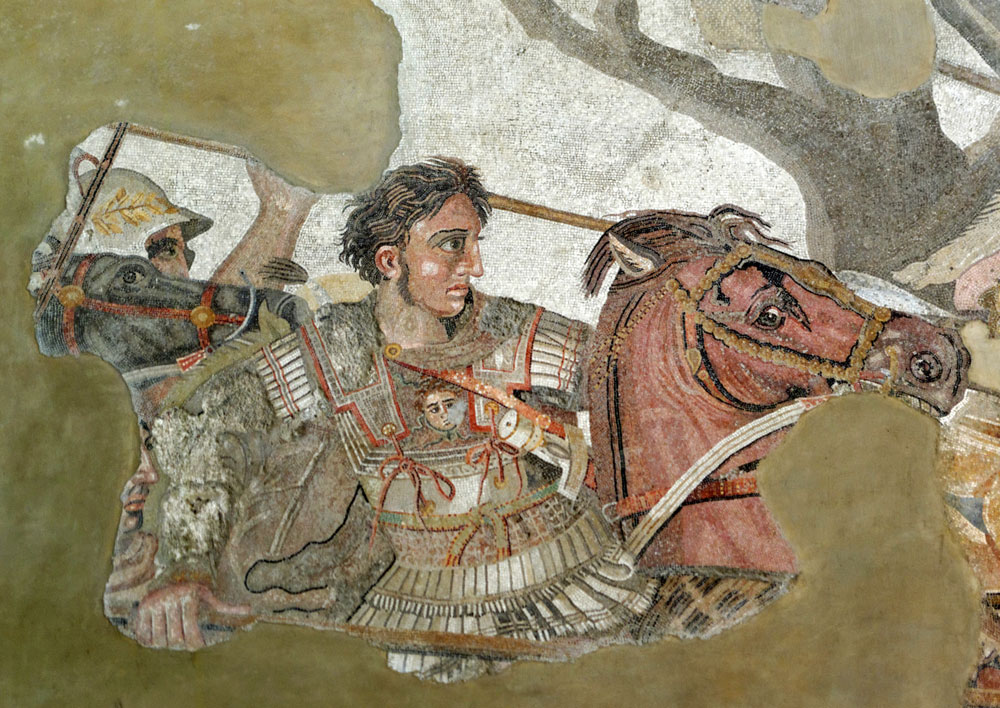
In 323 BC, Alexander the Great was still only 32 years old and had already conquered an empire stretching from Greece and Egypt to Persia and parts of India. Then, in Babylon, the most powerful man in the ancient world suddenly became desperately ill. For nearly two weeks, his condition deteriorated as fever, severe pain, weakness and paralysis took hold. When he finally died, rumors of poisoning began almost immediately. More than two thousand years later, historians still cannot say with certainty whether Alexander died from disease—or whether someone deliberately killed him.
The Conqueror Who Suddenly Began To Die
Alexander had survived battles, wounds and years of campaigning across some of the harshest terrain of the ancient world. By the spring of 323 BC, however, his attention had shifted from conquest to the future of his enormous empire. He was in Babylon, making plans for further campaigns and organizing the territories he had brought under Macedonian control. He was only 32, and there was little reason for those around him to believe that his life was about to end.
According to accounts preserved by later historians, Alexander became ill after a drinking gathering in Babylon. The precise sequence of events differs among ancient writers, but the broad outline is remarkably consistent: a previously vigorous ruler developed severe symptoms and deteriorated over a period of roughly twelve days. He experienced fever, abdominal pain, weakness and increasing difficulty moving and speaking. The illness did not resemble the sudden collapse one might expect from an ordinary wound. Instead, Alexander appeared to be slowly losing control of his own body.
As the days passed, the situation became increasingly grim. Ancient accounts describe Alexander as becoming progressively weaker until he could no longer walk. Eventually, he was unable to speak and could communicate only through movements of his head and eyes. His soldiers were reportedly allowed to pass by their dying king one final time. The man who had once led armies across continents was now lying helpless in a Babylonian palace, unable to command them.
Alexander died in June 323 BC, only weeks before his 33rd birthday. His empire did not collapse immediately, but the political struggle that followed his death would eventually produce decades of war among his generals and successors. The first mystery, however, was much more immediate: what had killed him?
Discover the mysterious final days of Alexander the Great. This gripping documentary explores whether he died of illness or murder, debunks the famous “to the strongest” legend, and reveals the dramatic heist behind his stolen corpse. Uncover the chaos that followed his death and reshaped the ancient world forever.
The Poisoning Theory Appeared Almost Immediately
Alexander’s death was suspicious enough to generate rumors in antiquity. Some accounts preserved a story of deliberate poisoning, while other traditions described a natural illness. Modern scholars face an enormous problem when trying to determine which version is closer to the truth: none of the surviving detailed accounts was written by a modern eyewitness recording the illness in real time, and the original court records on which some later writers relied have not survived.
That uncertainty left room for a murder theory that has proved remarkably difficult to kill. If Alexander had been poisoned, the motive would not have been difficult to imagine. His death suddenly transformed the future of an enormous empire. There was no obvious adult heir capable of simply stepping into his position, and powerful generals, relatives and political factions were left facing a succession crisis. A man who had spent his life deciding who would rule suddenly left everyone around him wondering who would rule after him.
The question therefore becomes more interesting than simply asking what poison could have killed Alexander. Who stood to gain from his death?
Centuries later, historians and popular writers have proposed a long list of possible suspects. Antipater, the powerful Macedonian regent, has been connected to poisoning stories. Aristotle has also appeared in some ancient traditions surrounding the alleged plot. Other theories have implicated ambitious commanders and members of Alexander’s own household. But the evidence becomes increasingly fragile as the list grows. There is no surviving piece of evidence that identifies a murderer beyond reasonable doubt.
That is what makes the case so frustrating. The ancient world supplied plenty of motives—but almost no forensic evidence.
Roxane: The Queen At The Center Of One Modern Murder Theory
One of the most dramatic modern theories points toward Alexander’s wife, Roxane.
Roxane was not simply a passive figure standing beside the Macedonian king. She was a Bactrian princess whom Alexander had married during his conquest of Central Asia. Their marriage had political significance, but Alexander later took another wife, Stateira, the daughter of the Persian king Darius III. For anyone trying to construct a motive for murder, the complicated relationships inside Alexander’s household provide fertile ground.
The most sensational version of the theory was advanced by writer Graham Phillips, who argued that Roxane could have poisoned Alexander with strychnine derived from a plant associated with the Indian subcontinent. Phillips pointed to Alexander’s time in India and argued that Roxane may have encountered knowledge of the substance during the campaign. His theory further suggested that the symptoms recorded in ancient accounts were compatible with poisoning.
It is an extraordinary theory because it seems to offer everything a historical murder mystery needs: a powerful victim, a potentially jealous spouse, political tensions, a rare poison and a death that occurred behind palace walls.
But there is a serious problem.
There is no direct evidence that Roxane poisoned Alexander.
The theory depends on a chain of assumptions: that Alexander was poisoned, that the poison was strychnine, that Roxane knew about it, that she had access to it, and that she had a reason to use it. Modern medical analysis has also raised significant objections to the strychnine explanation. A review of Alexander’s symptoms noted that the violent convulsions and muscle rigidity normally associated with strychnine poisoning do not fit the surviving description particularly well, while the gradual fever and delirium are also problematic for that diagnosis.
So Roxane remains a compelling suspect in a story—but not a proven murderer.
The Medical Mystery May Be Even More Intriguing
If Alexander was not murdered, what killed him?
This is where the mystery becomes considerably more complicated. Modern researchers have proposed a remarkable range of possible explanations, including malaria, typhoid fever, acute pancreatitis, alcohol-related illness, septicemia and other infections. Some researchers have even proposed West Nile encephalitis based partly on an unusual story about ravens behaving strangely and dying around the time Alexander entered Babylon.
Another possibility is particularly fascinating because it attempts to explain one of the strangest details in the ancient accounts: Alexander’s progressive paralysis.
In recent decades, some physicians have suggested Guillain-Barré syndrome, a neurological disorder that can cause rapidly progressing weakness and paralysis. One modern interpretation argues that Alexander may have remained alive while appearing almost completely unresponsive, potentially making his death difficult to determine using ancient medical practices. The theory has even been connected to reports that his body showed little sign of decomposition for several days.
That idea does not prove that Alexander died from Guillain-Barré syndrome. It simply demonstrates how difficult it is to interpret a medical case more than two thousand years after the patient died, using descriptions written in a very different medical world.
Another medical study has argued that Alexander’s illness may have been related to malaria, while other researchers have proposed typhoid or complications associated with heavy drinking. A toxicology review likewise concluded that both natural disease and poisoning remain part of the debate, with proposed poisons ranging from strychnine and arsenic to other botanical toxins.
In other words, modern medicine has not solved the mystery. It has simply given historians more possible explanations.

The Most Important Clue May Be What The Sources Do Not Tell Us
There is a temptation to look at Alexander’s death like a modern detective case. Find the symptoms. Match them to a poison. Identify the person with the strongest motive. Then declare the mystery solved.
Ancient history rarely works that way.
The detailed accounts of Alexander’s final illness were written long after the events themselves, although some later authors drew upon earlier material, including traditions associated with the royal journal. The surviving accounts also contain differences and uncertainties. Researchers therefore have to separate what several traditions consistently report from details that may have been embellished as the story passed through generations.
What appears relatively stable is the broad sequence: Alexander was in Babylon, he became seriously ill, his condition worsened over approximately twelve days, and he died at the age of 32. Beyond that, the certainty begins to disappear.
We do not have Alexander’s medical records. We do not have a surviving body that can be subjected to modern toxicological testing. We do not have a confirmed sample of the substance that allegedly killed him. And we do not possess a contemporary confession from anyone involved in a supposed assassination.
That leaves historians with something unusual: a famous death surrounded by an enormous amount of speculation but very little decisive evidence.
So, Who Really Killed Alexander?
The most honest answer is that we do not know whether anyone killed him at all.
The poisoning theory remains attractive because Alexander’s death came at a politically explosive moment, and because ancient writers preserved traditions about assassination. A deliberate poisoning is possible. But possibility is not proof. The modern Roxane-and-strychnine theory is especially dramatic, yet medical reviews have identified important reasons why Alexander’s symptoms do not fit strychnine particularly well.
Natural disease may ultimately provide the better explanation. Alexander’s prolonged fever and progressive deterioration are compatible with several illnesses, and researchers have proposed malaria, typhoid, West Nile encephalitis, pancreatitis and neurological disorders among the possibilities. None has been demonstrated conclusively.
There is also a darker possibility: perhaps the truth was already lost within Alexander’s own lifetime.
His death immediately created a succession crisis. His generals had enormous political interests at stake, and the empire he had built was about to enter a period of violent competition. In such an environment, rumors of murder would have been almost inevitable—whether Alexander had actually been poisoned or not.
And that may be why the mystery has survived for more than two thousand years.
Alexander conquered an enormous part of the known world. He defeated armies that appeared impossible to defeat, crossed deserts and mountains, survived wounds that might have killed another man and reached India before turning back. Yet the final enemy he encountered was not an army. It was a disease—or perhaps a poison—that left behind no reliable name.
The Conqueror Whose Final Battle Has No Answer
Alexander the Great died in Babylon in 323 BC at just 32 years old, after an illness that lasted roughly twelve days. Ancient accounts preserved the details of his physical decline, but they never gave history a definitive explanation for why a seemingly powerful young king suddenly died. Over the centuries, theories have ranged from malaria and typhoid to neurological disease and deliberate poisoning. Roxane has even been accused by one modern theory of killing him with strychnine, but no evidence proves it. The greatest conqueror of his age left behind an empire—and one final mystery that history still cannot solve.
This story draws on historical reporting and modern medical research examining the circumstances surrounding Alexander the Great’s death. The original History News Network article presents the dramatic Roxane-and-strychnine theory, while later medical studies show why the question remains far more complicated than a simple murder accusation. Source: https://www.historynewsnetwork.org/article/who-killed-alexander-the-great