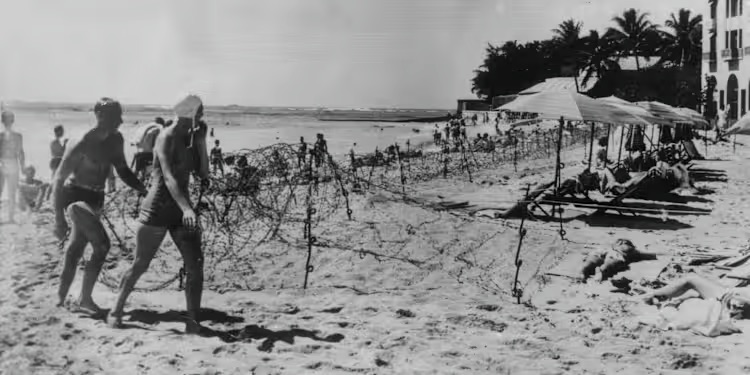
The attack on Pearl Harbor changed the course of World War II in a matter of hours. But for the people living in Hawaii, another transformation began almost immediately. By the afternoon of December 7, 1941, civilian authority had been pushed aside and the military took control. Curfews were imposed, habeas corpus was suspended, jury trials disappeared and thousands were arrested. For nearly three years, an American territory found itself living under a system that looked dramatically different from ordinary civilian government.
The Attack Was Over—But Hawaii’s Emergency Had Just Begun
The night after Pearl Harbor was filled with confusion and fear. No one knew whether the Japanese attack was the beginning of a much larger invasion, whether spies were operating across the islands or whether another attack was imminent. Hawaii was geographically isolated, strategically vital and located far closer to Japan than the continental United States.
The response was immediate. President Franklin D. Roosevelt approved the territorial governor’s plan to declare martial law on December 7, 1941. Governor Joseph Poindexter soon lost effective authority as the military took control. More than 2,000 people were arrested during the first 48 hours, while military and FBI agents searched for suspected spies and other individuals considered suspicious. What was expected by some officials to be a temporary emergency would eventually last almost three years.
How did relations between the United States and Japan deteriorate so badly before World War II? The answer came down to power, resources and control of the Pacific. As Japan expanded its empire in search of oil and raw materials, it increasingly collided with American strategic and economic interests—setting both nations on the road to Pearl Harbor.
Overnight, American Civilian Life Was Replaced by Military Rule
Martial law affected nearly every part of life. The military imposed a strict curfew, suspended habeas corpus and temporarily abolished trial by jury. Civilians were fingerprinted and issued identification papers that could be demanded by authorities. Coastal photography was prohibited, the press was censored and even long-distance telephone calls faced restrictions.
The military also assumed control over labor, giving the armed forces extraordinary influence over Hawaii’s economy during the war. The result was not simply a stronger security presence. The ordinary relationship between civilians and government had been fundamentally reversed. In peacetime, the military existed under civilian authority. In Hawaii after Pearl Harbor, civilian government had largely been pushed beneath military control.
For people accustomed to constitutional protections, the change was dramatic. Hawaii was not yet a state, but its residents were covered by protections established under the territorial government. After Pearl Harbor, however, the emergency created a situation in which military necessity became the dominant argument for restricting civilian freedoms.

One-Third of Hawaii’s Population Became a Security Question
The situation was especially complicated because approximately 37% of Hawaii’s population was of Japanese descent. This included Japanese immigrants who were not eligible for U.S. citizenship at the time, as well as more than 120,000 American citizens of Japanese ancestry.
Military and intelligence officials had long suspected that Hawaii’s large Japanese community might represent a security threat if war came with Japan. After Pearl Harbor, those suspicions became central to the military response. But Hawaii created a logistical and economic problem that did not exist on the mainland: authorities could not realistically imprison roughly one-third of the territory’s population.
The United States therefore took a different approach. Rather than removing the entire Japanese population, authorities placed the entire islands under an extraordinary security regime. Community leaders, suspected spies and others were arrested, while Japanese Americans faced intense surveillance and restrictions. In that sense, Hawaii itself became a kind of controlled wartime society.
Fear Turned Everyday Life Into a Test of Loyalty
Japanese-born residents faced particularly severe restrictions. They could not own shortwave radios, gather in groups larger than ten people or move freely without official permission. Many were classified as “enemy aliens.” Japanese-language schools were forced to close, while the pressure to speak English intensified under military rule.
But the atmosphere of suspicion extended beyond those directly detained. Families feared arrest, interrogation and separation. People restricted their movements because they did not know who might attract the attention of authorities. According to accounts from the period, even visiting detained relatives could create anxiety that additional arrests might follow.
At the same time, the military could not impose its restrictions only on people of Japanese ancestry. Hawaii’s economy depended heavily on Japanese residents, and an attempt to isolate one-third of the population would have created enormous practical problems. As a result, martial law imposed a broad system of restrictions that affected Hawaiian civilians generally, even though racial suspicion played a major role in shaping the wartime environment.
Thousands Were Arrested—But the Great Betrayal Never Appeared
The irony of the military crackdown was that the widespread betrayal authorities feared never materialized. Around 10,000 people were arrested during the period, and roughly 2,000 were incarcerated. Some detainees faced military hearings without being fully informed about the accusations against them.
Yet the results of the investigations were striking. According to the legal historians cited in the original account, with the exception of German immigrant Otto Kuehn, who was convicted of espionage, no internees or detainees were found guilty of overt acts against U.S. laws. No one was investigated for sabotage, and only a small number were suspected of espionage.
The episode exposed the enormous gap that can exist between perceived danger and proven danger during wartime. The attack on Pearl Harbor was real. Japan was a genuine military enemy. Hawaii was strategically vulnerable. But those facts did not automatically mean that thousands of civilians living in Hawaii were disloyal.
By the time that became clearer, however, the machinery of military rule was already deeply embedded in the territory.

Even After the Threat Changed, the Military Held On
Martial law did not end when the immediate panic faded. After the Battle of Midway in June 1942, the danger of a Japanese invasion was widely considered to have diminished significantly. Yet military control continued.
By early 1943, Hawaii’s new civilian governor and influential local figures were already petitioning the Roosevelt administration to restore civilian government. The military resisted strongly and agreed to surrender only part of its authority. Some civilian control returned in March 1943, but martial law itself did not formally end until October 1944.
Even then, the transition was incomplete. Restrictions remained on people classified as “enemy aliens,” while the Army retained significant control over Hawaiian labor. The emergency that began as a response to a single morning of war had reshaped the relationship between military power and civilian life for nearly three years.
The Supreme Court Eventually Drew the Line
The legal consequences continued after the war. In 1946, the U.S. Supreme Court heard Duncan v. Kahanamoku, a case involving the military prosecution of Hawaiian civilians during martial law.
The Court ruled against the system of military trials for civilians under the circumstances of the case. Justice Hugo Black emphasized a principle that went far beyond Hawaii: the American constitutional system was fundamentally opposed to total military rule and rested on civilian supremacy over the armed forces.
That decision became an important closing chapter in Hawaii’s wartime experience. Pearl Harbor had demonstrated how quickly a democracy could centralize power during a national emergency. Duncan v. Kahanamoku demonstrated that the restoration of civilian authority could eventually become a constitutional necessity rather than simply a political choice.

For nearly three years after Pearl Harbor, Hawaii lived through one of the most extraordinary episodes of military control in American history. Curfews, censorship, mass arrests and suspended legal protections became part of daily life as the United States fought for control of the Pacific. The fear of invasion and espionage was understandable, but the scale of the military response raised a lasting question: how much freedom can a democracy surrender in the name of survival? Hawaii’s experience showed both the power of wartime fear and the importance of eventually restoring the civilian institutions that fear can so quickly push aside.