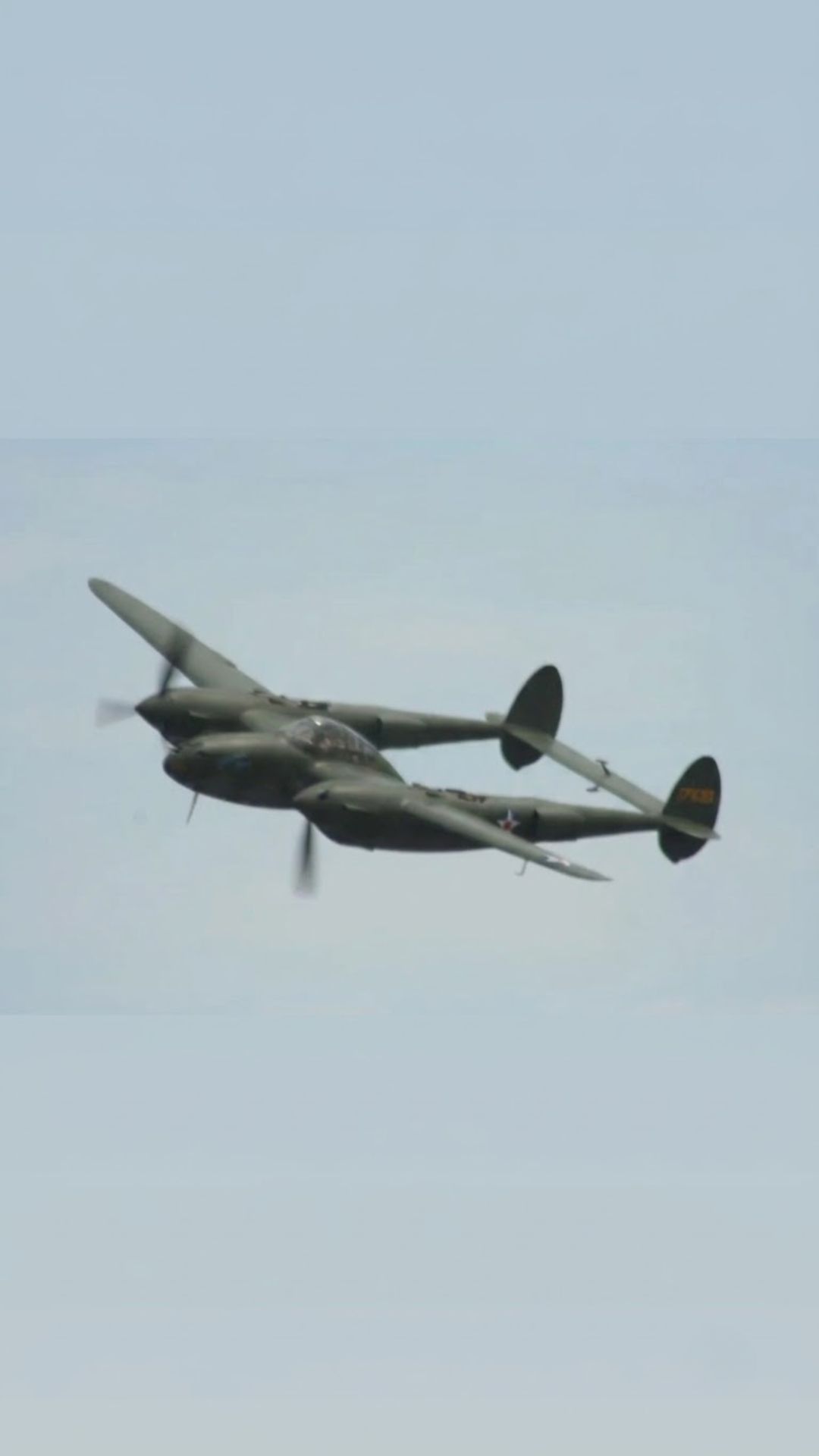
In 1942, a Lockheed P-38 Lightning was forced to land on the Greenland ice cap after bad weather disrupted a World War II ferry mission. The pilots were rescued, but the airplane was abandoned on the ice and gradually disappeared beneath it. More than 50 years later, a group of aviation enthusiasts went looking for the lost aircraft and discovered that it was buried 264 feet below the surface. Getting it out required years of searching, specialized equipment and an enormous excavation effort. Then came the most remarkable part: they rebuilt the P-38 and eventually put it back into the sky.
The P-38 Was Supposed To Fly From America To England
The airplane that would eventually become known as Glacier Girl began its story as a brand-new P-38F Lightning in 1942. It was one of several aircraft being ferried across the North Atlantic as part of Operation Bolero, a massive effort to move American aircraft toward Britain during World War II.
The route was difficult. The aircraft were expected to cross from North America toward Greenland and Iceland before continuing toward Britain, a journey that required pilots to operate over enormous stretches of remote territory and ocean.
On July 15, 1942, six P-38 fighters and two B-17 bombers encountered severe weather during the journey. The formation turned back, but worsening conditions and limited fuel left the pilots with few options. One by one, they were forced to land on the Greenland ice cap.
Harry Smith was flying the P-38 that would eventually become Glacier Girl. He brought the aircraft down with its landing gear retracted and managed to leave the airplane behind with the other aircraft. The 25 men eventually reached safety, but the eight aircraft remained on the ice. The mission had ended for the men. For the airplanes, another story was only beginning.
Discover the incredible true story of the Kee Bird, a B-29 bomber abandoned in Greenland for 50 years. Follow pilot Darryl Greenamyer and his brave crew as they attempt a daring, perilous mission to restore and fly this historic warbird home. Watch this gripping tale of aviation history and human determination!
The Lost Squadron Disappeared Beneath The Moving Ice
At first, the abandoned aircraft were simply left behind because recovering them in wartime Greenland made little practical sense. The ice cap appeared vast, empty and permanent.
It was neither.
Snow accumulated year after year, compressing into ice and gradually covering the aircraft. More importantly, the glacier itself was moving. When aviation enthusiasts eventually returned to search for the airplanes decades later, the aircraft were no longer sitting where the original coordinates suggested.
Pat Epps and Richard Taylor became fascinated by the story in the late 1970s and began organizing expeditions to find the Lost Squadron. Their early assumption was almost charmingly optimistic: they imagined the aircraft might still be sitting near the surface, perhaps requiring little more than some shoveling and mechanical work before they could be flown away. Reality was very different.
By 1988, sophisticated subsurface radar finally revealed the location of the aircraft. The planes had been carried roughly two miles from their original landing site by the moving ice. Then the search team discovered something even more extraordinary. The aircraft were buried beneath approximately 264 feet of solid ice.

Finding The Airplane Was Only The Beginning
Locating the Lost Squadron on radar did not mean the aircraft could simply be dug out.
The recovery team needed to create a shaft through more than 80 meters of ice and then excavate a large enough space around the P-38 to dismantle it. They developed specialized thermal equipment capable of melting passages through the glacier.
One of the most important inventions was a device nicknamed the Gopher. It used heated liquid circulating through copper tubing to melt a shaft through the ice. An improved version, the Super Gopher, eventually became the key tool in the recovery operation.
The team also needed physical evidence that the aircraft were actually beneath the ice. In 1989, a coring device was lowered deep into the glacier and brought back pieces of aircraft metal. For the people involved, this was the moment the decades-long search became undeniable.
They were no longer chasing radar blips.
There was a World War II airplane down there.
In 1992, with funding from Kentucky businessman Roy Shoffner, the recovery operation finally began. The team descended through a narrow shaft and worked deep below the surface, cutting a cavern around the aircraft. Rather than lifting the P-38 out intact, they dismantled it and brought the pieces back to the surface one by one.
The final center section was about 17 feet long and weighed roughly three tons. It emerged from the ice on August 1, 1992, about three months after the expedition began. The airplane had been recovered. Now they had to figure out whether it could ever fly again.
Every Part Of The P-38 Had Been Damaged By The Ice
When Glacier Girl reached a restoration facility in Kentucky, the project looked far more difficult than simply putting an old airplane back together.
The glacier had preserved the aircraft remarkably well, but preservation was not the same as keeping it intact. The enormous weight of the ice had damaged essentially every major component.
The canopy had been crushed. The airframe had suffered severe stresses. Components had to be cleaned, repaired, rebuilt or replaced while the restoration team tried to preserve as much original material as possible.
The landing gear was sent to B.F. Goodrich Aerospace in England for restoration. The Allison engines were rebuilt by specialists in Minnesota. Other parts were painstakingly repaired or reconstructed.
The restoration eventually used about 80 percent of the airplane’s original parts. The project cost roughly $4 million and took years longer than the original estimates.
On September 6, 2000, the restoration team finally started the engines for the first time.
For the people who had spent years looking at Glacier Girl as a pile of damaged components, that sound meant something profound. The airplane was alive again.
On October 26, 2002, pilot Steve Hinton took Glacier Girl into the air for the first time since 1942. Thousands of people gathered at the airport in Middlesboro, Kentucky, to watch the restored P-38 return to flight.
A machine that had spent half a century beneath a Greenland glacier had become an airworthy aircraft again.
Sixty-Five Years Later, Glacier Girl Tried To Finish Its Original Mission
The first flight was not supposed to be the end of the story.
The people restoring Glacier Girl wanted to do something even more ambitious: complete the mission the airplane had started in 1942.
In June 2007, 65 years after the original attempt, Glacier Girl departed Teterboro Airport in New Jersey on a journey toward Duxford, England. The plan was to retrace the general transatlantic route of Operation Bolero, traveling north through Canada and toward Europe.
The flight was given the name Operation Bolero II.
The symbolism was hard to miss. The same P-38 that had once been forced down on Greenland’s ice was now flying again toward the destination it had never reached.
Brad McManus, the surviving pilot from the original Lost Squadron at the time, accompanied the flight for its opening leg in another aircraft. He flew alongside Glacier Girl for roughly the first 100 miles, creating a remarkable connection between the 1942 mission and its modern recreation.
But the Arctic and North Atlantic had not become easy simply because 65 years had passed.
Glacier Girl reached Goose Bay, Labrador, where a coolant leak in the right-hand engine forced the aircraft to stop. The problem proved serious enough that the planned flight to England could not continue as scheduled. Both Allison engines were eventually replaced before Glacier Girl returned to flying.
The P-38 therefore did not complete the entire 2007 journey to Duxford as originally planned. But the attempt itself became the final chapter of the story that had begun on the Greenland ice cap.

Glacier Girl Became More Than A Restored Warplane
Today, Glacier Girl is remarkable not simply because it is an exceptionally rare surviving P-38. Its significance comes from the extraordinary chain of events surrounding it.
It was built in 1942, flown into the Arctic as part of a wartime ferry mission and abandoned after an emergency landing. It then disappeared beneath a moving glacier, where it remained for roughly half a century.
A team spent years finding it. Another team spent months extracting it from more than 80 meters of ice. Restorers then spent years rebuilding an aircraft whose components had been crushed and damaged by the weight of the glacier.
And finally, after more than 60 years on the ground, Glacier Girl flew again.
The airplane’s story is therefore divided into three journeys: the original wartime flight, the extraordinary journey out of the glacier and the later attempt to complete the mission that had been interrupted in 1942. That is what makes Glacier Girl so unusual. It was not merely preserved by history. It was brought back to life and given another chance to finish its journey.
Glacier Girl’s story began with a forced landing on the Greenland ice cap in 1942 and continued for more than six decades. The P-38 disappeared beneath 264 feet of moving ice, was located after years of searching, and was eventually dismantled and brought to the surface piece by piece. A painstaking restoration returned the aircraft to flying condition in 2002, and five years later it attempted to retrace its original journey toward England. The 2007 flight was interrupted by engine trouble, but the attempt completed something almost as remarkable: a forgotten World War II aircraft had returned to the sky.
Smithsonian’s Air & Space Magazine provides the detailed account of the Lost Squadron, the search, the 1992 extraction and the restoration of Glacier Girl. Contemporary reporting from The Guardian and aviation publications documents the 2007 Operation Bolero II attempt and the engine trouble that prevented the P-38 from completing the flight to England. Source: https://www.smithsonianmag.com/air-space-magazine/glacier-girl-the-back-story-19218360/