When Ford introduced the Pinto, the car was supposed to help America compete against the growing popularity of small imported vehicles. It was compact, affordable and economical at a time when more drivers were beginning to look beyond large American cars. The strategy worked: the Pinto became a major commercial success and millions were sold. Yet the same car would later become one of the most controversial vehicles in automotive history, remembered not only for its popularity but for a bitter dispute over fuel-tank safety, corporate responsibility and the disturbing question of whether the value of human safety could ever be reduced to a number.
Ford Wanted an American Answer to the Small Foreign Car
By the end of the 1960s, the American automotive market was changing. Imported compact cars were becoming increasingly attractive to consumers who wanted something cheaper to buy and less expensive to operate. Ford needed a serious competitor in the rapidly growing subcompact market.
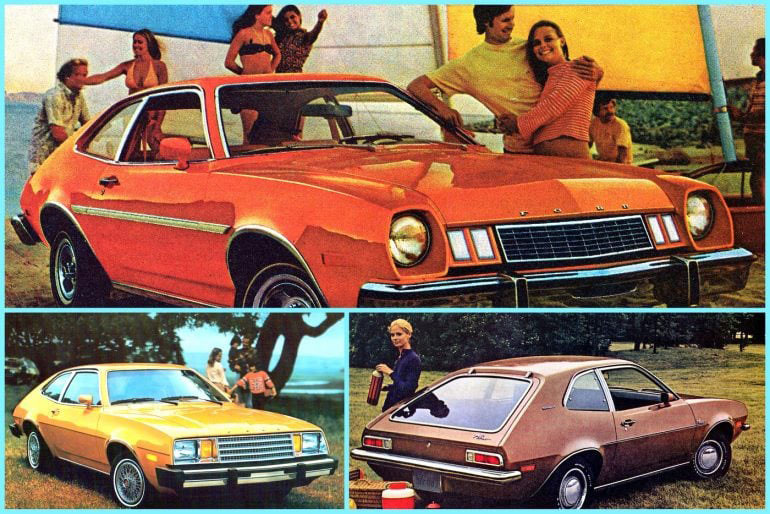
The result was the Ford Pinto, introduced as a 1971 model. It was small by traditional American standards, offered a relatively low price and was designed to appeal to buyers who no longer wanted a large, fuel-hungry vehicle for everyday transportation.
The Pinto arrived with several body styles over its production life, including a two-door sedan, the Runabout hatchback and a station wagon. For Ford, it was more than simply another model. It represented a direct attempt to prove that an American manufacturer could successfully compete in the small-car market.
And for a time, that is exactly what happened.

The Pinto Became a Genuine Best Seller
The Ford Pinto was not initially regarded as a commercial failure or an unwanted car. On the contrary, it became a familiar sight on American roads.
Its compact dimensions made it practical for urban driving, while its lower price helped attract younger buyers and families looking for affordable transportation. Ford also promoted the Pinto’s economy at a time when fuel efficiency was becoming increasingly important to consumers.
By 1980, Ford advertising celebrated a Pinto owner community of more than 2.5 million vehicles. That figure is important because the car’s later reputation can make it easy to forget that millions of people willingly bought and used Pintos. The model was not a fringe experiment. It was one of Ford’s most successful entries into the subcompact market.
For many owners, the Pinto was simply a practical little car. It was affordable, easy to understand and suited to an era increasingly concerned with fuel consumption.
But while the car was selling successfully, a much darker controversy was beginning to develop around one of its most important components: the fuel system.

Watch the video below to take a closer look at a remarkably preserved 1973 Ford Pinto Runabout. Before the Pinto became famous for controversy, it was one of America’s most popular small cars—and this surviving example offers a glimpse of what made it such a success.
Then a Dangerous Problem Began to Follow the Car
The central controversy involved the fuel tank design of certain early Pintos and their performance in rear-end collisions.
Investigations and litigation raised concerns that, under particular impact conditions, the fuel tank could be damaged, leading to fuel leakage and fires. In 1978, the National Highway Traffic Safety Administration concluded that pre-1977 model-year Pintos were associated with fuel-tank damage, leakage and fires in rear impacts at what it described as moderate speeds, including fatal and nonfatal burn injuries.
The Pinto’s reputation eventually became so closely associated with fire that popular culture sometimes exaggerated the story into the idea that every Pinto was essentially a rolling bomb. The historical reality was more complicated.
Not every Pinto caught fire. Not every rear-end collision produced the same result. Other vehicles of the era also faced fuel-system safety concerns.
However, that complexity did not erase the central issue: serious questions had emerged about the safety of the Pinto’s fuel system, and those questions would eventually become a national controversy.

The $11 Question That Destroyed Ford’s Reputation
The scandal reached a new level in 1977 when journalist Mark Dowie published the influential article “Pinto Madness” in Mother Jones.
The article focused heavily on an internal cost-benefit analysis that became popularly known as the “Pinto Memo.” The document compared the cost of safety-related fuel-system modifications with estimated societal costs associated with deaths, injuries and vehicle losses. It included an estimated modification cost of about $11 per vehicle across 12.5 million cars and light trucks sold by all manufacturers, producing a total figure of $137 million, compared with an estimated $49.5 million in benefits under the assumptions used in the analysis.
The public interpretation was explosive.
Many readers came away with the impression that Ford had explicitly calculated that paying for lawsuits involving injured or dead Pinto occupants would be cheaper than fixing the cars. That interpretation became one of the most powerful symbols of corporate indifference in American business history.
But the historical record is more nuanced than the popular legend suggests.
The analysis was prepared in connection with proposed federal fuel-system safety regulations and was not limited to the Pinto. It considered all cars and light trucks within its assumptions, and historians have pointed out that the document did not literally compare Pinto redesign costs with Ford’s expected legal payouts.
That distinction matters.
Yet even if the popular interpretation oversimplified the document, the damage was already done. The image of a major corporation appearing to place a monetary value on human life became impossible for Ford to escape.
The controversy was no longer only about engineering.
It had become a question of ethics.

The Investigation Led to a Massive Recall
Public pressure intensified rapidly after the controversy received national attention.
In 1978, Ford agreed to recall approximately 1.5 million Ford Pintos and Mercury Bobcats. The recall covered 1971–1976 Pintos and certain 1975–1976 Mercury Bobcats and involved modifications intended to reduce the risk of fuel-tank fires in rear-end collisions. At the time, it was one of the largest automotive recalls in history.
The recall was a major moment in the history of American automobile safety.
By then, however, the Pinto had already become far more than a product involved in a recall. Its name had become shorthand for a broader fear: what happens when the pressure to build a vehicle quickly and cheaply collides with concerns about safety?
Later economic analysis argued that modifying the design earlier would have been more cost-effective than waiting and carrying out the recall years later.
That finding only reinforced the tragedy of the controversy.

Ford Even Faced Criminal Charges
The Pinto case became even more extraordinary when Ford faced criminal charges in Indiana following a 1978 rear-end crash involving a 1973 Pinto that resulted in the deaths of three young women.
The case drew national attention because it raised the unprecedented question of whether a corporation could face criminal liability for alleged decisions involving product design. Prosecutors argued that Ford knew about the risks associated with the Pinto’s fuel system, while Ford’s defense maintained that the Pinto was comparable in relevant respects to other small cars of its era.
After a lengthy trial, a jury acquitted Ford of reckless-homicide charges in March 1980.
The acquittal did not restore the Pinto’s reputation.
In the public imagination, the case had already become much larger than the verdict itself. The Pinto was now a symbol in discussions about corporate responsibility, engineering ethics and product safety.
It entered classrooms, business schools and law courses as a case study that continues to provoke debate.

A Best Seller Became a Warning for an Entire Industry
The Ford Pinto is remembered because its history contains an uncomfortable contradiction.
It was a successful product.
Millions of people bought one.
It helped Ford compete in a rapidly changing automotive market.
And yet the same vehicle became associated with one of the most damaging safety controversies in American industrial history.
The Pinto’s legacy also demonstrates how difficult it can be to separate engineering, economics and ethics. Manufacturers must constantly make decisions based on costs, risks, regulations and technical limitations. Cost-benefit analysis itself is not unusual; governments and industries use it in countless areas.
But the Pinto controversy revealed the danger of what happens when such calculations appear disconnected from public expectations about human safety.
A company may understand its internal numbers perfectly and still fail to understand the moral meaning those numbers can acquire when tragedy occurs.
That is why the Ford Pinto remains relevant decades after production ended.
It was not simply a story about a flawed car.
It was a story about what can happen when commercial success and public trust move in opposite directions.

The Ford Pinto was never simply the worst car ever made, nor was it merely an unfortunate victim of exaggerated headlines. It was a genuinely successful subcompact that sold in enormous numbers before becoming trapped in one of the most famous automotive safety controversies in American history. The fuel-tank dispute, the “Pinto Memo,” the massive recall and the landmark criminal trial permanently transformed the car’s legacy. Decades later, the Pinto still raises the same uncomfortable question for manufacturers everywhere: when safety, speed and cost collide, how should the value of human life be weighed?