For millions of Americans, stopping at a gas station was once a very different experience. You pulled in, an attendant came to the car, filled the tank, cleaned the windshield and checked under the hood. They might even tighten a loose license plate or adjust a fan belt before sending you on your way. A 1944 service-station guide reveals just how seriously American businesses once treated these small gestures — and why full-service gas stations eventually became a thing of the past.
Back Then, You Didn’t Pump Your Own Gas
The modern gas station began taking shape in the early 20th century. The first purpose-built stations appeared around 1905 to 1910, after gasoline had previously been sold at places such as hardware stores and pharmacies. As car ownership expanded during the 1920s, dedicated stations began appearing throughout American towns and cities.
But customers generally didn’t get out of their cars to fill the tank.
An attendant did it for them.
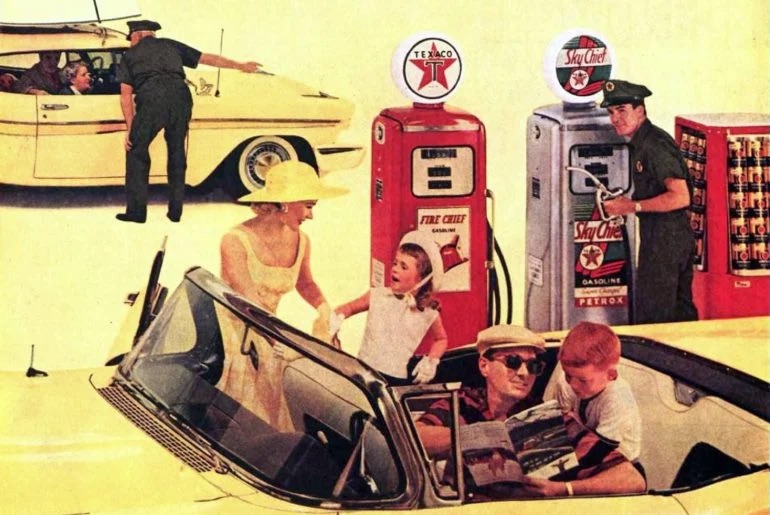
The attendant would approach the vehicle, ask what the customer wanted, pump the gasoline and often perform a quick inspection. Checking the oil, looking at the tires and cleaning the windshield were all part of the experience.
Oil companies also began paying greater attention to how their stations looked and how employees interacted with customers. Companies including Standard Oil, Gulf and Texaco invested in station design and attendant training, turning the gas station into something more organized and professional.
By the 1940s, filling up wasn’t simply a transaction. It was a service.
And there was a surprisingly detailed philosophy behind it.

The 1944 Guide Had A Surprisingly Simple Rule
A 1944 training guide called I Listened and Learned — About Service Station Operation attempted to teach attendants how to do more than simply pump gasoline.
The guide presented its lessons through a fictional or composite attendant named Bill Olson. His story begins with a realization that simply following instructions isn’t enough.
Take a nostalgic look at a 1957 service station, when attendants handled the work and filling up your car was a very different experience.
An employee could memorize the manual, perform the required motions and still fail to understand what good service actually meant.
The solution was surprisingly modern:
Listen, think and learn.
The guide encouraged attendants to treat customers the way they themselves would want to be treated. It emphasized being natural rather than mechanically repeating a rehearsed sales pitch.
That philosophy extended to the smallest details.
An attendant wasn’t supposed to wait for the customer to point out every problem. The job was to pay attention and notice things for them.
That meant looking at the car as well as the customer.

They Weren’t Just Selling Gas — They Were Watching The Car
The 1944 instructions read almost like a checklist for a modern vehicle inspection.
Attendants were encouraged to watch for a missing gas cap or valve cap, wipe the tail lights and rear window, clean the windshield and, when practical, raise the hood.
They were also told to check the radiator water level and engine oil using the dipstick. Even the opportunity to recommend items such as fan belts and spark plugs was part of the job.
The goal wasn’t simply to make the car look cleaner.
It was about showing the customer that someone was paying attention.
The guide also emphasized knowing the customer’s car and understanding petroleum products. An attendant who knew what kind of oil a particular vehicle required could provide better service and potentially earn the customer’s trust.
There was a commercial reason for all of this, too.
A customer who felt well treated was more likely to return.
In other words, the station wasn’t just selling gasoline. It was trying to sell confidence.

The Little Things Customers Never Asked For
This may be the most revealing part of the old service philosophy.
The guide specifically highlighted small repairs that customers might not expect.
A loose license plate could be tightened. A sticky door could be made to operate more smoothly. A loose bumper nut could be secured. A battery clamp could be tightened. A windshield wiper could be adjusted, as could a fan belt or radiator petcock.
None of these jobs was particularly glamorous.
But that was precisely the point.
A customer might forget how much gasoline they bought. They were less likely to forget an attendant noticing a problem they hadn’t even seen themselves.
The guide’s philosophy was essentially that unexpected helpfulness created goodwill.
That idea sounds remarkably familiar today. A business doesn’t always win customers by doing something spectacular. Sometimes it wins them by doing one small thing that nobody expected.

Why Did This Kind Of Service Disappear?
Full-service stations didn’t vanish because Americans suddenly stopped appreciating good service.
Economics played a major role.
After World War II, automobile ownership exploded. U.S. car registrations roughly doubled between 1945 and 1955, and gas stations expanded alongside them. During the 1950s, brightly designed stations with uniforms, clean facilities and waiting areas became part of everyday American driving culture.
But the economics of the industry eventually changed.
Self-service stations began appearing during the 1960s. At first, they spread slowly and were even prohibited by law in some states.
Then came the 1973 Arab oil embargo.
Gas prices surged, lines became longer and operating costs became more important. For station owners, reducing the number of employees could make a major difference. Self-service, once an unfamiliar concept, increasingly became a practical way to keep costs down.
By the end of the 1970s, self-service had become the norm across most of the country.
Full service did not disappear overnight. It increasingly became a premium option, usually costing more at the stations that continued offering it. By the 1990s, it had become rare in most parts of the United States.
The transaction had become simpler.
And cheaper.
But something had disappeared with it.

What Old Gas Stations Understood About Customer Loyalty
The old service-station manuals were ultimately teaching something much bigger than how to pump gasoline.
They were teaching attention.
Prompt service saved the customer’s time. Clean uniforms and personal neatness created confidence. Courtesy mattered. Knowledge of the customer’s vehicle mattered. And small acts of assistance could turn an ordinary transaction into an experience worth remembering.
That philosophy is easy to dismiss as nostalgia.
But it contains an important business lesson.
Customers don’t always remember exactly what they bought. They often remember how they were treated.
A full-service gas station could take something as ordinary as buying gasoline and add dozens of tiny moments of human attention. The attendant wasn’t merely standing beside a pump. He was checking the vehicle, answering questions and sometimes spotting problems before they became bigger ones.
Today, most drivers simply pull up, insert a card, select a grade of gasoline and pump it themselves.
It’s faster. It’s more efficient. And for most people, that’s exactly what they want.
But the old gas station represents a different idea of convenience.
Instead of saving customers the effort of pumping their own gas, the service station saved them the effort of paying attention to everything else.
And perhaps that is why the full-service gas station remains so memorable.
It wasn’t just about filling the tank.
It was about having someone notice the little things before you drove away. Take a look back at the days when gas stations meant more than just filling your tank, and attendants were there to serve you every step of the way.


Full-service gas stations eventually faded because self-service was cheaper, faster and better suited to a changing America. But the old model left behind an interesting lesson about customer service: people remember when someone notices the little things. A clean windshield, a checked oil level or a tightened license plate may seem insignificant, yet those small gestures once turned a routine stop into something more personal. The gas station may have changed, but the idea behind that service still feels remarkably relevant today.