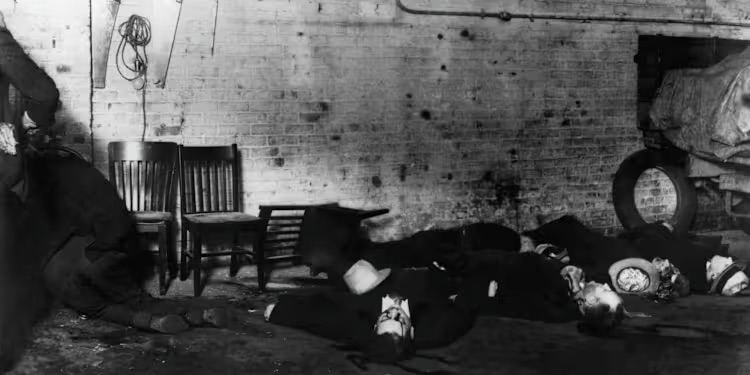
On February 14, 1929, seven men connected to Chicago gangster Bugs Moran were lined up against a garage wall by men posing as police officers. Moments later, more than 70 bullets were fired, leaving six victims dead at the scene and another dying shortly afterward. The massacre quickly became associated with Al Capone, Moran’s most powerful rival. But there was a problem: Capone was in Florida that morning and had a strong alibi. More than nine decades later, the question remains—did Capone really order the massacre, or did someone else plan the bloodshed?
Why Were Bugs Moran’s Men in the Garage?
The first mystery begins before the shooting even started: why were seven men connected to Bugs Moran gathered inside that particular garage that morning?
The victims included mob accountant Adam Heyer, Moran’s second-in-command Albert Kachellek, nightclub owner Albert Weinshank, enforcers Peter and Frank Gusenberg, mechanic John May and Reinhardt Schwimmer, an optometrist who associated with the gang. They were all connected in different ways to Moran’s North Side organization.
Early theories suggested that the men were there to divide a hijacked shipment of whiskey or prepare to travel to Detroit to obtain more liquor. But there was something strange about that explanation.
Most of the men were wearing expensive suits.
Their clothing did not look like that of men preparing to unload illegal liquor. Another possibility was that they had been summoned to a business meeting, perhaps under false pretenses.
That could also explain why they followed the supposed police officers’ orders without immediately resisting.
During Prohibition-era Chicago, corrupt police officers were hardly unimaginable. The men may have believed they were dealing with real officers who were simply putting on a show.
There was another important clue.
The victims still had thousands of dollars in their possession, making robbery an unlikely motive. Whoever organized the attack appeared to have come specifically to kill them.
And the intended target may have been even more specific.
George “Bugs” Moran himself was not inside the garage.
According to one theory, a lookout watching the area mistakenly believed that one of the men entering the building was Moran. The lookout then gave the signal to begin the attack before Moran himself arrived.
Moran was still about a block away.
If that account is correct, the gunmen may have carried out the massacre without realizing that their most important target had escaped them by pure chance.

Who Killed Them—and Why?
The most obvious suspect was Al Capone.
Capone and Moran were bitter rivals, and their organizations had been fighting over lucrative illegal businesses in Chicago. Bootlegging, gambling and other criminal operations generated enormous profits during Prohibition, and controlling those businesses meant controlling territory and influence.
Capone certainly had a motive.
But he also had an unusually strong alibi.
On the morning of February 14, 1929, Capone was in a Dade County, Florida courthouse being questioned by prosecutors about another murder. He was hundreds of miles away when the massacre occurred. Of course, being away from Chicago did not mean he could not have ordered the killings.
That distinction has fueled the Capone theory for generations.
Some mob historians have argued that Capone hired a group of St. Louis gunmen known as the “American boys” to eliminate Moran. Because the shooters allegedly did not know exactly what Moran looked like, they killed everyone in the garage to make sure their target was among the dead.
But other historians have questioned that explanation.
Jonathan Eig, author of Get Capone, argued that the operation would have been unnecessarily elaborate if Moran alone were the intended target. A single gunman could theoretically have been placed outside Moran’s home.
Why organize a carefully planned execution of seven people?
That question remains part of the mystery.
There was also a potentially important weapons clue.
Later in 1929, Fred “Killer” Burke, an occasional associate of Capone, fatally shot a police officer in Michigan. Authorities searching Burke’s home discovered a large collection of weapons, including two Thompson submachine guns whose bullets reportedly matched those used in the St. Valentine’s Day killings.
Burke was sentenced to life in prison for the police officer’s murder.
But remarkably, he was apparently never questioned about the massacre weapons.
Another possible lead emerged years later.
In 1935, the Chicago American newspaper claimed that the case had been solved and reported that Bryon Bolton, a member of another gang, had confessed to participating in the massacre. Officials denied the report, but federal investigators did question Bolton.
According to an FBI summary, Bolton claimed that he had purchased the Cadillac used in the attack and had been present at a Wisconsin resort where Capone planned the massacre. He also identified five alleged gunmen.
Yet the information went nowhere.
The FBI apparently never shared Bolton’s claims with Chicago police, and his allegations were never fully investigated.
Check out the video to learn more about the St. Valentine’s Day Massacre, the suspects surrounding the case, and the mystery that has remained unsolved for decades.
Was It Actually an Act of Revenge?
The Capone theory is famous, but another explanation emerged from FBI files decades later.
In 1935, Frank Farrell, a state highway employee, wrote to FBI Director J. Edgar Hoover urging an investigation into the 1928 killing of William Davern Jr., the son of a Chicago police sergeant.
According to Farrell, Davern had told his criminal cousin, William “Three-Fingered Jack” White, that members of Moran’s organization had shot him.
Farrell claimed that White then arranged the St. Valentine’s Day Massacre as an act of revenge.
The alleged plan was to lure Moran’s men to the garage by promising them a share in a factory robbery. Once they arrived, the killers could execute them.
This theory has one major advantage: it potentially explains several strange details at once.
Why were Moran’s men at the garage?
Why did they appear willing to cooperate with men dressed as police officers?
And why would Chicago police potentially have been involved or looked the other way?
If the killings were connected to revenge for the murder of a police officer’s son, the presence of corrupt or sympathetic police officers might make more sense.
But the theory also has a major weakness.
William “Three-Fingered Jack” White was reportedly in prison from 1926 until July 1929, meaning he was behind bars when the massacre occurred.
Supporters of the theory have suggested that White might have bribed his way out temporarily, but there is no definitive proof that he did so.
White himself was later killed at his home in 1934.
The revenge theory therefore remains exactly that—a theory. It may explain some of the unexplained details, but it has never been established as the true explanation for what happened that morning.

Why Were the Chicago Cops So Ineffective?
The massacre also exposed a much larger problem in Chicago.
During Prohibition, organized crime was deeply embedded in the city’s economy and political system. HISTORY notes estimates of roughly 10,000 speakeasies and around 500 unsolved gangland murders during the era.
The scale of the problem was enormous.
Gangsters were not simply hiding in isolated corners of the city. Their organizations operated businesses, controlled illegal alcohol distribution and maintained relationships with people inside law enforcement.
Historian Jonathan Eig described the system as thoroughly corrupt, with officials allegedly being bought off at multiple levels.
One particularly striking allegation came from Bryon Bolton, who told federal investigators that Chicago’s chief of detectives was on Capone’s payroll and received $5,000 a week at the time of the massacre.
Whether every detail of Bolton’s testimony was accurate is difficult to establish, but the broader picture is clear: corruption made it extremely difficult for authorities to pursue organized crime effectively.
Capone himself was frequently arrested.
Yet he rarely remained in custody for long.
That changed dramatically when he was arrested in Philadelphia later in 1929 for carrying illegal weapons.
Unlike his experiences in Chicago, the Philadelphia authorities moved quickly. Capone and his bodyguard were charged, convicted and sentenced to a year in prison in less than 16 hours.
The contrast was revealing.
The problem was not necessarily that law enforcement lacked the ability to arrest Capone.
The problem was that Chicago’s deeply compromised system made it extraordinarily difficult to hold powerful gangsters accountable.
And that helps explain why the St. Valentine’s Day Massacre could become one of the most famous unsolved murders in American history.
Where Was the FBI?
Perhaps the most surprising part of the story is that the FBI did not take the leading role in solving the massacre.
Today, the FBI is associated with major organized-crime investigations. But in 1929, the agency did not yet have the same role or reputation.
J. Edgar Hoover wanted little to do with the massacre.
He insisted that it was a local matter and resisted requests from the Justice Department to investigate it. HISTORY also notes that Hoover famously denied the existence of organized crime for years.
There have been different explanations for Hoover’s position.
Some writers have suggested that Mafia figures possessed compromising information about him.
Others argue that Hoover simply prioritized other targets, including bank robbers and suspected subversives, rather than becoming deeply involved in organized crime.
Whatever the reason, the result was the same: the federal government did not make solving the massacre a major priority.
President Herbert Hoover—who was unrelated to J. Edgar Hoover—eventually took a different approach to bringing down Capone.
Rather than relying on the massacre investigation, he ordered the Treasury Department to investigate Capone’s finances.
That strategy proved far more successful.
In 1931, Capone was convicted of federal tax evasion and sentenced to 11 years in prison.
Ironically, the government ultimately found a way to imprison one of America’s most notorious gangsters without ever proving that he ordered the St. Valentine’s Day Massacre.
Capone was never tried for the seven killings.
No one else was either.
By the time Capone was released, his health had deteriorated severely because of syphilis, and he was no longer considered a major threat. He died in 1947.
Yet the suspicion surrounding him never disappeared.
In fact, it became part of his legend.
Books, movies and television shows transformed Capone into the gangster who supposedly orchestrated one of the most infamous murders in American history and somehow escaped punishment for it.
The historical reality is more complicated.
Capone had a motive.
He had connections to men suspected of carrying out the attack.
But he also had an airtight alibi, and no court ever established that he ordered the killings.
More than nine decades later, the garage on North Clark Street still represents a crime that was never fully solved.

The St. Valentine’s Day Massacre remains one of America’s most famous unsolved crimes because every apparent answer raises another question. Al Capone had a clear motive, yet he had an airtight alibi and was never tried for the seven murders. Other theories point to the “American boys,” Fred “Killer” Burke or even a revenge plot involving William “Three-Fingered Jack” White, but none has been conclusively proven. The deeper mystery may be the system that allowed the killers to escape justice: a combination of organized crime, corruption and weak federal involvement. More than 90 years later, the truth remains buried with the victims.