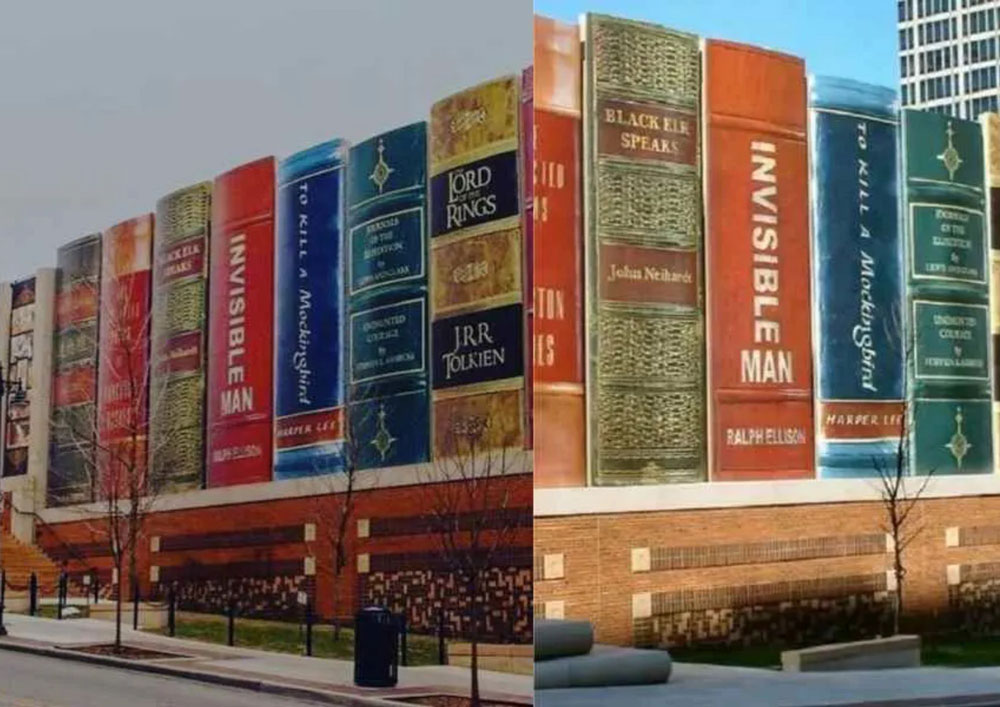
In the heart of Kansas City, one public library looks like something far larger than a building: a giant bookshelf filled with famous books. The Kansas City Public Library’s striking Community Bookshelf features 22 enormous book spines, each about 25 feet tall, turning literature into architecture and making the library one of the city’s most recognizable landmarks. But behind those giant books is a real public library built to serve the community.
It Looks Like a Giant Bookshelf From the Street
At first glance, the building can look less like a library and more like an enormous collection of books standing upright along the street. Instead of hiding the idea of books inside the building, the designers placed them directly onto the exterior.
The result is the Community Bookshelf, one of the most recognizable features of the Kansas City Public Library’s Central Library. The enormous book spines line the exterior of the parking garage and create the impression that the entire building is a giant shelf filled with literature.
The idea works because the visual message is almost impossible to misunderstand.
You do not need to see a sign explaining that the building is associated with books. The books themselves are the sign.
From a distance, the colorful spines immediately attract attention. Drivers and pedestrians can see titles that would normally appear on the shelves of a bookstore or library, except these books are enormous.
Instead of asking visitors to imagine the stories waiting inside, the building puts literature directly into the city’s streetscape.

The Community Bookshelf Holds 22 Giant Book Spines
The feature is officially known as the Community Bookshelf, and its scale is what makes it so memorable.
The installation consists of 22 giant book spines, each measuring approximately 25 feet high. Together, they create the appearance of a massive bookshelf running along the side of the library’s parking facility.
That scale completely changes how people normally experience books.
A conventional book is something you hold in your hands. Even a large hardcover occupies only a small amount of physical space. Here, individual works of literature become pieces of architecture.
The books are no longer objects sitting quietly on shelves.
They become part of the city.
The design also gives the building a playful quality. A parking garage is normally one of the less exciting elements of an urban environment, but covering its exterior with giant books transforms something utilitarian into a landmark.
It is an unusual example of architecture communicating its purpose through imagery rather than relying entirely on conventional signs and symbols.
Anyone walking past can immediately understand the connection between the building and literature.
Want to see the giant bookshelf for yourself? Watch the video to take a closer look at Kansas City’s remarkable library landmark and the 22 enormous book spines that transformed a parking garage into one of the city’s most recognizable sights.
The Books Were Chosen From Beloved Classics
The giant book spines were not simply decorated with random titles. They were selected to represent books that could appeal to a broad community of readers.
Among the titles represented are well-known works such as The Adventures of Huckleberry Finn, To Kill a Mockingbird, The Lord of the Rings, A Tale of Two Cities and Romeo and Juliet.
Other selections include books familiar to younger readers, including Winnie the Pooh, Little House on the Prairie and The Wonderful Wizard of Oz.
The variety is part of what makes the bookshelf interesting.
Instead of presenting literature as something belonging to one particular generation or type of reader, the selection brings together different periods, genres and audiences.
Someone might recognize a Shakespeare play.
Another person might immediately spot a childhood favorite.
Someone else might recognize a famous American novel or a fantasy classic.
The titles therefore work almost like invitations. They give people a reason to stop, look more closely and think about the books they have read—or perhaps the ones they have always intended to read.
The bookshelf becomes more than a decoration. It becomes a conversation between the city and its readers.

The Building Turns Reading Into Architecture
The most interesting part of the Community Bookshelf is not simply that the books are large. It is the idea behind making literature part of the building itself.
Libraries traditionally place books inside.
You enter the building, walk between shelves and discover thousands of titles waiting to be explored.
Kansas City reverses that relationship.
Here, the books are visible before you even walk through the doors.
The exterior effectively announces the purpose of the institution. It turns an abstract idea—love of reading—into something physical and immediately recognizable.
This also creates an unusual relationship between literature and architecture. A book normally tells a story through words and images, while architecture tells a story through space, materials and design.
The Community Bookshelf combines the two.
The building becomes a giant visual representation of the library’s collection and its role within the community.
It also demonstrates how public architecture can be playful without losing its purpose. The design attracts attention precisely because it is unexpected, but underneath the novelty is a straightforward message: books and reading are important enough to become part of the city’s identity.
Inside, It Is Still a Real Public Library
The giant bookshelf may be the feature that attracts photographers and tourists, but the building itself serves a much more practical purpose.
Behind the unusual facade is a functioning public library.
The Central Library provides residents and visitors with access to books, resources, programs and spaces for learning. People can come to read, study, research, attend events or simply spend time in a public environment centered around information and culture.
That distinction is important.
The building is not merely a piece of public art that happens to look like a library. The unusual exterior supports the identity of a working public institution.
The giant books attract attention from outside.
The library’s real purpose begins once people walk inside.
In that sense, the Community Bookshelf works particularly well because the design does not replace the function of the building. Instead, it reinforces it.
A visitor sees the giant books outside and immediately understands what kind of place they are approaching.
A Building Designed to Make People Fall in Love With Books
The Kansas City Public Library’s giant bookshelf succeeds because it turns an ordinary idea into something impossible to overlook.
Books are usually associated with quiet rooms, wooden shelves and small printed pages. Here, they become enormous architectural objects visible from the street.
That transformation gives the library a distinctive identity while also making literature part of the public landscape.
The Community Bookshelf suggests that a library does not have to feel hidden or formal. It can be playful, memorable and visually connected to the people it serves.
It also creates an interesting contrast with the modern world. As more reading moves onto phones, tablets and computers, Kansas City’s giant physical representation of books makes the printed word visible on an almost monumental scale.
You do not have to enter the library to encounter its message. You can simply drive or walk past and see dozens of feet of literature standing above the street. And perhaps that is the most successful part of the design. It makes people curious. Someone who notices the giant bookshelf may wonder which titles are represented, why those books were chosen or what is waiting inside the building.
A piece of architecture has accomplished something that every good library hopes to do: it has made people want to discover a book.
The Kansas City Public Library proves that a library does not have to look ordinary. By turning 22 giant book spines into part of its architecture, the Community Bookshelf transforms famous stories into a landmark that anyone can see from the street. Behind those enormous books is still a real public library, but the building itself has already done something remarkable: it makes people stop, look and think about books before they even walk through the doors.

The Kansas City Public Library proves that a library does not have to look ordinary. By turning 22 giant book spines into part of its architecture, the Community Bookshelf transforms famous stories into a landmark that anyone can see from the street. Behind those enormous books is still a real public library, but the building itself has already done something remarkable: it makes people stop, look and think about books before they even walk through the doors.