The 1970s changed what Americans wanted from their cars, and the Chevy Nova changed with them. A model that entered the decade with genuine muscle-car credentials and engines producing up to 375 horsepower gradually became a practical compact focused on affordability, fuel economy and reliability. From the oil crisis to its surprising success with police departments, the Nova’s story reflects how dramatically America’s car culture shifted during one of the most turbulent decades in automotive history.
Before the Oil Crisis, the Nova Still Had Muscle-Car DNA
The Nova began life in 1962 as the Chevy II, Chevrolet’s quick response to compact cars such as the Ford Falcon. It was originally designed as straightforward, inexpensive transportation rather than as a performance icon. By 1969, however, Chevrolet had dropped the Chevy II name and moved the entire lineup under the Nova name. By then, the compact had developed a much more interesting personality.
The 1969 Nova could be ordered with a 396-cubic-inch V8 producing 375 horsepower. That made it a genuine muscle car in a relatively compact package, and its front suspension geometry was shared with the Camaro. The performance-oriented formula continued into the beginning of the 1970s, with the 1970 Nova SS 396 still producing 375 horsepower.
That combination made the early-1970s Nova particularly interesting. It was small enough to be more manageable than many full-size American cars, but buyers could still choose serious V8 performance. The Nova therefore represented a moment when practicality and muscle-car culture could still coexist in the same Chevrolet.
But that era was about to change.

The Nova Changed as America Changed
The 1973 oil crisis permanently changed the conversation around American automobiles. Fuel economy and operating costs became much more important, and automakers had to reconsider the idea that bigger engines and larger cars were always better.
Chevrolet’s response was visible in the redesigned fourth-generation Nova introduced for the 1975 model year. The car moved away from its earlier performance-oriented image and adopted a more formal, boxier appearance. Instead of emphasizing the attitude of the SS, Chevrolet increasingly positioned the Nova as a sensible family compact.
The mechanical changes reflected the new priorities as well. A catalytic converter became standard, which meant the car required unleaded fuel, while engine choices became less aggressive than they had been during the height of the muscle-car era. The Super Sport package, which had been one of the Nova’s most recognizable performance features since the 1960s, was discontinued after 1976.
At first glance, this might seem like the end of the Nova’s identity. In reality, it was an adaptation to a changing market.
The car no longer needed to convince buyers that it was powerful.
It needed to convince them that it made sense.
Want to take a closer look at the iconic Chevy Nova and its transformation through the 1970s? Watch the video to explore its design, performance and the story behind one of Chevrolet’s most memorable cars.
The Nova Became the Practical Car Americans Wanted
Chevrolet’s advertising from the early 1970s reveals how the company was repositioning the Nova. A 1971 advertisement emphasized the car’s dependable reputation, reasonable price, manageable dimensions and relatively low operating costs. Chevrolet presented it as neither too small nor too large, highlighting its ability to remain easy to park and handle while still providing useful interior and cargo space.
That approach became even more obvious in 1972, when Chevrolet introduced the Nova hatchback coupe. Instead of a conventional trunk, the hatchback provided a large rear opening and a folding rear seat that created a roughly six-foot load floor. Chevrolet promoted it as a vehicle that could function somewhat like a station wagon while retaining the compact dimensions of the Nova.
The advertising also emphasized the model’s reputation among mechanics. A 1972 advertisement cited a survey from Motor Service and Service Station Management magazines that rated the Nova highly for ease of service, mechanical reliability and overall performance among compact cars.
This was a very different sales pitch from the one used for a 375-horsepower SS.
Instead of asking buyers how fast they wanted to go, Chevrolet was asking them how much they valued reliability, practicality and manageable ownership costs.
The Nova had become a car for everyday life.

In 1974, Economy Became Part of the Nova’s Identity
By 1974, Chevrolet was openly embracing the Nova’s role as an economical compact. The Nova 6 was marketed around the idea that buyers could save money on operating costs without sacrificing interior space.
The model was available in three body styles: a two-door, a three-door hatchback and a four-door. Chevrolet emphasized that the two-door was small enough to be easy to drive and park while still offering room for up to six passengers. The four-door provided additional convenience for rear-seat passengers, while the hatchback could transform into a practical cargo carrier when the rear seat was folded down.
The 1974 Nova 6 advertisement listed a base price of $2,647 for the standard two-door coupe. Chevrolet also highlighted its interior dimensions, claiming that the Nova offered more front and rear headroom and shoulder room than any domestic compact at any price according to the cited Automotive Industries Roominess Index.
The message was clear: the Nova was not trying to be the most exciting car in the showroom.
It was trying to be the car that made the most sense.
That was increasingly valuable in an America where drivers were paying much closer attention to fuel consumption and household budgets.

The Nova Found a New Reputation With Police Departments
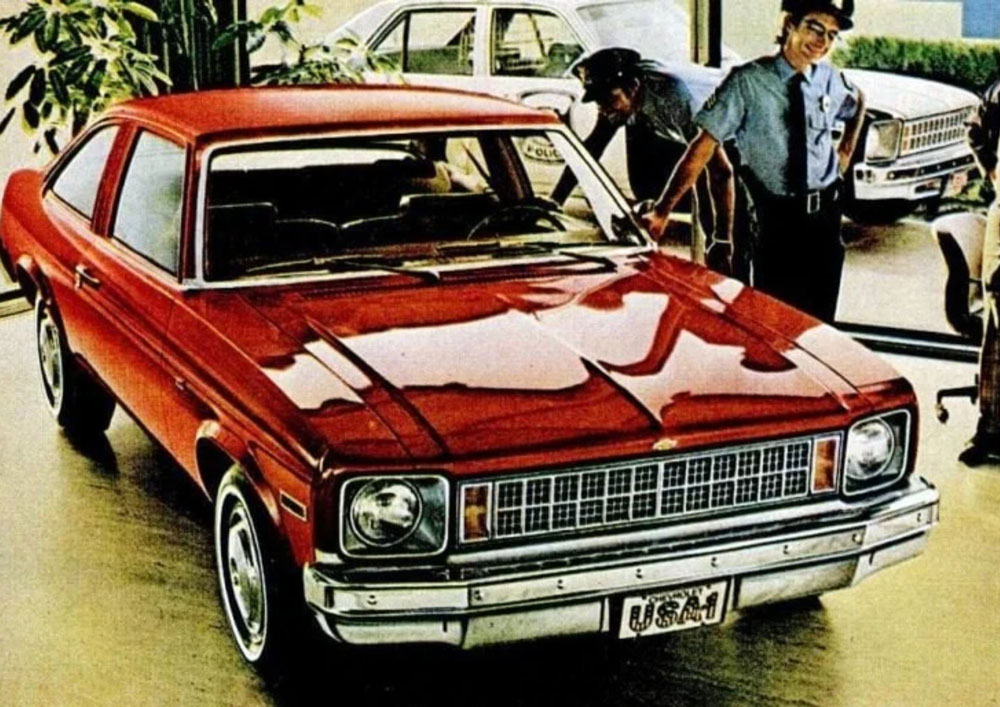
Perhaps the most surprising chapter in the Nova’s 1970s story came when police departments began adopting it.
In 1976, the Los Angeles County Sheriff’s Department tested six competing compact cars. The vehicles were subjected to 24 separate durability and performance tests. After the testing was completed, the department ordered 222 Chevrolet Novas, which Chevrolet described as the largest single order for compact police cars in U.S. history at that time.
Chevrolet quickly turned that result into a marketing advantage.
The company argued that many of the characteristics police departments valued—durability, reliability and rugged performance—were also important to ordinary drivers. The same factory building specially equipped police Novas was producing regular Novas for customers.
By 1978, specially configured police Novas had reportedly reached departments in 47 states. Chevrolet promoted the model as a proven compact police car, using its law-enforcement reputation to reinforce the Nova’s image among everyday buyers.
This was a remarkable transformation.
A car that had entered the decade with a 375-horsepower V8 could now be marketed just as effectively through its durability and efficiency.
The Nova had not disappeared because the muscle-car era ended. It had found another reason to matter.
The Nova’s Final Years Marked the End of an Era
By 1978, the Nova had become a veteran of the Chevrolet lineup. The company advertised the Nova Coupe at a starting price of $3,702 and highlighted its combination of quality and value. Chevrolet also stated that approximately four million Novas had been sold over the model’s history.
Fuel economy had become an important part of the sales message. The standard 250-cubic-inch six-cylinder engine with manual transmission was advertised with EPA estimates of 26 mpg highway and 19 mpg city, although actual mileage varied according to driving conditions and equipment.
The Nova continued through the 1979 model year, with the final custom-order examples completed in March of that year. Chevrolet replaced it with the front-wheel-drive Citation, reflecting another major change in the company’s approach to compact cars.
Interestingly, the Nova name would return from 1985 through 1988, but the later car was fundamentally different. It was built at the NUMMI plant in Fremont, California, through a General Motors-Toyota partnership and was essentially a rebadged Toyota Corolla. After that brief return, the Nova name disappeared for good.
The 1970s Nova therefore represents much more than one Chevrolet model. It captures an important transition in American automotive history. At the beginning of the decade, a compact Chevrolet could still carry serious V8 muscle-car credentials. By the middle of the decade, the same name was associated with practicality, efficiency and affordable transportation. By the end, its reputation for durability had become strong enough to attract police departments across the country.
The Nova did not simply survive the 1970s. It changed with America.

The 1970s Chevy Nova tells the story of an American car industry forced to adapt. It entered the decade with muscle-car performance, but the oil crisis, changing regulations and new consumer priorities pushed Chevrolet toward efficiency, practicality and affordability. The Nova’s later success with police departments showed that its new identity was not simply about saving fuel—it was also about durability and reliability. By the time production ended in 1979, the Nova had evolved from a compact performance car into something arguably more important: a practical symbol of how American drivers changed with the times.