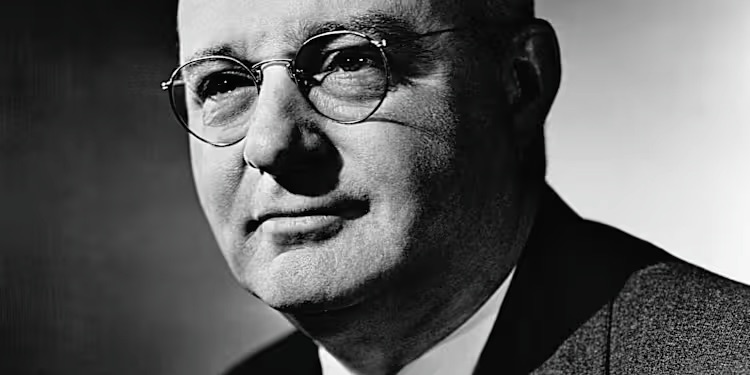
Thomas Midgley Jr. spent his career solving practical problems with chemistry. In the 1920s, he helped develop tetraethyl lead, a fuel additive that dramatically reduced engine knock and helped engineers build more powerful gasoline engines. A few years later, he and his colleagues developed chlorofluorocarbons, or CFCs, to replace hazardous refrigerants used in early cooling systems. At the time, both achievements looked like breakthroughs. Decades later, leaded gasoline became a major source of widespread lead exposure, while CFCs were found to damage the ozone layer and contribute strongly to warming. Midgley’s career became an extraordinary lesson in unintended consequences.
He Started By Solving The Problem Of Engine Knock
When Midgley joined General Motors’ research operation, one of the major challenges facing automobile engineers was engine knock. Under heavy loads, early internal-combustion engines could produce destructive combustion inside the cylinders, limiting how much power engineers could extract from them.
Midgley and other researchers tested large numbers of possible fuel additives. In December 1921, he and Thomas Boyd reported that tetraethyl lead dramatically suppressed engine knock. The compound was effective at very small concentrations and allowed engines to operate with higher compression and greater power. The U.S. Environmental Protection Agency later described the discovery as an important step in the development of high-power internal-combustion engines.
From an engineering perspective, the appeal was obvious. Instead of redesigning the entire engine, manufacturers could change the fuel and solve a major combustion problem. The chemistry worked remarkably well. The problem was what happened next.
One scientist, two disasters, and millions of lives changed. You won’t believe the true story behind the inventions we take for granted. Watch the full story now!
Leaded Gasoline Made His Discovery A Commercial Success
Tetraethyl lead reached the market in 1923 under the name Ethyl. General Motors and Standard Oil formed the Ethyl Gasoline Corporation to manufacture and sell the additive, and leaded gasoline quickly became part of the rapidly expanding automobile industry.
The additive did something the industry desperately wanted: it allowed gasoline engines to produce more power without suffering destructive knock. That helped make higher-compression engines practical and contributed to the development of increasingly powerful automobile and aircraft engines. The EPA describes tetraethyl lead as an important enabler of the high-power internal-combustion engines that dominated American transportation for decades.
At the time, this looked like exactly what industrial chemistry was supposed to accomplish: take a difficult engineering problem and solve it cheaply at enormous scale. But there was already a warning attached to the solution.
Lead was not an unknown substance with mysterious properties. Its toxicity was established, and concerns about tetraethyl lead appeared from the beginning of its commercial development. Smithsonian notes that the compound was recognized as poisonous when it entered gasoline production.
Then Workers Began Showing Signs Of Lead Poisoning
The warning became impossible to ignore in 1924, when workers at an experimental tetraethyl-lead plant in New Jersey suffered severe poisoning. Five workers died, while 35 others experienced symptoms including tremors and hallucinations. The incident triggered public concern and led some states to suspend or restrict sales of leaded gasoline temporarily.
Midgley himself had already experienced serious exposure to tetraethyl lead. History records that he inhaled the fumes and even washed his hands in the chemical while participating in demonstrations intended to show that the product could be handled safely. He subsequently became ill and needed time away from work.
The episode reveals one of the most complicated aspects of Midgley’s story. The technical usefulness of tetraethyl lead was real, but so were the health risks. Industry, government agencies and researchers continued debating how those risks should be understood and controlled while the product became increasingly embedded in the fuel system.
Leaded gasoline ultimately remained widely used for decades before being phased out in many countries. In the United States, regulatory action to reduce leaded gasoline use accelerated in the 1970s. The environmental legacy lasted much longer, because lead deposited in soil and dust can remain long after the fuel itself is gone. Midgley’s next major invention began with a very different problem.

He Found Another “Safe” Solution For Refrigerators
Early refrigeration presented an engineering challenge that had little to do with automobiles. Refrigerators needed chemicals that could efficiently absorb and release heat, but many of the refrigerants then in use were either toxic, flammable or both. Ammonia, sulfur dioxide and other compounds had obvious safety disadvantages for domestic refrigeration.
General Motors and its refrigerator division Frigidaire wanted a safer alternative. Midgley and a team of chemists began searching for a compound that would be chemically stable, nonflammable and much less toxic than the refrigerants being used at the time.
In 1930, they developed dichlorodifluoromethane, later known as R-12 or Freon-12, the first commercially important CFC refrigerant. The compound was unusually stable and appeared dramatically safer for everyday refrigeration.
To demonstrate just how safe the new refrigerant appeared to be, Midgley famously inhaled it and then blew it across a candle flame, extinguishing the flame. By modern safety standards, the stunt was obviously inappropriate, but at the time it was an impressive demonstration of the material’s low flammability. The new chemistry seemed to have solved another difficult industrial problem. This time, the problem was simply much farther away.
CFCs Solved One Problem And Created Another
CFCs became enormously useful. They were used not only in refrigerators and air-conditioning systems but also as aerosol propellants and in other industrial applications. Their chemical stability was precisely what made them attractive: they did not readily react with materials around them.
That stability, however, had an unexpected consequence.
CFC molecules could survive long enough to reach the upper atmosphere. There, ultraviolet radiation could break them apart and release chlorine atoms. Those chlorine atoms participate in chemical reactions that destroy ozone, weakening the protective ozone layer that shields Earth’s surface from harmful ultraviolet radiation.
Scientists eventually recognized the scale of the problem, and international governments negotiated the Montreal Protocol in 1987 to phase out substances that damage the ozone layer. The agreement became one of the major environmental treaties of the modern era.
CFCs also turned out to be powerful greenhouse gases. Some have atmospheric lifetimes measured in decades or even more than a century, meaning their effects can persist long after production is reduced.
The irony is striking: the very chemical stability that made CFCs such excellent refrigerants also made them persistent enough to cause a problem high above the Earth.
His Story Became A Lesson In Technological Consequences
It is tempting to look backward and describe Midgley as if he knowingly created two global environmental problems. The historical record is more complicated.
The two discoveries emerged from different technical problems, different scientific knowledge and different understandings of risk. CFCs were developed specifically because earlier refrigerants presented serious hazards, and their effect on the ozone layer was not understood when they were introduced.
Leaded gasoline is a more difficult case because the toxicity of lead was already known, and serious occupational poisoning occurred during the early development of tetraethyl lead. The eventual widespread use of leaded gasoline therefore reflected not just one inventor’s decisions, but the choices of corporations, regulators, engineers and industries that continued to adopt and expand the technology. That is what makes Midgley’s career so interesting.
He demonstrated how powerful industrial chemistry could be: one compound could change the performance of an engine, while another could make refrigeration vastly safer and more practical.
But chemistry does not exist in isolation. A substance that solves one problem can create another somewhere else, sometimes on a completely different time scale.
Midgley developed roughly 170 patents during his career, and many of his achievements were celebrated in his lifetime. The later history of leaded gasoline and CFCs illustrates a much broader lesson about technological progress: an invention can be successful, useful and commercially transformative while still carrying consequences that its creators cannot fully see.
Thomas Midgley’s career shows how complicated technological progress can be. He helped solve engine knock with tetraethyl lead and helped make refrigeration safer with CFCs, two breakthroughs that transformed modern industry. Yet the first contributed to widespread lead exposure, while the second was later found to damage the ozone layer and contribute to warming. His story is not simply about one inventor creating harmful chemicals. It is about how technologies designed to solve immediate problems can produce consequences that may remain invisible until they are used on a global scale for decades.
The original HISTORY article traces Thomas Midgley’s career from the development of leaded gasoline to the creation of CFC refrigerants, showing how two celebrated industrial innovations later raised major health and environmental concerns. Additional scientific and historical sources provide context on the chemistry, the early warnings and the eventual consequences of these technologies. Source: https://www.history.com/articles/cfcs-leaded-gasoline-inventions-thomas-midgley