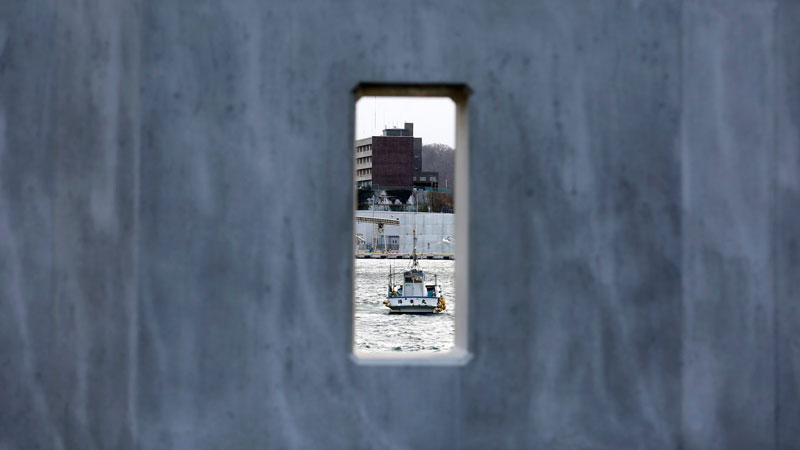
Along Japan’s northeastern coastline, enormous concrete walls now stand between towns and the Pacific Ocean. Some rise as high as 12.5 meters, while others contain openings that allow fishing boats and the sea to remain visible from behind the barrier. Together, these structures form one of the most ambitious coastal engineering projects in modern Japan. About 395 kilometers of seawalls were built at a reported cost of 1.35 trillion yen, transforming stretches of coastline into a landscape where concrete engineering and the ocean now exist side by side.
Some Of These Seawalls Rise 12.5 Meters Above The Ground
The most striking feature of Japan’s new coastal defenses is their sheer size. At Hirota Bay in Rikuzentakata, for example, a concrete seawall rises approximately 12.5 meters high, replacing an older four-meter breakwater. In photographs, ordinary objects such as vending machines look surprisingly small beside the structure, giving a clear sense of how massive these barriers really are.
The walls are not simply oversized fences placed beside the ocean. They are engineered coastal infrastructure designed to absorb, redirect and slow incoming water. Their height, thickness and position are calculated according to local geography, coastline shape and the level of protection required for the communities behind them.
The result is an unusual kind of architecture. From a distance, the walls can resemble long concrete cliffs stretching along the coastline. Up close, however, their surfaces contain roads, openings, access points and viewing sections that allow everyday activities to continue around them.
Discover the incredible story of Japan’s massive $12.7 billion tsunami seawall! Spanning 400 km, this engineering marvel was built to defy the ocean after the 2011 disaster. From automated floodgates to record-breaking foundations, see how Japan protects its coast. Watch the full engineering process now and be truly amazed!
The Walls Stretch For About 395 Kilometers
The scale becomes even more impressive when the individual structures are considered together. By 2018, approximately 395 kilometers of new seawalls had been constructed along Japan’s northeastern coast, replacing or strengthening older coastal defenses. The reported cost was about 1.35 trillion yen.
That distance is difficult to visualize. Imagine placing a concrete barrier along the coastline for hundreds of kilometers, with each section designed around the particular terrain and settlement it protects. Some sections border fishing ports, others run beside roads or residential areas, while some stand directly between beaches and nearby communities.
This is what makes the project interesting from an engineering perspective. There is no single standard wall stretching continuously from one end of Japan’s coast to the other. Instead, the defenses form a network of different structures adapted to individual locations.
The result is almost a second layer of infrastructure along the shoreline—one built specifically to manage the movement of the ocean.

Some Walls Have Windows To The Sea
Perhaps the most visually unusual detail is that some of these enormous barriers are not completely closed from the communities behind them.
At a port in Miyako, for example, a fishing boat can be seen through an opening in the seawall. Similar viewing openings appear elsewhere along the coast, creating an unexpected contrast: a massive concrete structure stands between people and the ocean, yet carefully designed gaps still provide a direct view of the water.
These openings are more than a photographic curiosity. The communities behind the walls remain closely connected to fishing and maritime activities, so completely turning the coastline into an inaccessible concrete barrier would create its own practical problems.
The design therefore has to balance protection with access. Fishing boats still need to reach ports, people need roads and walkways, and residents still need to interact with the coastline. In places, the seawall becomes almost like a piece of urban infrastructure rather than a simple barrier.
That combination makes the photographs particularly striking. A person can stand beside a wall several stories high and still look through a carefully positioned opening directly toward a fishing boat on the other side.

The Technology Is Designed To Buy Time
The most important engineering principle behind the walls is not that they can make the ocean completely harmless. Instead, they are designed to reduce the impact of flooding and delay the movement of water.
Hiroyasu Kawai, a researcher at Japan’s Port and Airport Research Institute, told the Guardian that even if a tsunami is larger than the wall, the structure can delay flooding and provide additional time for evacuation.
That makes the seawall part of a larger coastal-defense system rather than a single solution. Its effectiveness depends on the wall itself, the surrounding terrain, evacuation infrastructure and the way communities are organized behind it.
This is also why the structures can be so large. Adding height is not simply about creating a taller wall; engineers have to consider foundations, wave pressure, soil conditions, drainage and the forces generated when large volumes of water interact with the structure.
The finished product may look like an enormous slab of concrete, but underneath that simple appearance is a complex engineering problem: how do you put a massive structure along a dynamic coastline and make it remain functional for decades?

Building A Wall This Large Changes The Landscape
There is an unavoidable consequence to constructing hundreds of kilometers of concrete infrastructure beside the ocean: the coastline itself looks different.
Before the reconstruction, many communities had open views of beaches and bays. Now, in some locations, residents and visitors see large concrete barriers before they see the water. A photograph from Kesennuma shows a man looking through an opening in a seawall, while another shows a bus traveling alongside one in Yamada.
This has created an unusual architectural landscape in which roads, homes, fishing facilities and public spaces are built around enormous coastal structures. The walls have become part of everyday life rather than temporary construction projects.
Some residents have also raised concerns about the effect on tourism and the traditional relationship between communities and the sea. The Guardian documented visitors who remembered driving along scenic coastal roads where the ocean was once fully visible.
From an engineering perspective, however, the walls represent a deliberate trade-off: changing the appearance and accessibility of the coastline in exchange for another layer of physical protection.

Japan’s Coast Has Become A Giant Engineering Experiment
What makes Japan’s seawalls fascinating is not simply their size. It is the way the country has integrated massive infrastructure into an environment that remains constantly shaped by the ocean.
The project combines reinforced concrete, coastal engineering, port design, roads, drainage systems and evacuation infrastructure. Some areas also restrict new housing construction in low-lying coastal zones and encourage relocation toward higher ground, meaning the seawalls are only one component of a much broader redesign of coastal communities.
The photographs reveal the scale better than statistics ever could. A person walking beside the wall looks tiny. A fishing boat visible through one of its openings appears almost like a model. And in some locations, the wall stretches so far along the coast that it becomes part of the horizon.
Japan’s northeastern coastline has therefore become an unusual example of how modern engineering can reshape an entire landscape. The ocean remains exactly where it has always been, but between the water and the communities now stands a vast network of concrete structures designed to control how the two interact.

Japan’s giant seawalls are a remarkable example of coastal engineering on a massive scale. Rising as high as 12.5 meters in some locations and extending for roughly 395 kilometers, the structures combine concrete construction, coastal planning and carefully designed openings that allow communities to remain connected to the sea. They have transformed the appearance of Japan’s northeastern coastline, turning ordinary beaches and fishing ports into places where enormous engineered barriers dominate the landscape. From an engineering perspective, they show how dramatically modern infrastructure can reshape the boundary between land and ocean.
The Guardian’s photo essay provides a striking visual record of these seawalls, including their scale, unusual openings and integration into fishing communities and coastal roads. Source: https://www.theguardian.com/world/gallery/2018/mar/09/after-the-tsunami-japan-sea-walls-in-pictures