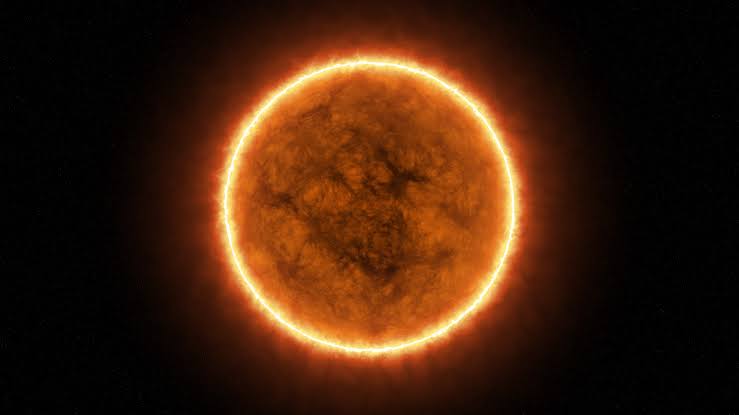
If the Sun suddenly disappeared, life on Earth would continue normally for a little over eight minutes. The sky would still look familiar, sunlight would still reach the ground, and Earth would continue moving along its orbit as if nothing had happened. Then, about 8 minutes and 20 seconds later, the sunlight would vanish—and so would the Sun’s gravitational hold on our planet. Earth would begin drifting through space, while the surface slowly lost the energy that has supported life for billions of years. The strange part is that the disaster would not begin with a sudden explosion, but with a delay.
For 8 Minutes And 20 Seconds, Nothing Would Seem Wrong
The first thing to understand is that Earth never sees the Sun exactly as it is “right now.” The Sun is about 150 million kilometers away, and its light takes roughly 8.3 minutes to reach us. In other words, every sunrise and every ray of sunshine we see is already more than eight minutes old.
So imagine that the Sun somehow vanished at this exact moment. For the next 8 minutes and 20 seconds or so, nobody on Earth would notice anything unusual. Daytime would remain daytime, shadows would still appear on the ground, and the Moon would continue to shine at night because we would still be seeing reflected sunlight that had already left the Sun.
The same delay applies to gravity. Earth is held in its orbit by the Sun’s gravitational influence, but changes in that influence do not reach us instantaneously. NASA explains that in the hypothetical case of the Sun suddenly disappearing, Earth would continue orbiting for roughly eight minutes before losing the Sun’s gravitational attraction.
For those few minutes, the most extraordinary event in the Solar System would already have happened—but from Earth, everything would look completely normal.
Ever wondered what would happen if the sun suddenly went out? While it sounds like a disaster, this fascinating video explores some bizarre, unexpected “benefits” to the scenario—before revealing the chilling reality. Don’t miss this mind-bending deep dive into one of science’s most popular questions. Watch it now!
Then The Sun Would Disappear From The Sky
At roughly the 8-minute-20-second mark, the situation would change almost simultaneously.
The sunlight would stop arriving. The daytime sky would become dark, with stars becoming visible even though the clock might say noon. The Moon would also disappear from view because it does not produce its own visible light; it shines by reflecting sunlight. NRAO describes the result simply: Earth would be left in darkness except for light from the stars.
But the darkness would not be the only dramatic change.
Earth would also stop following its current orbit around the Sun. It would not suddenly plunge downward, because there is no invisible “down” in space. Instead, Earth would continue moving in the direction it was already traveling, essentially along a straight path tangent to its former orbit. NASA’s Jet Propulsion Laboratory describes the same basic result: without the Sun’s gravity, Earth would fly off along a straight line rather than continuing its orbit.
This would be one of the strangest moments imaginable. The planet would still be rotating. The atmosphere would still be there. The oceans would still be there. People would still be standing on the ground. But Earth would no longer be circling the Sun.

The Planet Would Not Freeze Instantly
One of the biggest misconceptions about this scenario is that Earth would immediately become a frozen ball.
It would not.
The Sun provides the overwhelming majority of the energy that keeps Earth’s surface warm, but the planet does not lose all of its stored heat the instant sunlight disappears. Earth’s atmosphere, oceans and land would continue releasing heat that they had already absorbed. The atmosphere would also slow the loss of heat into space.
That means the surface temperature would fall progressively rather than instantly dropping to some extreme temperature.
The timeline would also vary greatly from place to place. Areas with large oceans would behave differently from dry land, and the atmosphere would continue redistributing heat for some time. Eventually, however, the basic direction would be unavoidable: without incoming sunlight, Earth’s surface would continue losing more energy than it received.
NASA notes that the Sun’s energy influences Earth’s weather, seasons and climate, while the atmosphere plays an important role in insulating the planet and slowing heat loss into space.
The darkness would therefore arrive in minutes, but the deepest consequences would unfold much more slowly.
Plants Would Lose Their Main Source Of Energy
The next major problem would not be cold. It would be energy.
Plants depend on sunlight for photosynthesis, the process that allows them to convert light energy into chemical energy. Once the Sun disappeared, photosynthesis would stop almost immediately.
That would eventually affect almost every ecosystem on the planet.
Plants would begin using stored energy and living off whatever resources remained available, but they could not continue producing new energy indefinitely. Herbivores would then lose their primary food source, followed by animals that depend on those herbivores. Food webs would begin collapsing from the bottom upward.
Humans would face the same fundamental problem, although our technology could buy us time. Artificial lighting could replace sunlight for some crops, and stored food could support populations for a while. Underground facilities could potentially use nuclear or geothermal energy to maintain controlled environments.
The key point is that the disappearance of the Sun would not destroy every living thing at the same moment. It would remove the primary energy source that supports most of the surface biosphere, beginning a much longer ecological decline.

Earth Would Become A Rogue Planet
As Earth moved away from its former orbit, it would effectively become a rogue planet—an object traveling through interstellar space without orbiting the Sun.
The planet would still have its own gravity. It would still rotate on its axis, so day and night would continue in the ordinary sense. The disappearance of the Sun would not cause Earth’s gravity to suddenly vanish or cause people to be thrown into space.
Instead, Earth’s entire journey through space would change.
The planet would continue along its new trajectory while becoming progressively colder. Eventually, much of the surface water would freeze. The atmosphere could also change dramatically as temperatures fell, with some gases eventually condensing or freezing under sufficiently cold conditions.
Yet Earth would not necessarily become completely lifeless.
Life has already demonstrated that it can exist without sunlight. Deep beneath the ocean, ecosystems around hydrothermal vents rely on chemical energy rather than direct sunlight. Microorganisms also live deep underground, where sunlight never reaches them.
That means the disappearance of the Sun would probably not represent the instantaneous end of all life on Earth. It would instead transform Earth from a warm, surface-dominated biosphere into a much darker and colder world where only certain environments could remain habitable.
The Sun Is More Than A Light In The Sky
The thought experiment becomes fascinating because it reveals how much of Earth’s environment depends on one distant star.
The Sun provides the energy driving Earth’s climate system, powers photosynthesis and keeps the planet warm enough for liquid water to exist across much of its surface. Its gravity also keeps Earth and the other planets in orbit. NASA describes the Sun as central to Earth’s weather, seasons and climate as well as the structure of the Solar System.
Remove the Sun, and those functions disappear separately but with different timelines.
The first effect we would notice would be the darkness. Within minutes, Earth would leave its orbit. Over longer periods, the surface would cool and ecosystems dependent on sunlight would collapse. Farther into the future, Earth would become a frozen, wandering world moving through interstellar space.
And yet the strangest part happens before any of that. For about eight minutes and 20 seconds after the Sun was already gone, we would have absolutely no idea. The sunlight reaching our faces would still be on its way.
The sudden disappearance of the Sun would not produce an immediate explosion or cause Earth to collapse. Instead, the planet would experience a delayed chain of consequences. For about 8 minutes and 20 seconds, everything would appear normal because that is how long sunlight and changes in the Sun’s gravitational influence take to reach Earth. Then the sky would go dark, Earth would leave its orbit, and the planet would gradually lose the energy that sustains its surface environment. Some life might survive in protected environments, but the familiar world above us would slowly disappear.
The National Radio Astronomy Observatory explains the immediate effects of this hypothetical scenario, including the 8-minute-20-second delay, the loss of sunlight and the end of Earth’s orbit around the Sun. NASA provides additional background on the distance between Earth and the Sun, the travel time of sunlight and the Sun’s role in Earth’s environment. Source: https://public.nrao.edu/ask/what-would-happen-to-earth-if-the-sun-suddenly-disappeared/