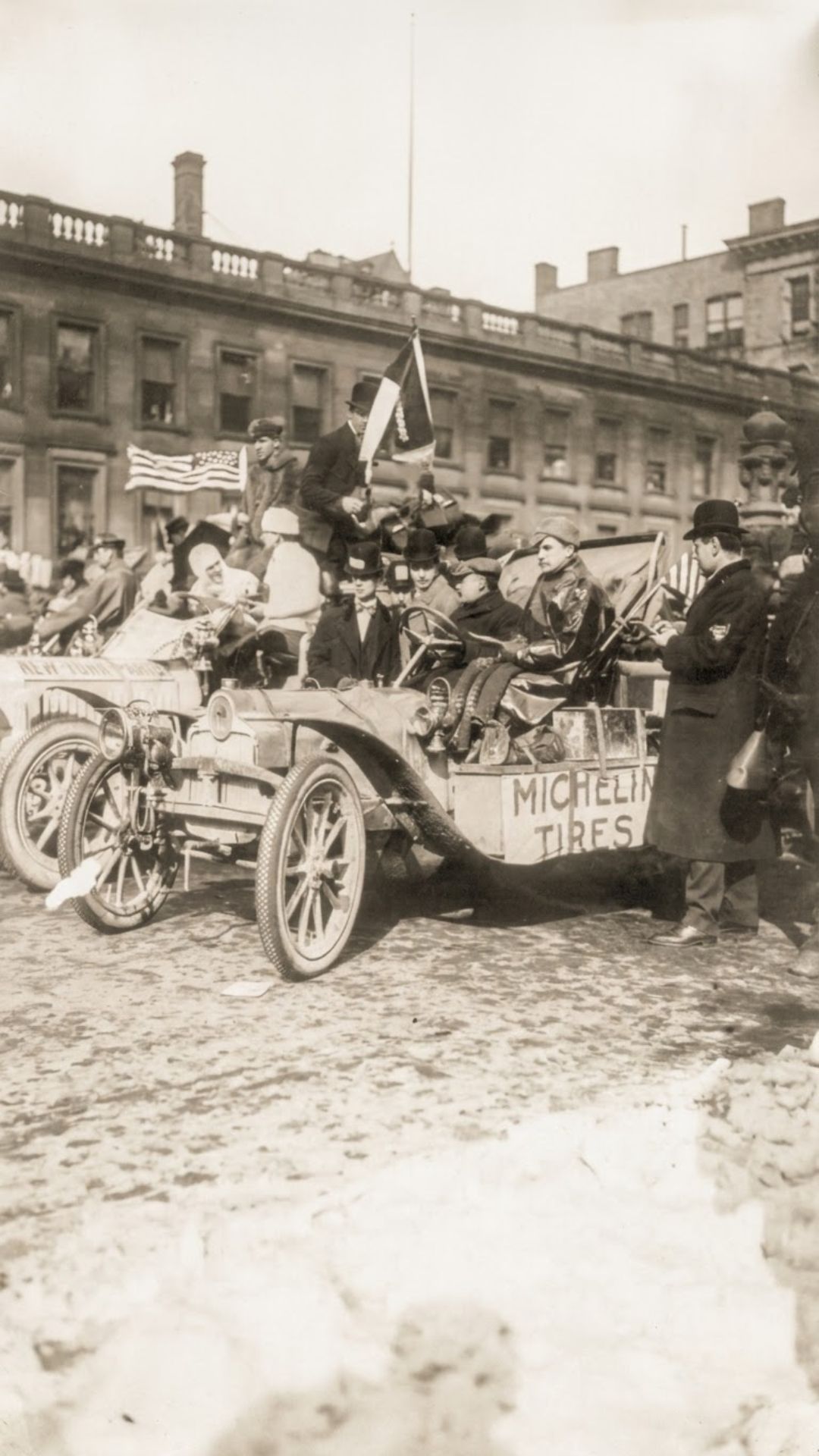
On a cold February morning in 1908, more than 250,000 people crowded Times Square to watch six automobiles begin a journey that sounded almost impossible. Their destination was Paris, thousands of miles away, and the route would cross North America, the Pacific, Japan, Siberia, Manchuria and Europe. The American entry was a 1907 Thomas Flyer, driven by George Schuster and his team. What followed was not a normal car race. It was a 169-day struggle against mud, snow, broken roads, mechanical problems and terrain that often seemed completely unsuitable for automobiles.
The Race Began With 250,000 People Watching
The race started in Times Square on February 12, 1908, with six cars representing the United States, France, Germany and Italy. Newspapers promoted the event as an extraordinary test of the automobile, and the public turned the start into a major spectacle. An estimated 250,000 people gathered to watch the cars leave New York.
The American team entered a 1907 Thomas Flyer, a large touring car built by the E.R. Thomas Motor Company of Buffalo, New York. George Schuster was its principal driver, and the car would eventually become the only American entry to complete the full route. The Thomas Flyer had a four-cylinder, 60-horsepower engine, four-speed manual transmission and rear-wheel mechanical brakes—impressive engineering for its era, but hardly the sort of machinery modern drivers would associate with a 20,000-mile international journey.
And the biggest problem was not the car itself. It was the world outside it.
In 1908, there was no modern highway network connecting New York to San Francisco, let alone a road system stretching across Asia and Europe. Large sections of the planned route had few paved roads, and some had no roads at all. The teams would have to improvise their way across terrain that had never been designed for automobiles.
Ever wonder how cars survived a 36,000-mile race through Siberia in 1908? Join Jay Leno as he gets behind the wheel of the legendary 1907 Thomas Flyer! Discover the grit, history, and raw power of the actual car that conquered the world. Don’t miss this incredible time-traveling ride. Watch now!
The First 41 Days Were Already An Adventure
The Thomas Flyer immediately faced the reality of winter motoring.
Crossing the United States meant dealing with snow, mud, rough roads and mechanical problems. The journey west was so difficult that simply reaching San Francisco became a major achievement. The Thomas Flyer arrived there after 41 days, 8 hours and 15 minutes, leading the American leg of the race. It was also the first automobile to cross the United States during winter.
Today, driving from New York to San Francisco is a routine road trip. In 1908, it was something else entirely.
There were few paved roads, limited services and no modern network of repair shops or fuel stations waiting along the route. When the cars encountered terrain that vehicles could not easily cross, crews had to find their own solutions. In some places, competitors even used railroad tracks as improvised routes when ordinary roads were unavailable.
The Thomas team therefore wasn’t simply racing another automobile. It was constantly negotiating with the landscape. Every mile completed meant the car, its tires, its engine and its crew had survived another obstacle.

The Route Became A Journey Across The World
Reaching San Francisco was only the end of the first major stage.
The original race plan called for the competitors to continue toward Alaska and eventually cross the Bering Strait, but the conditions proved impossible. Instead, the teams used ships to cross the Pacific and reached Japan before continuing toward the Asian mainland. From there, the Thomas Flyer entered one of the most difficult sections of the entire journey: Siberia and Manchuria. The contrast with modern road travel was extraordinary.
There were no continuous highways stretching across the continent. There were enormous distances between settlements, primitive roads and conditions that changed with the seasons. Spring thaw turned parts of Siberia and Manchuria into deep mud, making progress painfully slow. At times, the teams were measuring their progress in feet rather than the miles per hour that would define a modern race.
Only three of the original six competitors ultimately made it beyond Vladivostok. The Thomas Flyer was still in the race. And it still had Europe ahead.
169 Days Of Mud, Snow And Repairs
This is what makes the number 169 days so important.
The Thomas Flyer did not spend 169 days simply driving at a steady speed. The journey stretched across seasons, continents and transportation systems. The team had to keep the car functioning while navigating roads, trails and stretches where roads effectively did not exist.
George Schuster was the only driver to complete the full New York-to-Paris route. The Automotive Hall of Fame records that the Thomas Flyer covered more than 22,000 miles across three continents in 169 days.
The journey became a test of endurance as much as speed.
A modern racing team can replace damaged parts quickly, rely on detailed maps and communicate instantly with its support crew. Schuster’s team had none of those advantages. Their ability to continue depended on mechanical skill, improvisation and sheer persistence. Even the meaning of “road” was different.
A road could be a muddy track, a railway route, an uncertain trail or whatever surface allowed the car to move forward. The race was therefore partly a contest between automobiles and partly a contest between humans and geography. After more than five months on the road, the Thomas Flyer finally approached Paris.

The Car Arrived In Paris — But The Race Was Not Over
The German Protos reached Paris before the Thomas Flyer, but the apparent result was not the final result.
The German team had been penalized because it had not followed the prescribed route and had transported the car by rail for part of the journey. After the penalties were applied, the American Thomas Flyer was declared the winner.
The Thomas Flyer reached Paris on July 30, 1908, after 169 days on the journey. Some historical sources describe the event as taking 170 days, depending on how the start and finish are counted, but the 169-day figure is widely used by the Automotive Hall of Fame and the National Automobile Museum. The final arrival was fittingly dramatic.
The Thomas Flyer approached Paris with a damaged headlamp, and a police officer initially stopped the car. The team ultimately managed to continue into the city with help from a bicycle light attached to the automobile. After 169 days, the American machine finally reached the finish.
The race had begun with a quarter-million people watching in Times Square. It ended with an American car at the Eiffel Tower.
The 169-Day Journey Helped Change The Automobile
The victory mattered for reasons far beyond the race itself.
In 1908, automobiles were still associated largely with wealth, novelty and recreation. A journey of this scale demonstrated something much more consequential: an automobile could survive an extraordinarily long-distance journey across difficult terrain and between continents.
The race did not prove that automobiles were already perfect. Quite the opposite. It exposed their weaknesses at every stage. But it also demonstrated what determined drivers, mechanics and increasingly capable machines could accomplish. The event helped strengthen the idea that automobiles could become practical forms of long-distance transportation and contributed to growing calls for better roads.
The Thomas Motor Company itself would not remain a major automobile manufacturer for long. Production ended in 1913, but the winning car survived.
Today, the original 1907 Thomas Flyer is preserved at the National Automobile Museum in Reno, Nevada, where visitors can see the machine that completed one of the most extraordinary automobile journeys of the early 20th century.
More than a century later, the most remarkable number may still be the simplest one. 169 days.
That is how long it took one American automobile to travel from New York to Paris in a world where paved roads, reliable maps and modern automotive infrastructure barely existed. The Thomas Flyer did not just cross three continents. It helped show what the automobile might eventually become.
The 1908 New York-to-Paris race was far more than an early automobile competition. For 169 days, the Thomas Flyer and its crew crossed three continents through snow, mud, rough roads and vast stretches of terrain that offered little help to an automobile. The journey began before 250,000 spectators in Times Square and ended in Paris after a route of more than 22,000 miles. Its victory helped demonstrate that automobiles could become more than expensive curiosities—and the Thomas Flyer remains today as a remarkable survivor of that extraordinary journey.
The original Thomas Flyer is now preserved at the National Automobile Museum in Reno, where its story is presented as part of the 1908 New York-to-Paris race. Source: https://www.pierce-arrow.com/collections/thomas-flyer-automobiles/