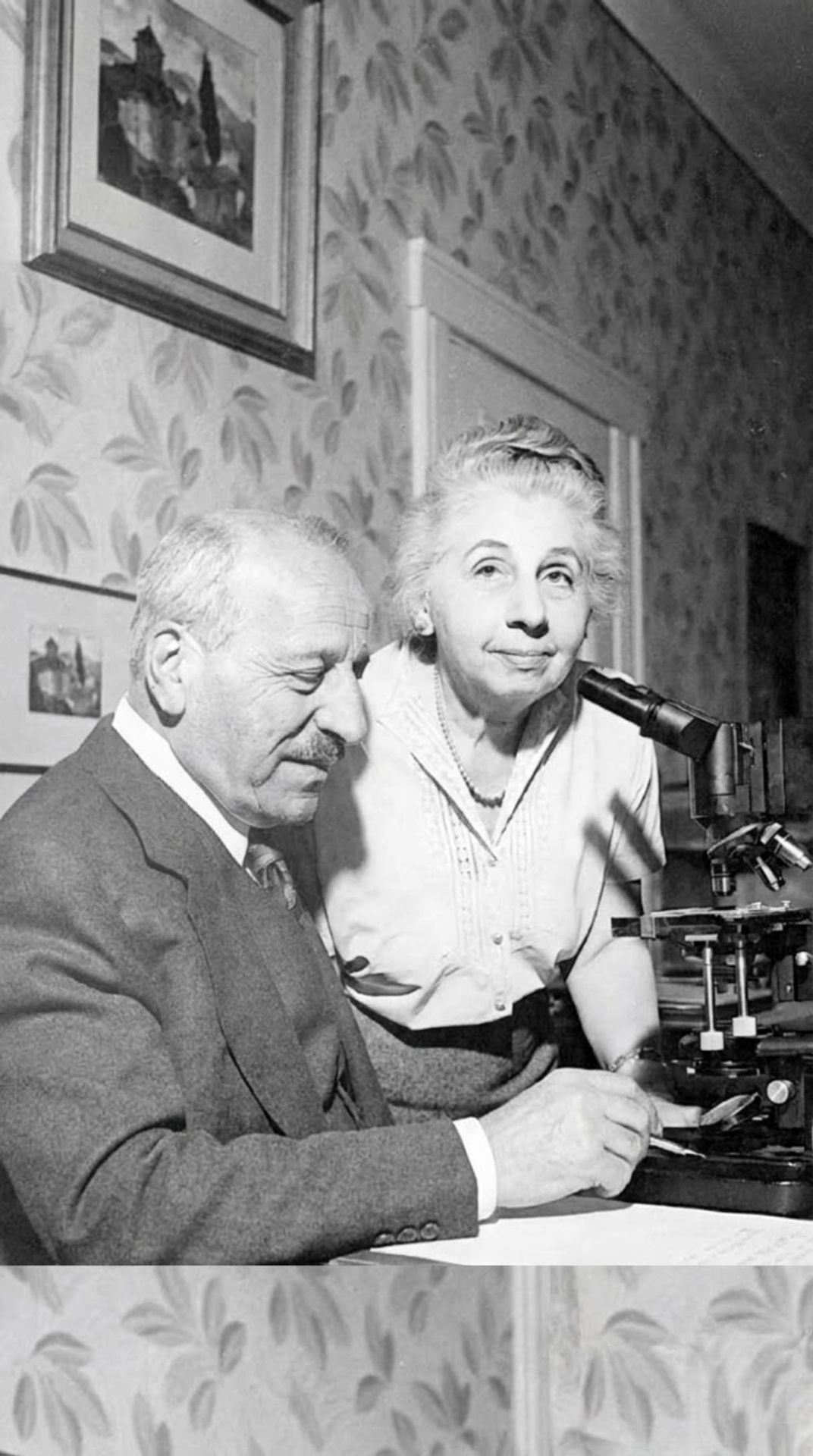
Mary Papanicolaou did something almost unimaginable by modern standards. For roughly 21 years, she allowed her husband, scientist George Papanicolaou, to collect samples of cells from her cervix again and again—eventually producing about 7,600 samples. At first, George was not looking for cancer at all. He was studying how cells changed during the reproductive cycle. But under his microscope, those ordinary cells gradually revealed patterns that would lead to one of the most important screening tests in medical history: the Pap smear.
It Started With Guinea Pigs, Not Cancer
When George Papanicolaou began this line of research at Cornell Medical College, his goal was far removed from cancer screening. He was interested in the reproductive cycle and discovered that cells found in vaginal secretions could provide clues about changes occurring inside the body. His early experiments involved guinea pigs, whose reproductive cycles could be studied by examining cells collected from vaginal fluid.
The idea was scientifically simple but potentially powerful: instead of cutting into tissue, perhaps a researcher could collect cells that had naturally been shed, place them under a microscope and learn what was happening inside the reproductive system.
George eventually wondered whether the same principle could work in humans. He asked Mary, his wife, to participate. She agreed, and the decision would become one of the most consequential contributions of her life. For years, Mary became George’s most consistent research subject, allowing him to collect samples while he learned what normal cells looked like at different stages of a woman’s life.
What began as an experiment in reproductive biology was slowly becoming something much bigger.
Did you know the life-saving Pap smear test exists because of a remarkable love story? Discover how Dr. George Papanicolaou and his devoted wife, Mary, spent decades working together to revolutionize cervical cancer screening. Watch The love story behind the Pap smear test to uncover their incredible legacy today!
Mary Became A Living Laboratory
Mary was not simply someone who occasionally helped with her husband’s work. She became an extraordinary source of long-term scientific information.
According to the Science History Institute, she allowed George to collect cervical cells nearly every day for 21 years, eventually accumulating around 7,600 samples. The repeated observations gave him something a single examination could never provide: a detailed picture of how cells changed naturally over time, from the reproductive years through menopause.
George also relied heavily on Mary outside the examination room. She assisted with laboratory work, drove him to and from Cornell, prepared meals and helped him continue working through the long hours he routinely spent studying cells.
The scientific value of her participation was enormous because George first needed to understand normal cellular changes before he could recognize something abnormal.
That distinction is fundamental to modern medicine. A scientist cannot reliably identify a dangerous pattern without first knowing what the ordinary pattern looks like. Mary’s samples helped establish that baseline. And eventually, another kind of cell appeared under the microscope.

Then The Microscope Revealed Something Disturbing
As George expanded his research to women receiving medical care, he encountered cells that looked dramatically different from the normal cells he had spent years studying.
In women with cervical cancer, the cells could become enlarged and visibly abnormal. Their appearance was different enough that George realized the microscope might be revealing cancer without requiring doctors to examine an entire piece of tissue in the traditional way. This was the crucial scientific insight.
The body was constantly shedding cells. Some of those cells could be collected relatively easily. If abnormal cells associated with cancer could be identified under a microscope, perhaps doctors could detect disease before it became obvious from symptoms.
That mattered enormously because cervical cancer can develop slowly and may cause few symptoms in its early stages. A screening method capable of finding abnormal cellular changes before advanced disease could therefore give doctors an opportunity to intervene much earlier.
But discovering something under a microscope was not the same as convincing the medical profession that it worked. George was about to learn that scientific evidence can take years to gain acceptance.

His First Big Presentation Was Almost A Failure
In 1928, George presented his findings at a conference in Michigan. The presentation should have been a breakthrough. Instead, it received little attention.
The problem was not necessarily that the underlying observation was wrong. The medical community was simply not ready to embrace a new way of detecting cancer. At the time, many physicians considered tissue biopsy and examination to be the appropriate approach, while George’s method seemed unconventional and insufficiently established.
George became discouraged and spent years continuing other aspects of his research before returning more seriously to cancer detection. Then he found an important collaborator: Herbert Traut, a gynecological pathologist at Cornell.
Together, Papanicolaou and Traut examined samples from more than 3,000 women. They identified 127 cases of cervical cancer, most of which were detected at stages when the disease might otherwise have remained unnoticed. Their work was published in the landmark 1943 book Diagnosis of Uterine Cancer by the Vaginal Smear. This time, the evidence was much harder to dismiss. The technique was becoming a real medical tool.

A Few Cells Could Tell A Much Bigger Story
The underlying principle of the Pap test is remarkably elegant.
A clinician collects cells from the cervix and sends them for microscopic examination. Historically, those cells were spread onto a glass slide and stained so that their structures could be examined more clearly. Scientists then look for cellular abnormalities that can indicate precancerous changes or cancer. Modern cervical screening has evolved considerably, but the basic idea of examining cervical cells remains rooted in Papanicolaou’s work.
The power of the method was not that it could magically identify every cancer.
Its importance was that it offered a way to look for dangerous cellular changes before a woman necessarily knew anything was wrong.
That transformed cancer detection from something largely triggered by symptoms into something that could be approached through screening.
The distinction is enormous. Instead of waiting for disease to announce itself, medicine could begin looking for early warning signs.
The Pap smear therefore became more than a laboratory technique. It became part of a new philosophy of preventive medicine.
The Test Eventually Changed The Course Of Cervical Cancer
The method did not become universally accepted overnight. It took years of additional research, clinical validation, improved techniques and organized screening programs before the Pap test became widely established.
By the 1960s, the test was being recommended more broadly in the United States. Over the following decades, cervical cancer mortality in the country fell dramatically, although access to screening has remained uneven around the world.
The science has also continued to evolve.
Researchers later established that persistent infection with certain types of human papillomavirus, or HPV, causes most cervical cancers. HPV vaccination and modern screening methods have therefore added new layers of prevention to the foundation established by early cervical cytology.
Yet the central idea remains remarkably recognizable: look closely at cells, recognize abnormal changes and find disease before it becomes advanced.
And behind that idea was a scientist who spent decades studying cells—and a woman who allowed him to study thousands of them from her own body.

The Woman Behind The Name
George Papanicolaou became the name attached to the test. Mary Papanicolaou became far less famous.
That imbalance is one of the most interesting parts of the story.
Mary was not merely a passive subject. The historical record describes her as a willing participant who worked alongside George, assisted in the laboratory and supported his research through the long period when the scientific community showed little interest in his findings. The numbers alone are extraordinary: approximately 7,600 samples over 21 years. For most people, a medical test is an event lasting minutes. For Mary, participation in this research became part of everyday life for years.
Her contribution also illustrates something important about how scientific discoveries are actually made. Breakthroughs rarely come from one dramatic moment at a microscope. They often emerge from thousands of observations, repeated measurements, failed presentations and years of patient work. The Pap smear became associated with one man’s name. But the science was built from countless cells—and many of those cells came from Mary.
The story of the Pap smear is not simply the story of a famous medical test. It is the story of how careful observation can turn something ordinary into something medically revolutionary. George Papanicolaou spent years learning what normal cells looked like before recognizing the cellular changes associated with cervical cancer, while Mary provided thousands of samples that made that long-term study possible. Their work helped establish a new approach to cancer screening: finding dangerous changes early, before symptoms become the first warning.
This story is based primarily on the Science History Institute’s account of George and Mary Papanicolaou and the development of the Pap smear, supplemented by medical and historical sources documenting the scientific validation and later evolution of cervical cancer screening. Source: https://www.sciencehistory.org/stories/magazine/21-years-7600-tests/