In 1979, West Berlin opened a building that looked less like a conference center than a spaceship waiting to leave Earth. More than 300 meters long and covered in aluminum, the Internationales Congress Centrum—better known as ICC Berlin—was one of the most ambitious buildings in postwar Germany. It could accommodate 14,500 people across 80 rooms and contained technology that seemed remarkably futuristic for its time. But the world around it changed. The Berlin Wall fell, Germany was reunified, and the enormous building eventually became too expensive to operate. By 2014, the futuristic landmark had fallen almost completely silent. What had once represented the future of West Berlin was suddenly a monument to a past that had disappeared.
Berlin Built A Building That Looked Like A Spaceship
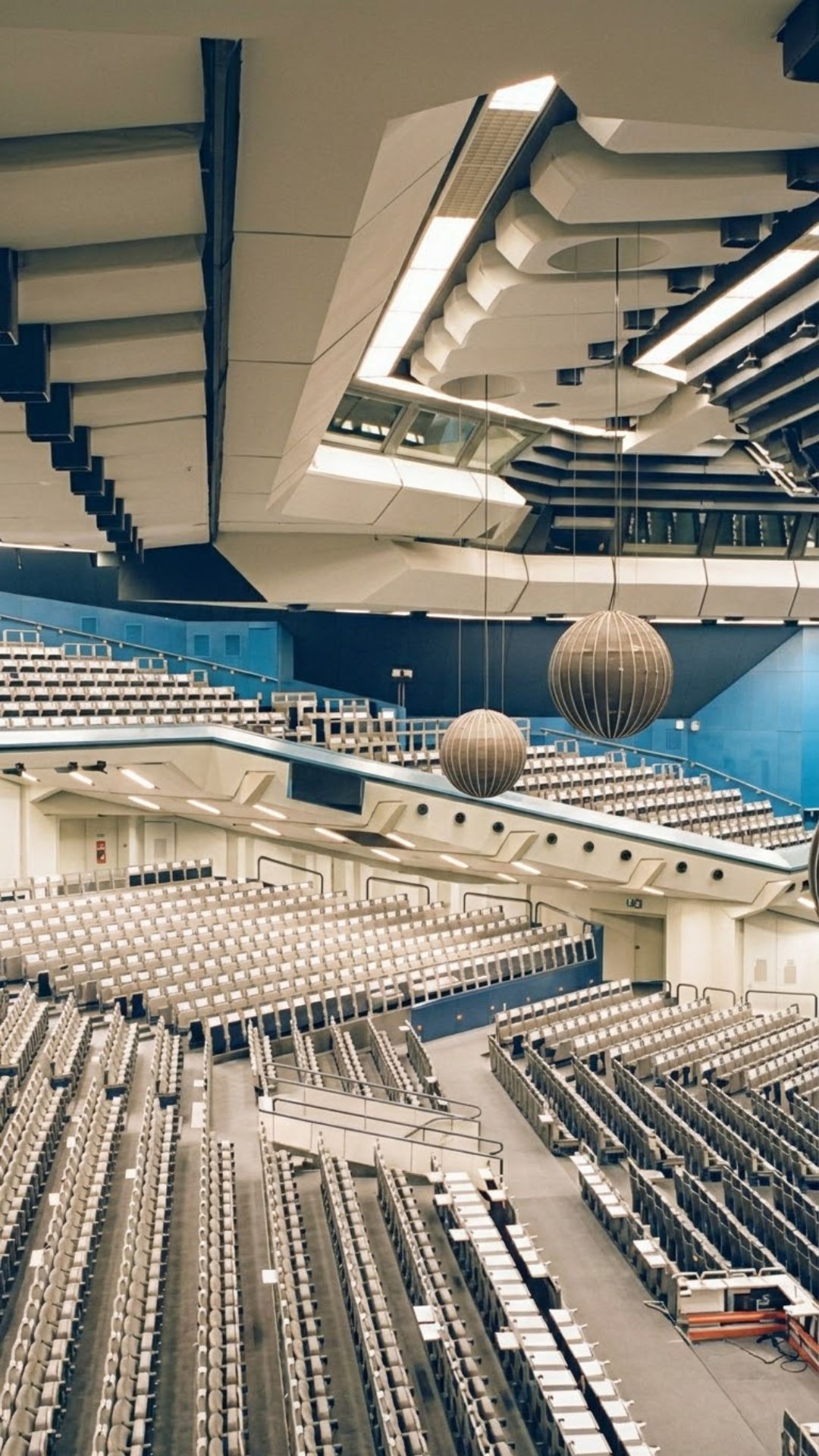
Seen from the outside, ICC Berlin is difficult to mistake for an ordinary convention center. Its huge aluminum facade stretches more than 300 meters across the landscape, while its geometric levels give the building a distinctly futuristic silhouette. The architects, Ralf Schüler and Ursulina Schüler-Witte, designed it to feel almost like a vessel, and the interior continues the illusion, with cavernous halls, elevated walkways, staircases and mezzanine levels that can make visitors feel as though they are moving through a giant ship or futuristic transportation hub.
When ICC opened in 1979, its scale was extraordinary. The building was 313 meters long, 89 meters wide and 40 meters high, making it one of the most imposing pieces of high-tech architecture in West Germany. It contained 80 flexible rooms, including a main auditorium capable of holding up to 5,000 people and another hall with room for 4,000. The building was not designed merely to look futuristic; almost every part of it was intended to communicate the idea that Berlin belonged at the center of international business and communication.
Ever wondered what a billion-dollar abandoned structure looks like? Step inside Berlin’s legendary ICC, a massive architectural marvel frozen in time. From its futuristic “spaceship” design to hidden engineering secrets, explore the history and future of this iconic landmark. Watch now to discover why this giant is being revived!
The Building Was Born From The Cold War
ICC Berlin did not appear in a politically neutral city. When its architects were developing the project, Berlin was divided between East and West, and architecture itself had become part of the competition between the two German states. West Berlin needed more than another place to hold meetings. It wanted a building that could demonstrate confidence, modernity and international relevance at a time when the city stood on the front line of the Cold War.

Across the Wall, East Germany was developing its own architectural statement: the Palast der Republik, a vast complex intended to serve as the seat of parliament and a major public building. Its plans were advancing at almost exactly the same time as the ICC project. The two buildings eventually became very different expressions of the same political reality, with both sides using enormous modern structures to project an image of strength, progress and national identity. In that sense, ICC Berlin was never simply a conference center. It was part of the architecture of a divided Europe.

West Berlin Wanted Something Bigger Than The Future
The story of ICC actually began with a problem that sounds almost ordinary: Berlin needed somewhere bigger to hold international conferences. The existing Kongresshalle in Tiergarten, which could accommodate about 1,200 people, was increasingly considered too small for the city’s ambitions. In 1966, officials organized a competition for a new multipurpose hall with a proposed capacity of roughly 4,000. The winning design came from the relatively unknown architectural team of Schüler and Schüler-Witte.
Then the project became much larger. City officials decided that the original proposal would not be enough for the future they were imagining. Instead of settling for a conventional conference building, the architects were eventually asked to create something far more ambitious: a gigantic structure capable of handling international gatherings on an entirely different scale. The final result was so large and technologically ambitious that it became the most expensive building ever constructed in West Germany when it opened, with construction costs approaching one billion Deutsche Mark.

Inside Were Technologies That Seemed Almost Futuristic
The most impressive part of ICC was not simply its size. It was what the building allowed people to do inside it. Thousands of visitors could gather under one roof, move between dozens of spaces and participate in international conferences supported by technology that was advanced for the late 1970s. One of the clearest examples was the conference seating: approximately 8,000 chairs were equipped with integrated interpretation technology capable of supporting up to eight languages.

The architecture was also designed around movement. Long staircases, escalators, elevated walkways and large intermediate spaces connected the various parts of the building, creating an experience that was closer to navigating a futuristic transport terminal than entering a traditional meeting hall. Even the lighting contributed to the effect. Artist Frank Oehring created an extraordinary installation known as The Brain, a network of neon elements that wound through the lower levels and became part of the building’s wayfinding system.

Then The Berlin Wall Fell
For more than a decade after its opening, ICC Berlin stood as a symbol of West Berlin’s ambitions. Then history moved faster than the building could have anticipated. In 1989, the Berlin Wall fell, and in 1990 Germany was reunified. The political world that had helped give ICC its meaning disappeared almost overnight. The city was no longer an isolated Western outpost surrounded by the territory of East Germany. It was becoming the capital of a reunified country.
The transformation produced a striking contrast between the two great conference-era monuments of divided Berlin. ICC survived, but the Palast der Republik eventually did not. The East German building was demolished in 2008 after years of controversy, with many former East Germans regarding its destruction as an attack on part of their architectural and cultural history. ICC, meanwhile, remained standing—but its survival would bring a different problem. Keeping such an enormous building alive was becoming extraordinarily expensive.

The Future Suddenly Had A Problem
By the 21st century, the technology and infrastructure that had once made ICC exceptional were no longer enough to justify its enormous operating costs. In 2014, the building was effectively retired from regular use because maintaining it as an active conference center was considered too expensive. The spaceship remained where it had always been, but the crowds disappeared. Corridors that had once carried thousands of international visitors became quiet, while the enormous halls stood largely unused.
That created one of the strangest sights in modern Berlin: a building designed to accommodate 14,500 people sitting almost silently on a traffic island. Its architecture had survived the Cold War, German reunification and the transformation of Berlin, but the original purpose that justified its extraordinary scale was gone. ICC had not been destroyed. It had become something perhaps even more haunting—a monument still waiting for its next purpose.

ICC Berlin Was Saved From Demolition
For a while, the building’s future looked uncertain. An enormous structure that cost a fortune to maintain and no longer served its original purpose might easily have become a candidate for demolition or radical redevelopment. But Berlin eventually decided that ICC was too important to lose. In 2019, it received protected historic status, effectively ensuring that the building could not simply be torn down or radically altered in a way that destroyed its architectural character.
The decision was partly about architecture, but it was also about memory. ICC had become one of the most recognizable pieces of postwar architecture in Berlin, carrying decades of history inside its walls. The fate of the demolished Palast der Republik had also demonstrated how difficult it can be to recover a building once it has disappeared. By protecting ICC, Berlin was making a very different choice: preserve the strange spaceship, even if nobody yet knew exactly what its next life would be.
But Saving The Building Created Another Problem
Protection solved one problem but created another. A listed building cannot simply be demolished, yet preserving a 313-meter-long technological giant costs money even when nobody is using it. According to Berlin officials quoted by 10 Magazine, keeping ICC inactive costs the city about €2 million every year. The building was effectively consuming millions while waiting for someone to figure out what it should become.
That is why Berlin eventually began looking for a new answer. In late 2024, the city opened a tender inviting potential investors to submit proposals for the building’s future, with the goal of finding a concept that could return ICC to public life without requiring the state to carry the full financial burden. The winning proposal was expected to determine what happens next to one of Berlin’s most unusual landmarks.

Berlin Now Wants To Wake The Sleeping Giant
The challenge is not simply to find someone willing to occupy the building. Any new use has to respect the architecture that makes ICC special in the first place. Berlin officials have emphasized that they want the building to become accessible to the public again, rather than turning it into another private development that disconnects the landmark from the people who live in the city.
That makes the future of ICC unusually interesting. A building designed in the 1970s to represent tomorrow cannot simply be restored to its original function and pretend that the past forty years never happened. Its next life has to be something different. The question is whether Berlin can find a purpose ambitious enough to match the building itself without destroying the strange character that allowed it to survive for so long.
The Space-Age Building That Refused To Die
There is something almost poetic about ICC Berlin’s survival. It was created during a period when West Germany wanted to demonstrate confidence in the future, while Berlin itself remained divided by a concrete wall and surrounded by Cold War tensions. The building looked forward, both physically and symbolically. It promised a world of international meetings, advanced technology and global connections.
Then the world changed. The Wall disappeared, Germany reunited, technology moved on and the building became too expensive for the role it had originally been designed to play. Yet ICC itself remained. The aluminum exterior still stretches across the Berlin skyline, the vast halls still exist behind its walls and the strange futuristic interior remains remarkably intact. What once represented the future has become a physical record of what people in the 1970s thought the future would look like.
A Building With Decades Of People’s Lives Inside It
Perhaps the most important reason ICC has survived is that its value is not limited to concrete, steel and aluminum. Tens of thousands of people passed through its halls over the decades, attending conferences, exhibitions, performances and international gatherings. Its spaces became part of the personal histories of people who experienced a very different Berlin from the one that exists today.
That is what makes the building more than an abandoned piece of futuristic architecture. It is a time capsule from an era when the future looked different, when technology seemed capable of transforming everyday life and when architecture itself was being used to announce political confidence. ICC may no longer perform the job for which it was built, but the history embedded inside it cannot simply be replaced by a newer building.

The Future Was Never Really The Problem
ICC Berlin was designed to solve a problem about the future: how could West Berlin become more important, more international and more connected to the world? The answer was a building so enormous and ambitious that it seemed to belong to another decade entirely. Yet the irony is that the future eventually arrived in a form nobody could have predicted. The Berlin Wall fell, Germany reunited and the city’s priorities changed.
Now Berlin faces a different challenge. It has a building that was designed to embody tomorrow, a building that cost almost a billion marks to construct and millions of euros a year simply to keep asleep. The question is no longer whether ICC can survive. It already has. The question is whether the city can give this extraordinary relic a second life without turning it into something unrecognizable.
ICC Berlin was built to represent the future, but history gave it a future its architects could never have predicted. Born during the Cold War, it became one of West Germany’s most ambitious buildings before falling silent after German reunification and eventually closing in 2014. Protected from demolition in 2019, the giant structure now waits for a new purpose. Berlin is looking for investors willing to bring it back to life. The spaceship is still there. The only question is where it will go next.
This story draws primarily on 10 Magazine’s history of ICC Berlin, including its Cold War origins, extraordinary scale, futuristic technology, closure and protected status. The article also explores Berlin’s current effort to give the landmark a second life rather than allowing one of the city’s most remarkable postwar buildings to remain asleep. Source: https://10magazine.com/icc-berlin-10-issue-8/