For years, photographs of birds and bats beside Tanzania’s Lake Natron have made the place look like a natural death trap. The animals appear frozen in lifelike poses, coated in white mineral deposits as if the lake had turned them into stone. The images are real, but the story attached to them is not quite what it seems. Lake Natron does have an unusually harsh chemistry that can preserve dead animals remarkably well, yet it is not a lake where creatures simply touch the water and become petrified. In fact, the same strange environment supports one of Africa’s most important flamingo breeding grounds.
The Photographs That Created A Monster
The legend surrounding Lake Natron exploded after photographer Nick Brandt photographed the remains of birds and bats along its shoreline. His black-and-white images showed the animals in eerily lifelike positions, their bodies covered with a crust of minerals against the still waters of the lake.
The pictures were so striking that they quickly became associated with a simple explanation: animals flew over the lake, fell into the water, and were turned to stone. It was an extraordinary claim, and the photographs seemed to provide extraordinary evidence.
There was just one problem. The scenes did not happen exactly as the pictures suggested.
Brandt later explained that he found dead animals along the shore and repositioned them on branches and other perches before photographing them. The photographs were deliberately composed to resemble the creatures as they might have appeared in life.
That does not make the phenomenon fake. It makes it different.
The lake can preserve dead animals in a way that makes them look almost sculpted, but the photographs were artfully arranged rather than snapshots of animals being transformed before the camera.
Ever wondered if a lake could turn you into stone? Join me as I explore the mysterious Lake Natron in Tanzania, one of the deadliest yet most beautiful places on Earth. Discover the truth behind its extreme alkalinity, stunning flamingos, and wild landscapes. Watch the full adventure now!
Why Lake Natron Can Preserve Dead Animals
Lake Natron is an unusual body of water in northern Tanzania, surrounded by one of East Africa’s most dramatic volcanic landscapes. Its chemistry is strongly alkaline, and evaporation can concentrate salts and other minerals in the shallow water.
Those conditions are extremely difficult for most animals. But when a bird or bat dies and ends up along the shoreline, the mineral-rich environment can help slow decomposition and leave the body heavily coated in salts.
Scientists who examined the famous photographs suggested that the animals were more likely to have died from natural causes and later become encrusted as the lake level changed. They were not literally transformed into calcium stone, as the popular description often implies.
The difference is important. The lake is not performing some bizarre chemical version of the mythical Medusa’s gaze. Instead, it can act more like a natural preservation chamber, leaving behind bodies that look hauntingly intact long after death.
That distinction actually makes Lake Natron more interesting, because the same chemistry that preserves the dead also creates an environment where specially adapted life can thrive.

A Lake That Looks Dead Is Full Of Life
Despite its reputation, Lake Natron is far from lifeless.
Certain algae can survive in its extreme conditions, providing food for organisms that have adapted to the environment. A specially adapted species of tilapia also lives in the lake’s alkaline waters, showing that even this hostile-looking ecosystem has its own rules for survival.
But the most remarkable residents are the lesser flamingos.
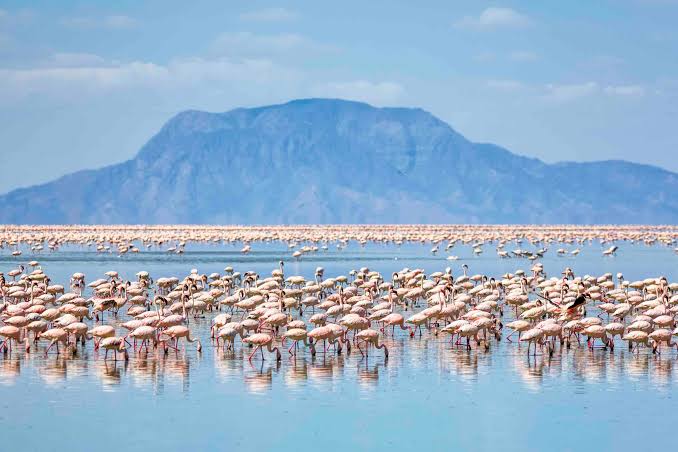
Lake Natron is one of the most important breeding sites for lesser flamingos in East Africa. Ramsar, the international wetland conservation organization, recognizes the Lake Natron Basin as an internationally important wetland and identifies the lake as a major regular breeding site for the East African population of lesser flamingos. Estimates cited by Ramsar put that regional population at roughly 1.5 to 2.5 million birds.
So the lake that became famous online as a place where animals supposedly turn to stone is also a place where enormous numbers of living birds come to reproduce. That contradiction is at the heart of the real story.
Why Flamingos Choose Such A Harsh Place
For lesser flamingos, Lake Natron’s harsh conditions are not simply something they tolerate. They can actually help protect the birds.
The lake is shallow, highly alkaline and difficult for many predators to navigate. Flamingos build their distinctive cone-shaped nests in areas where the surrounding water provides a natural barrier, while the water level can remain low enough that the nests are not simply washed away.
The lake also supports the algae that flamingos feed on, creating a food source in a place that appears almost barren to human eyes.
The result is an unusual ecological arrangement: conditions that are dangerous for many creatures can be highly useful to one particular species.
In other words, Lake Natron is not an ecosystem that somehow survives despite its chemistry. Its chemistry is part of what makes the ecosystem possible.
The Mystery Was Only Part Of The Story
The famous animal photographs created a powerful image of Lake Natron as a place of death, but scientists have long emphasized another side of the lake.
The dead birds are unusual because they are so well preserved. The living flamingos are unusual because they have adapted to conditions that many other animals cannot tolerate. Together, they reveal a much more complicated environment than the popular “lake that turns animals to stone” story suggests.
There is also a broader lesson in how the photographs spread. A striking image can communicate something instantly, but it cannot explain what happened before the shutter was pressed.
In this case, the visual evidence encouraged a dramatic conclusion that the photographer himself later clarified. The animals were not shown in the precise circumstances in which they died, and the lake was not turning living creatures into stone statues.
The photographs were real. The most famous explanation for them was the part that needed correcting.

A Fragile Refuge For Millions Of Flamingos
Lake Natron’s importance goes well beyond its unusual appearance.
The basin has international wetland status because of its value to wildlife, particularly lesser flamingos. That importance also makes changes to the lake potentially significant. Ramsar assessments have highlighted concerns that large-scale industrial development, including soda ash extraction and changes to the lake’s hydrology, could alter the ecological conditions on which the flamingos depend.
That creates a striking final contrast. The most memorable images of Lake Natron show dead birds preserved along its shore. But the bigger conservation story is about the millions of living birds that rely on the lake as a breeding refuge. The danger to Lake Natron is not that it will keep turning animals to stone. The real danger is that changes to the environment could make it less suitable for the animals that have evolved to depend on it.
The Real Lake Natron Is Stranger Than The Myth
Lake Natron became famous because it looked like something out of a nightmare. Dead birds covered in minerals appeared to have been transformed into stone, and dramatic photographs seemed to show a landscape where life could not survive.
The reality is more fascinating. The lake’s extreme alkaline and salty conditions can preserve animals after they die, but the famous photographs were carefully posed, and the animals were not simply petrified the moment they touched the water.
At the same time, the lake supports fish, algae and enormous numbers of lesser flamingos. It is both harsh and productive, seemingly lifeless in one photograph and filled with life in the next.
That is what makes Lake Natron worth remembering: the truth is not less strange than the myth. It is simply more complicated.
Lake Natron does not literally turn living animals into stone, despite the reputation created by some of the world’s most haunting wildlife photographs. Dead birds and bats can become heavily coated with salt and minerals, preserving their bodies in eerie forms, while photographer Nick Brandt later revealed that he repositioned some of the remains before photographing them. At the same time, the lake is a crucial breeding ground for lesser flamingos and supports life specially adapted to its extreme chemistry. What first looks like a story about a deadly lake is actually a story about preservation, adaptation and one of Africa’s most unusual ecosystems.
P.S. This story draws on National Geographic’s reporting on Lake Natron’s unusual chemistry and the famous “stone animals” photographs, along with Ramsar’s information on the lake’s importance to lesser flamingos. Sources: National Geographic; Ramsar Sites Information Service. https://www.nationalgeographic.com/science/article/lake-that-turns-animals-to-stone-not-so-deadly-as-photos-suggest