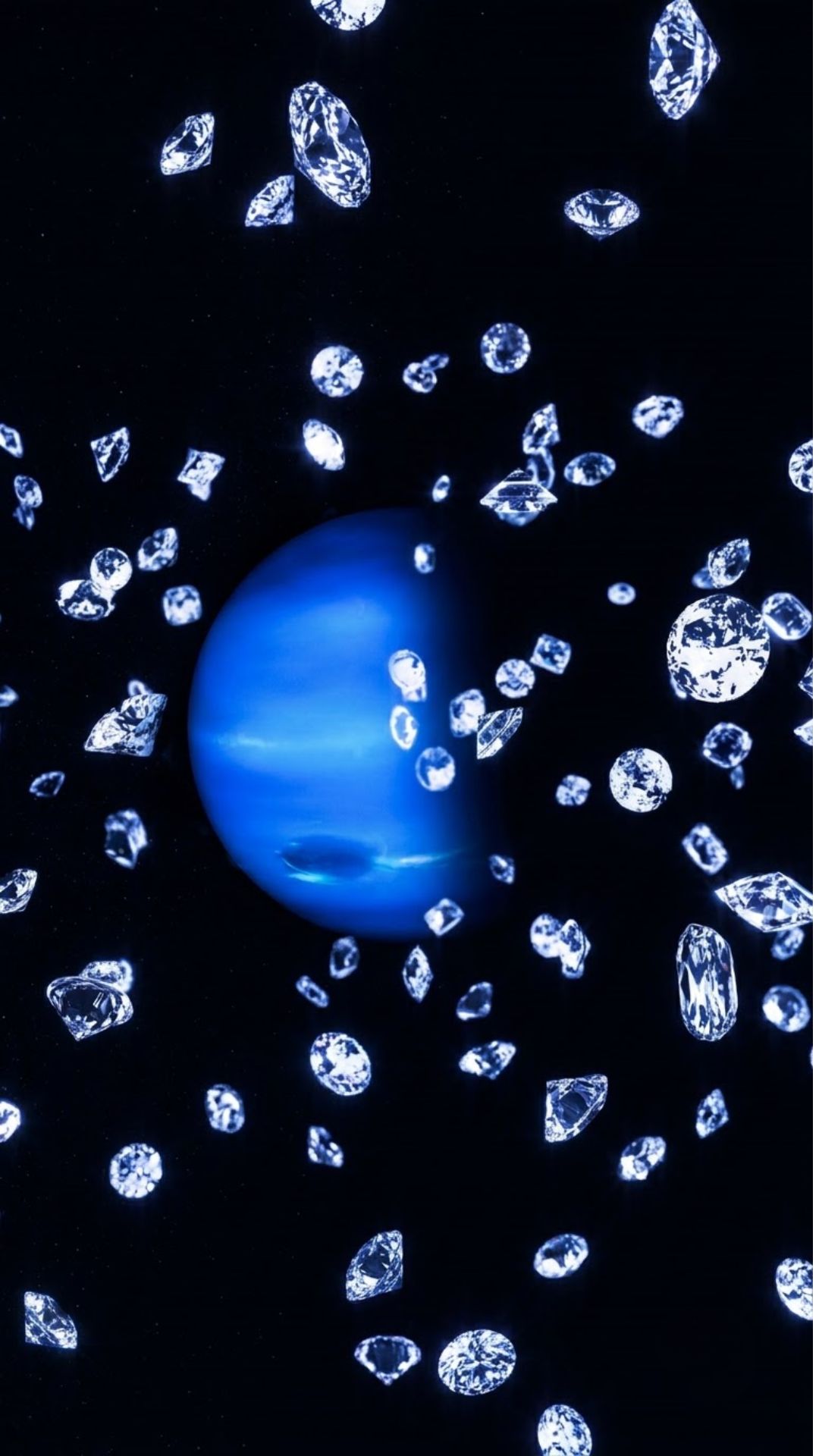
Far beneath the clouds of Uranus and Neptune, conditions become so extreme that ordinary materials behave in extraordinary ways. Scientists think the crushing pressure can break methane apart, freeing carbon that may compress into diamonds and sink through the planets’ interiors. In other words, it may literally rain diamonds deep inside two worlds of our solar system. We have never watched this happen directly, but mathematical models and laboratory experiments have provided compelling evidence that the bizarre process could be real.
Uranus And Neptune Are Stranger Than They Look
From Earth, Uranus and Neptune can appear like relatively featureless blue-green spheres. They are often grouped as the solar system’s ice giants, but the name can be misleading because their interiors are not filled with ordinary ice like the material in a freezer.
Instead, these planets are composed largely of water, ammonia and methane, along with hydrogen and other materials. Deep beneath their visible clouds, pressure and temperature rise enormously, creating conditions that do not exist naturally anywhere on Earth’s surface.
That hidden environment is one reason scientists remain fascinated by these two distant planets.
We have far less direct information about their interiors than we do about Jupiter and Saturn. Voyager 2 made the only close flybys of Uranus and Neptune decades ago, leaving scientists to combine spacecraft observations with laboratory experiments and mathematical models to figure out what may be happening deep below the clouds.
And those models produced an extraordinary prediction.

The Pressure Can Turn Carbon Into Diamonds
As scientists move deeper into Uranus and Neptune, the pressure becomes immense and temperatures climb to thousands of degrees.
Models discussed by Space.com put temperatures in some of the deeper mantle regions at around 7,000 kelvins, while pressures can reach roughly 6 million times Earth’s atmospheric pressure. Even higher than the upper atmosphere, those conditions create a completely different kind of chemistry.
Methane is particularly important.
Under extreme pressure, methane molecules can break apart, separating carbon from hydrogen. The carbon atoms can then form long structures and eventually arrange themselves into crystalline patterns characteristic of diamond.
That does not mean diamonds float around like hailstones in an Earth-style cloud. The proposed process happens deep inside the planet, where the pressure is strong enough to produce the crystal structure. And once those dense diamonds form, gravity takes over.
The Diamonds Could Fall Through The Planet
Diamond is much denser than the surrounding material, so newly formed crystals would tend to sink deeper into the planet’s interior.
According to the model described by Space.com, the diamonds could continue descending until they reach regions where temperatures become high enough for them to vaporize. The material could then rise again, with the process repeating as conditions change at different depths.
That cycle is where the phrase “diamond rain” comes from.
It is not a storm that anyone could see from the surface. It is a massive chemical and physical process occurring far below the clouds, where pressure, heat and gravity work together in ways that are almost impossible to reproduce on Earth.
The result would be one of the strangest forms of weather in the solar system. On Earth, water falls from clouds. On Uranus and Neptune, carbon may fall toward the interior as diamonds.

Scientists Have Created Diamond Formation In The Laboratory
The biggest problem is obvious: scientists cannot simply fly a spacecraft into the depths of Neptune and watch.
Voyager 2 never entered the planets’ atmospheres, and a mission capable of directly sampling their interiors is far beyond current exploration capabilities. So researchers have turned to experiments that recreate some of the relevant pressure and temperature conditions on Earth.
In laser experiments, researchers have compressed hydrocarbon-rich materials to extreme pressures and temperatures and observed the formation of tiny diamonds. Earlier work used dynamically compressed polystyrene as a laboratory stand-in for the carbon-hydrogen chemistry expected inside the ice giants.
More recent research published in Nature Astronomy in 2024 provided additional evidence. Scientists observed diamond formation in statically compressed polystyrene heated with X-ray pulses at pressures of about 19 to 27 gigapascals and temperatures above 2,500 kelvins—conditions thought to resemble parts of the shallower interiors of Uranus and Neptune.
That does not amount to directly observing a diamond falling inside Neptune.
But it strengthens the physical case that the chemistry required for the process can actually occur under planetary conditions.
Ever wondered what it’s like on Saturn? Dive into this fascinating video to discover how powerful lightning transforms methane into soot and, eventually, beautiful diamonds! It’s a mind-blowing journey through the intense pressures of our solar system. Click now to watch this incredible space spectacle and unlock the planet’s secrets!
We Still Haven’t Seen The Rain Itself
This distinction matters because the phrase “diamond rain” sounds more certain than our observations really are.
Scientists have not sent an instrument deep into Uranus or Neptune’s interiors to photograph diamonds falling through a mantle. What we have instead is a combination of planetary composition data, physical models and laboratory experiments that reproduce important parts of the predicted process.
That is how much of planetary science works.
We cannot directly examine every layer of a distant planet, so scientists test whether the underlying physics works under controlled conditions here on Earth. When the experiments and models agree with what is known about a planet, confidence in the explanation grows.
In this case, the result is remarkable. A phenomenon that sounds like pure science fiction has a plausible physical explanation.
The Diamond Rain May Reveal What Lies Inside Two Mysterious Worlds
The real scientific value of diamond rain is not that Uranus and Neptune might contain enormous quantities of precious material.
It is that the process could affect how their interiors behave.
The sinking of dense diamond could transport carbon downward and release energy as the material moves through the planets. Recent laboratory work suggests that diamond precipitation could influence convection inside the conductive layers of these worlds, potentially helping scientists understand their internal structure and even aspects of their unusual magnetic fields.
That makes the diamonds more than a spectacular curiosity.
They may be part of the machinery that helps shape an entire planet.
And because Uranus and Neptune remain among the least directly explored major worlds in our solar system, even an exotic phenomenon like diamond rain can provide clues about what is happening far beyond anything our spacecraft have yet reached.
Uranus and Neptune may hide one of the strangest processes in the solar system: diamond formation deep inside their interiors, followed by the gradual sinking of those dense crystals through layers of extreme pressure and heat. Scientists have not directly watched this “rain,” but laboratory experiments and physical models increasingly support the chemistry behind it. What sounds like science fiction is therefore rooted in real planetary physics. And the diamonds themselves may be more than a spectacular curiosity—they could help scientists understand how these mysterious ice giants work from the inside out.
P.S. This article is based primarily on Space.com’s explanation of diamond rain on Uranus and Neptune, with additional context from a 2024 Nature Astronomy study on diamond precipitation under ice-giant interior conditions. Source: https://www.space.com/diamond-rain-atmosphere-uranus-neptune