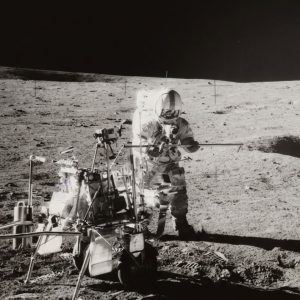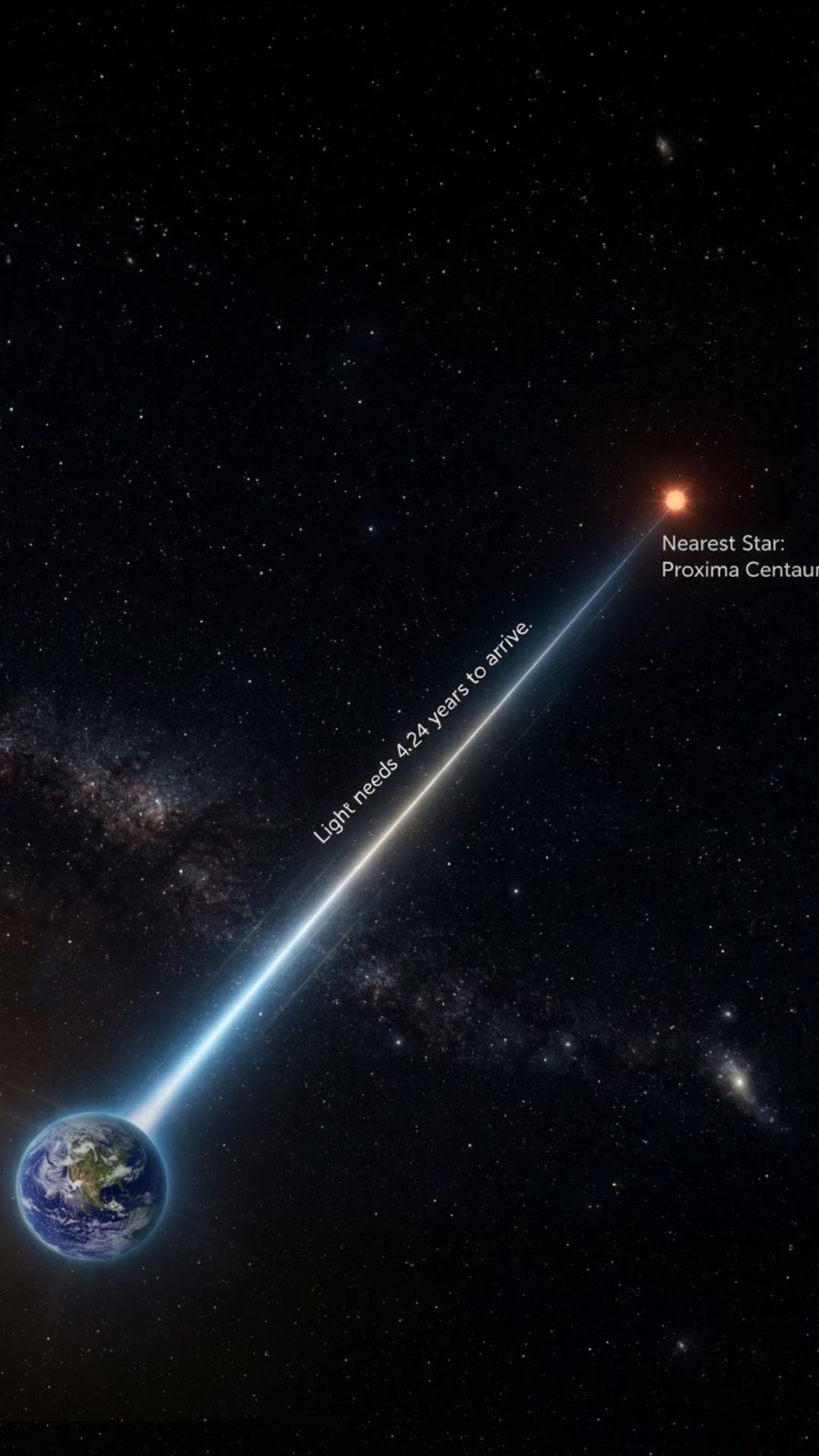
The nearest star system is only about 4.24 light-years away, yet sending humans there is far beyond anything we can do today. The challenge is not simply building a faster spacecraft. A crew would have to survive radiation, altered gravity, isolation, equipment failures and an extraordinarily long journey, while future generations might have to live and die aboard the same vessel. NASA identifies many of these hazards as fundamental challenges of long-duration human spaceflight. The stars may be close on a cosmic scale. For humans, they remain incredibly difficult to reach.
The Nearest Star Is Still Far Away
When people imagine interstellar travel, the first obstacle is usually distance. That is understandable when the nearest stellar system is more than four light-years away.
Proxima Centauri, the closest individual star to the Sun, lies about 4.24 light-years away. Alpha Centauri A and B are about 4.37 light-years distant. A light-year is the distance light travels in one year, or roughly 5.9 trillion miles.
Those numbers sound manageable only because we are accustomed to thinking in terms of Earthly distances. Even reaching the edge of our own solar system has taken decades for robotic spacecraft.
NASA’s Voyager 1 and Voyager 2 probes have entered interstellar space, but that is not the same as traveling to another star. NASA notes that sending humans across the enormous distances between stars remains firmly in the realm of science fiction for now.
And that leads to the real problem. A spacecraft can survive a journey that takes decades. A human civilization has to survive one that could take vastly longer.

Going Faster Solves Only Part Of The Problem
Suppose future engineers develop a spacecraft far faster than anything humanity has built so far. The journey would still require the crew to live inside a closed environment for years, perhaps decades or longer.
NASA already treats distance from Earth as a major human-spaceflight hazard. The farther astronauts travel, the more difficult it becomes to receive supplies, medical assistance or replacement equipment. At interstellar distances, there is no realistic rescue mission coming from home.
That changes everything.
On the International Space Station, astronauts live in a carefully supported environment with regular resupply and the ability to return to Earth. An interstellar crew would have to carry nearly everything required to survive—or be capable of producing it themselves.
Food would have to be grown or stored. Water would have to be recycled. Air would have to be maintained. Mechanical systems would have to continue working even as they aged.
A journey between stars would therefore be less like taking a long flight and more like creating a tiny, self-sufficient civilization inside a spacecraft.
Why is deep space so quiet? Discover the physical barriers that might keep humanity trapped in our Solar System forever.
The Human Body Was Not Built For Deep Space
Even if the engineering worked, the human body would still face serious challenges.
NASA identifies radiation, isolation and confinement, altered gravity, distance from Earth, and hostile or closed environments as major hazards of human spaceflight. These problems do not occur independently; they can reinforce one another over long missions.
Microgravity is already known to cause significant changes in the body. Bones become weaker, muscles lose mass and other physiological systems adapt to an environment humans did not evolve to inhabit. NASA’s current research continues to examine these effects and ways to reduce them.
Radiation is another major obstacle.
Earth’s atmosphere and magnetic field provide substantial protection from space radiation. Outside that protection, astronauts can be exposed to galactic cosmic rays and solar particle events. NASA considers space radiation one of the most hazardous aspects of long-duration human exploration.
An interstellar spacecraft would therefore need far more than engines. It would need to function as a shield, habitat, medical system and artificial ecosystem for its crew.

Then There Is The Problem Of Isolation
The psychological challenge may be just as difficult.
NASA identifies isolation and confinement as a major hazard because astronauts in small groups must live and work together for long periods without the normal social environment of Earth. Crews have to be selected and trained carefully because interpersonal problems can affect both performance and safety.
Now stretch that problem across generations.
A generation ship is one proposed solution: rather than trying to make one crew survive for thousands of years, a large population would live aboard a self-contained spacecraft, with children being born during the journey and descendants eventually reaching the destination.
That creates a remarkable problem that ordinary space missions do not face. The passengers would not simply be astronauts. They would be the ancestors of everyone who arrives.
Their children might never see Earth. Their grandchildren might regard the Sun as something remembered only through recordings and stories. Every generation would inherit a mission it did not choose.
The original article that inspired this discussion raises exactly this concern, arguing that even if the engineering obstacles could eventually be overcome, maintaining a stable human society inside a confined spacecraft for thousands of years could be extraordinarily difficult.
We Don’t Even Know What Awaits Us
There is another problem that is easy to overlook: reaching another star does not guarantee finding another Earth.
A planet can orbit within the so-called habitable zone of its star and still be a terrible place for humans. The habitable zone is defined by the possibility of conditions that could allow liquid water on a planet’s surface; it does not mean the planet has breathable air, a suitable atmosphere, safe radiation levels or an environment compatible with human biology.
That uncertainty becomes enormous when the journey itself is measured in generations.
Imagine building a civilization-sized spacecraft, sending it across interstellar space and finally arriving at a planet only to discover that humans cannot safely live there.
The destination may be habitable in an astronomical sense without being habitable for us.
Even nearby systems therefore offer no guarantee of a second home. NASA notes that the nearest stellar systems are only the beginning of the question; determining what their planets are actually like requires much more observation and study.
Does That Mean Humanity Will Stay Here Forever?
Not necessarily.
This is where the dramatic claim that humans will “never leave the Solar System” goes too far. There is no scientific basis for proving that interstellar travel will never happen. Future civilizations may develop propulsion systems, artificial gravity, radiation shielding, closed ecosystems or other technologies that radically change what is possible.
NASA itself continues to study the technologies and human-health problems that could eventually enable deeper exploration. The agency describes humanity’s journey into interstellar space as something that is not currently possible for humans, rather than something permanently forbidden by physics.
There is also an important distinction between sending humans and sending machines.
Robotic spacecraft do not need food, oxygen, psychological support or reproductive systems. They can operate for decades, tolerate environments that humans cannot and accept communication delays that would be unbearable for a crew.
That is why machines will almost certainly reach places humans cannot reach for a very long time. The harder question is whether humans themselves can become an interstellar species.
The Real Barrier May Be Human Civilization
The most interesting conclusion is therefore not that the stars are unreachable.
It is that the technology required to reach them may have to solve a problem much larger than propulsion.
A successful interstellar mission would need a spacecraft that can function for extraordinary periods, a crew that can remain healthy, a society that can remain stable, and a destination that can actually support human life. Each problem is enormous by itself. Together, they turn interstellar travel into a civilization-scale engineering challenge.
For now, Earth remains the only world known to support human life naturally. That makes the idea of simply leaving it behind much more complicated than science fiction often suggests. We can imagine enormous ships, fusion engines and distant colonies, but the biggest question may always be the same:
Can humans build a civilization capable of surviving the journey? The stars are not necessarily too far away. We may simply not be ready for the trip.
Interstellar travel is often presented as a problem of speed: build a powerful enough engine and the stars become reachable. In reality, the challenge is much broader. Humans would have to survive radiation, altered gravity, isolation and a completely closed environment while maintaining a functioning society far beyond the reach of Earth. Even the nearest stars are more than four light-years away, and reaching them would demand capabilities far beyond today’s technology. The future may eventually solve those problems. But for now, the hardest part of becoming an interstellar species may not be crossing the distance. It may be carrying humanity safely across it.
P.S. This article draws on the original ER Scream opinion piece that inspired the topic, while updating its more absolute claims and human-spaceflight arguments with current NASA information on radiation, isolation, gravity and the challenges of deep-space exploration. Source: https://www.erscream.com/post/why-humans-will-never-leave-the-solar-system