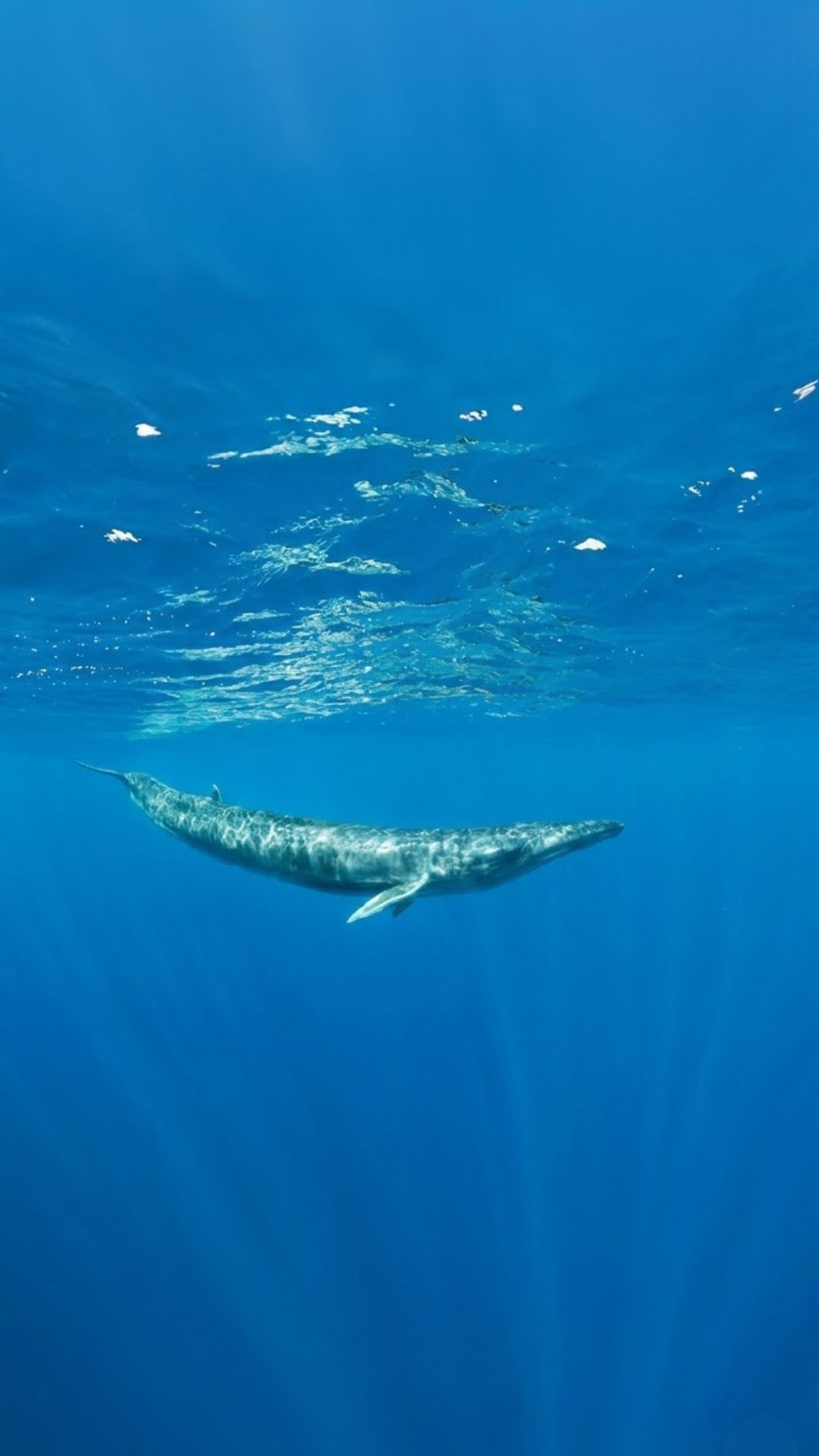
In 2014, scientists recording the waters around the Mariana Archipelago captured a strange sound unlike anything they could confidently identify. It was low, mechanical and then abruptly rose into a high-pitched tone, earning the nickname “biotwang.” For years, the source remained a mystery. Then researchers combined years of underwater recordings with visual observations and artificial intelligence—and discovered that the bizarre sound was coming from a surprisingly familiar creature: a Bryde’s whale.
The Strange Sound Beneath the Pacific
The mystery began in 2014 during an autonomous acoustic survey in the Mariana Archipelago. A robotic glider picked up an unusual whale-like call that lasted only a few seconds but had a striking sequence of sounds, beginning at low frequencies and ending with a metallic tone that could reach much higher frequencies. Because there were no observers watching animals at the time, researchers could not determine which species was responsible. They gave the mysterious call a memorable name: “biotwang.”
The setting made the discovery even more intriguing. The Mariana region includes the Mariana Trench, the deepest known part of the world’s oceans, and scientists have used acoustic instruments there to record everything from whale calls to earthquakes, ships and storms. Even in one of the least accessible environments on Earth, the ocean is far from silent.
But the biotwang was different enough to stand out. Researchers knew it sounded like something produced by a baleen whale, yet they had no way to connect the recording to a particular animal.
That left them with an unusual scientific problem: they had the sound, but not the singer.

Ten Years of Recordings Held the Clue
Identifying an animal from an underwater sound is much harder than it might appear. Marine scientists need both acoustic recordings and visual observations of the animals making those sounds, and opportunities to collect both at exactly the same place and time can be rare. Bryde’s whales are especially difficult to study because they are widespread and relatively poorly understood.
In 2018, NOAA researchers were conducting visual and acoustic surveys in the Mariana Archipelago. They encountered Bryde’s whales and began collecting the kind of evidence that had been missing when the original biotwang was recorded.
The breakthrough eventually came from matching what scientists heard with what they could see. During the survey, researchers observed Bryde’s whales on multiple occasions, and on nine of those encounters they also recorded the mysterious biotwang. The repeated connection was strong evidence that the whales were responsible.
The mystery had finally narrowed from “something out there” to a specific species.
Ever wondered what lies at the bottom of the ocean? Check out the video about the mysterious sound in the Mariana Trench to hear an eerie, alien-like sound recorded in the deepest place on Earth. Is it an unknown whale call or something else? Watch now to find out!
AI Helped Find the Pattern
Once scientists identified the likely source, another problem remained. NOAA had accumulated more than 200,000 hours of underwater acoustic recordings over the years. Manually listening to all of that material would have been impractical.
Researchers therefore turned to machine learning. With help from Google AI, they developed tools capable of scanning enormous collections of acoustic data and identifying the distinctive biotwang pattern much faster than people could do by hand. NOAA says the machine-learning system allowed researchers to analyze the recordings in hours rather than years.
The technology revealed that biotwangs were not random noises scattered throughout the Pacific. They appeared consistently in the Mariana Archipelago and also around Wake Island, with additional detections farther away in parts of the central Pacific. Their seasonal pattern was consistent with the movements of a western North Pacific population of Bryde’s whales.
What began as a strange recording had turned into useful information about where these whales travel and when they are present.
The “Alien” Sound Had a Familiar Source
The final explanation is almost more surprising because it is so ordinary. The sound that had seemed mysterious and almost mechanical was a previously undocumented vocalization produced by Bryde’s whales, a species found in tropical and warm-temperate waters around the world.
The call itself is genuinely unusual. Researchers described it as a complex vocalization lasting about 3.5 seconds with multiple sections, beginning around 30 hertz and ending with a much higher-frequency metallic sound. That strange combination helps explain why the recording sounded so unlike the whale calls people usually imagine.
But identifying the source solved only one part of the mystery. Scientists are still learning why this particular population produces the sound, what information the call carries and why it appears at certain times and locations.
In other words, the mystery was solved—but the biology behind the sound is only beginning to come into focus.
What the Sound Reveals About Bryde’s Whales
The discovery has implications beyond a curious piece of ocean trivia. Researchers found evidence that the biotwang is associated with a western North Pacific population of Bryde’s whales and that the calls appear seasonally as the animals move between lower and higher latitudes.
That gives scientists another way to track a whale population that remains poorly understood. Acoustic monitoring can detect animals even when researchers cannot see them, allowing scientists to build a broader picture of where the whales travel and how their distribution changes from year to year.
The discovery also illustrates how much of the deep ocean remains difficult to observe directly. A sound can be recorded thousands of miles from where its source was first understood, and decades of recordings may contain patterns that are invisible to human listeners.
Sometimes the clue is already sitting in the archive. The difficult part is knowing how to recognize it.

The Ocean Is Still Full of Unanswered Sounds
The biotwang mystery is now one of those rare cases in which technology helped turn an unexplained signal into a scientific discovery. What first sounded almost otherworldly was eventually traced to a real animal, using a combination of field observations, underwater recordings and machine learning.
That does not make the ocean any less mysterious. NOAA’s recordings from the Mariana region have captured a huge variety of natural and human-made sounds, demonstrating just how active the deep ocean can be. And scientists continue to encounter vocalizations whose sources are not immediately known.
The story of the biotwang is therefore not really about a monster hiding in the Mariana Trench. It is about something more interesting: how a bizarre sound can remain unexplained for years until scientists finally have the technology and observations needed to connect the sound to its source.
For a decade, the ocean had been making the noise. Scientists simply did not know who was speaking.
For years, a strange “biotwang” recorded in the waters around the Mariana Archipelago had no known source. Scientists eventually connected the sound to Bryde’s whales after matching acoustic recordings with visual observations, then used machine learning to search more than 200,000 hours of archived recordings for the same call. The discovery turned an eerie ocean mystery into a scientific clue about whale movements and behavior. The strangest part is also the simplest: the sound never came from an unknown creature at the bottom of the sea. It came from a whale we simply had not heard properly before.
P.S. This story draws on the original mystery report along with NOAA’s 2024 research and the peer-reviewed study identifying Bryde’s whales as the source of the biotwang call. Source: NOAA Fisheries — Hey, Google: Find this New Whale Sound and Bryde’s Whales Produce Biotwang Calls.