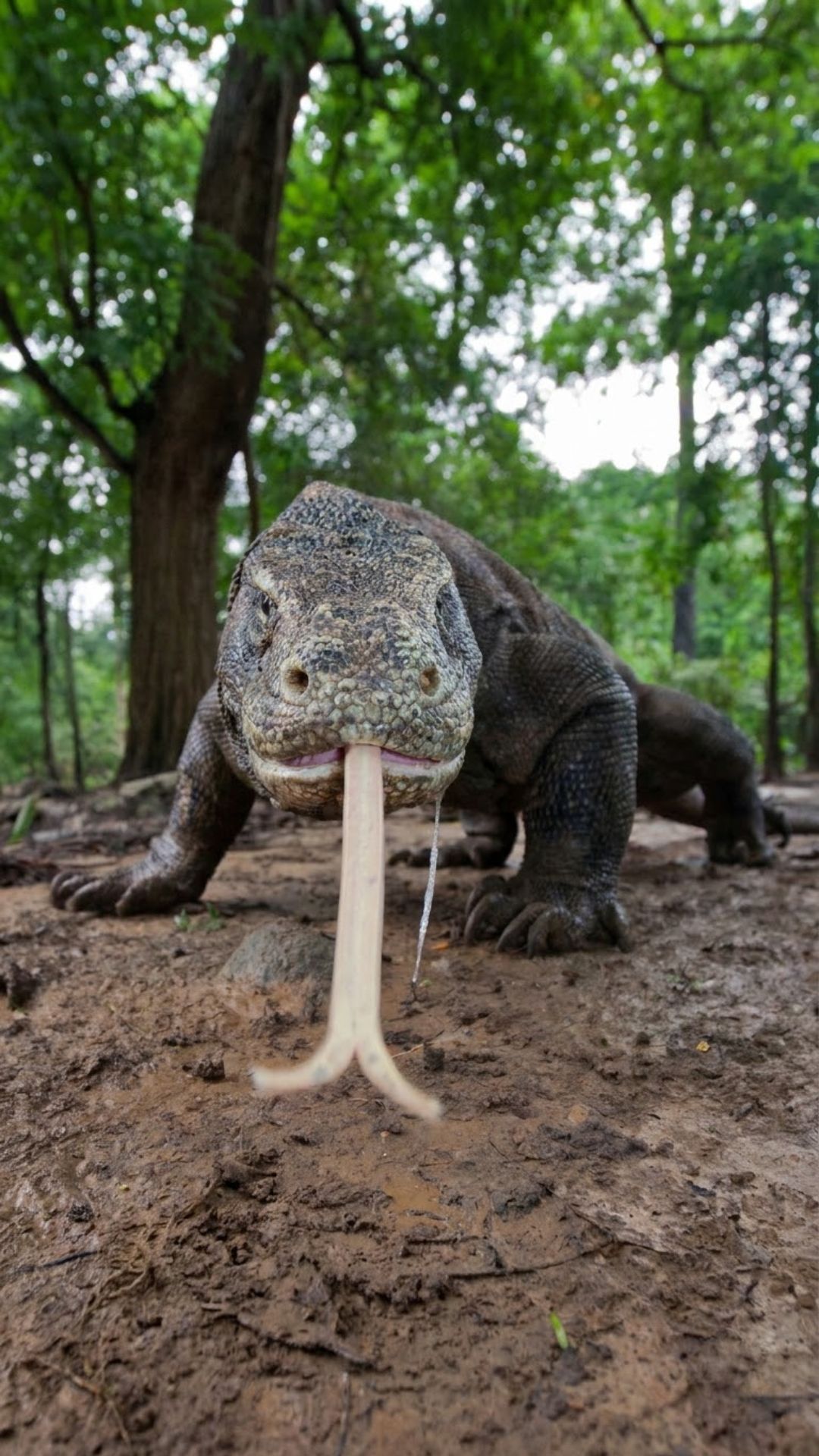
People travel to Indonesia hoping to get a glimpse of the Komodo dragon. Some have instead found themselves fighting for their lives. One 8-year-old boy was killed, a park guide was attacked by a dragon that wandered beneath his desk, and even a zoo encounter in the United States ended with a man badly injured. These incidents are rare—but they reveal what can happen when humans get too close to one of the world’s most formidable predators.
The World’s Largest Lizard Is No Harmless Tourist Attraction
Komodo dragons live on only a handful of Indonesian islands, including Komodo and Rinca, and that isolation is part of their appeal. Tourists increasingly visit the islands hoping to see the reptiles in their natural environment, often with guides leading them along established routes. The animals can reach around ten feet in length and more than 150 pounds, and Smithsonian notes that a single feeding can involve food equal to as much as 80 percent of a dragon’s body weight.
Despite their fearsome reputation, attacks on people are exceptionally rare. The problem is that rarity can create a false sense of security, especially when visitors or workers become accustomed to having the animals nearby. On the islands, dragons may wander around villages, roads, buildings and construction areas, turning an encounter that looks extraordinary in photographs into a real physical risk.
That danger became clear in a series of incidents documented by Smithsonian over the past several decades.

The Eight-Year-Old Who Never Came Home
One of the most tragic encounters occurred in 2007 on Komodo Island, when an 8-year-old boy was attacked and killed. He had been playing with other children near his village when he went behind a bush, and a Komodo dragon attacked him. His uncle and others rushed to help, but the boy did not survive.
The attack was especially significant because it was reported as the first fatal human attack by a Komodo dragon in 33 years. Local rangers launched a search for the animal afterward, while speculation focused on unusually dry conditions that may have reduced the availability of the prey the dragons normally hunt.
Another fatal encounter came two years later. In 2009, 31-year-old Muhamad Anwar was gathering sugar apples on Komodo Island when he fell from a tree and encountered two dragons below. He suffered fatal injuries before he could receive medical help.
The circumstances surrounding Anwar’s death were reported somewhat differently by different outlets, illustrating how details can become blurred in remote locations. But the larger point was clear: entering dragon territory can carry risks that are easy to underestimate.
Ever wondered what to do if you come face-to-face with the world’s largest, most dangerous lizard? Our latest video reveals the crucial survival tips for a Komodo dragon encounter, from zigzagging to fighting back. Don’t risk your safety—watch now to learn how to stay alive in the wild!
The Dragon Under the Desk
Perhaps the strangest incident involved Maen, a guide working at Komodo National Park on Rinca Island. His office was built on stilts, as were many structures on the island, and dragons sometimes gathered beneath buildings looking for scraps. One morning in 2009, Maen sat down at his desk and looked toward his feet—only to discover that a Komodo dragon had already entered the room.
The office door had apparently been left open, allowing the animal to wander inside during the night. When Maen tried to move away, the dragon lunged and bit his leg. He managed to force its jaws open and eventually escaped with help from other rangers, but the situation became even more dangerous when other dragons were attracted by the smell of blood.
Maen had to be carried to the dock and taken by boat to Flores. The medical treatment ultimately required a flight to Bali, where doctors treated his injuries with dozens of stitches. His recovery took roughly six months, yet he eventually returned to work—although he later chose to stay indoors rather than remain around the animals.
The incident demonstrated something unsettling about Komodo dragons: they do not need a remote wilderness setting to become dangerous. Sometimes the encounter can begin in a place where a person believes he is completely safe.
When a Zoo Encounter Went Wrong
The risk is not limited to remote Indonesian islands. In 2001, journalist Phil Bronstein had an unexpected encounter at the Los Angeles Zoo after being invited into a Komodo dragon enclosure. The visit was supposed to be a memorable chance to see the animal at close range, but the dragon suddenly lunged and grabbed Bronstein’s foot.
According to Smithsonian’s account, Bronstein managed to force the animal’s jaws open and pull himself away. He survived the attack, although he suffered serious injuries and required medical treatment. The incident later drew scrutiny because it raised obvious questions about how closely visitors should ever be allowed to approach a large carnivorous reptile.
The danger appeared again in 2013, when two male dragons at Ohio’s Akron Zoo unexpectedly ended up in the same enclosure and began fighting. A zoo employee tried to separate them and was bitten several times by the larger animal. Occupational Safety and Health Administration later reviewed the zoo’s procedures and found that the employee had not violated safety standards, although the zoo planned additional training afterward.
The lesson was not that Komodo dragons are constantly attacking humans. It was almost the opposite: even experienced professionals can find themselves in trouble during a rare moment when normal precautions fail.
The Wildest Encounter May Have Been a Survival Story
Not every Komodo-related incident ended with an attack. In 2008, a group of scuba divers was swept away by strong currents and eventually reached Rinca Island, where one of the world’s largest populations of Komodo dragons lives. They had been drifting for roughly ten hours before reaching shore and then had to survive for two days and two nights before being rescued.
Their challenge was not simply finding food and water. They were stranded in the habitat of a large predator while trying to remain alive long enough to be found. The group survived by gathering food from the shoreline, including shellfish, while avoiding the dragons that inhabited the island.
That story illustrates a different side of the Komodo dragon’s danger. Sometimes the threat is not an animal actively hunting a human. It is the fact that a person can suddenly find himself exhausted, isolated and trapped inside an ecosystem where the balance of power is unmistakably on the other side.
For the divers, survival depended on enduring the environment until help arrived. For anyone living or working on the islands, the same environment is home.

The Dragon Is in Trouble, Too
There is an important twist to the story of the Komodo dragon. While the reptiles have become symbols of danger and wildness, their own future is increasingly uncertain. The International Union for Conservation of Nature reclassified the species from vulnerable to endangered in 2021, and its most recent estimate cited by Smithsonian put the number of mature Komodo dragons at about 1,380.
The animals face habitat loss and a changing environment, with rising sea levels identified as an important threat. Smithsonian also notes that suitable Komodo dragon habitat could decline substantially in coming decades, while human land use outside their protected stronghold adds additional pressure.
That creates an unusual contrast. Tourists arrive because they want to experience one of the world’s most intimidating predators, while conservationists are working to make sure the species survives at all. The Komodo dragon is dangerous enough to command respect, yet vulnerable enough to need protection.
Perhaps that is the most important lesson from these encounters. The goal is not to defeat the dragon or prove how close a person can get. It is to understand that a wild animal does not become harmless simply because humans have learned how to photograph it.
Komodo dragons have survived for millions of years as powerful predators in a remarkably isolated corner of Indonesia. Modern visitors may see them as extraordinary wildlife attractions, but a series of rare encounters has shown what can happen when people underestimate them. An 8-year-old boy was killed, workers have been injured and one guide famously found a dragon beneath his desk. Yet the bigger story is not simply about danger. It is about living alongside a rare predator whose habitat is shrinking—and whose survival now depends on giving it enough space to remain wild.
P.S. This article is based primarily on Smithsonian Magazine’s compilation of notable Komodo dragon encounters, including attacks involving visitors, park workers and zoo employees, as well as the species’ declining conservation status. The article was originally published in 2013 and updated in November 2024. Source: https://www.smithsonianmag.com/science-nature/most-infamous-komodo-dragon-encounters-this-century-fatal-attack-8-year-old-boy-zookeeper-bitten-by-battling-animal-5831048/