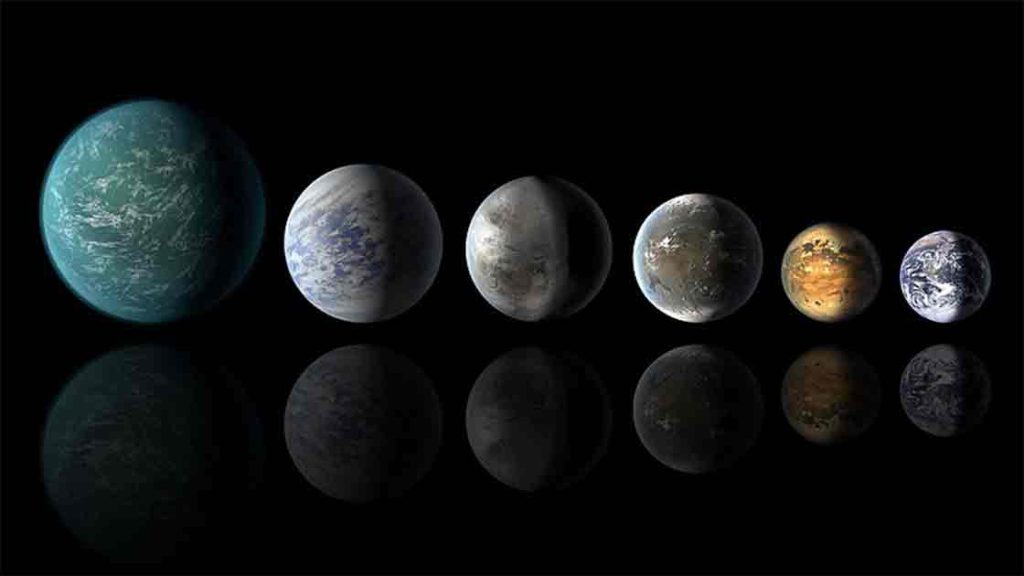
The universe is unimaginably old, enormous and filled with stars and planets. With hundreds of billions of galaxies and more than 100 billion planets in the Milky Way alone, it seems almost inevitable that life should have appeared somewhere else. Yet after decades of searching, humanity has found no confirmed evidence of an extraterrestrial civilization. That contradiction is known as the Fermi Paradox—and the deeper scientists look, the more unsettling the question becomes: if someone else is out there, why haven’t we seen them?
The Question Enrico Fermi Could Not Ignore
The Fermi Paradox is built around a deceptively simple question: Where is everybody? Physicist Enrico Fermi reportedly raised the question during a lunchtime conversation about extraterrestrial intelligence, pointing toward a contradiction that still has no accepted solution.
We now know that planets are common, and thousands of exoplanets have been identified beyond our solar system. Many orbit within regions where temperatures could potentially allow liquid water and life as we know it. If even a fraction of those worlds produced intelligent civilizations, the galaxy should seem less like an empty wilderness and more like a crowded neighborhood.
Instead, the sky remains remarkably quiet. That silence is the heart of the paradox.
Ever wonder why the universe seems so quiet despite billions of stars? Dive into the fascinating Fermi Paradox! This video explores the mystery of alien life, civilization scales, and the potential fate of humanity. Are we truly alone? Click to uncover the mind-bending possibilities of our vast, mysterious cosmos!
The Galaxy Should Have Left Evidence
One of the most intriguing arguments involves something called a Von Neumann probe. The idea is theoretical: instead of sending biological beings across interstellar distances, a civilization could send automated spacecraft capable of reproducing themselves using materials found on other worlds.
Each probe would arrive at a new star system, build additional probes and send them onward. Repeated again and again, that process could theoretically spread across a galaxy on timescales that are tiny compared with the age of the Milky Way.
The implication is startling. A civilization would not necessarily need to travel personally from star to star. Machines could do the expansion for it.
If such technology had been used by even one sufficiently advanced civilization millions or billions of years ago, we might expect to find some trace of it today—artificial objects, altered systems, unusual signals or other evidence of large-scale activity.
We have not. So the mystery is no longer simply whether aliens exist. It is why a galaxy old enough to produce them appears to show so little evidence that anyone ever did.

Maybe Intelligent Life Is Extremely Rare
The most straightforward explanation is also one of the most humbling: perhaps advanced life is extraordinarily uncommon.
The Rare Earth Hypothesis suggests that simple microbial life might emerge relatively often, while complex life requires such a rare combination of conditions that Earth could be an unusual exception. A suitable orbit may not be enough. Geological activity, a protective magnetic field and other factors could all play important roles in allowing complex organisms to survive and eventually develop intelligence.
Under this explanation, the universe could contain countless worlds with simple life while producing very few civilizations capable of building radio telescopes, spacecraft or interstellar probes.
That would make humanity less like one member of a crowded cosmic civilization and more like an improbable exception. But another possibility is far darker.
The Great Filter May Be Waiting Ahead
The Great Filter hypothesis proposes that somewhere along the path from simple life to a civilization capable of reaching the stars lies an enormous obstacle. Most forms of life may never get past it.
The filter could involve the origin of life itself, the transition to complex cells or the development of intelligent organisms. But the most disturbing version is that the filter comes later, after technology has given a civilization enormous power.
A technological species might become capable of destroying itself before it becomes capable of spreading beyond its home world. War, environmental collapse, runaway technology or some other form of self-destruction could repeatedly eliminate civilizations before they become visible across the galaxy.
That possibility turns the Fermi Paradox into something much more personal.
If the Great Filter is behind us, humanity may already have passed the hardest step. But if it lies ahead, the silence of the universe could represent a warning rather than a mystery.

Perhaps They Are Watching Without Interfering
Not every explanation is so bleak.
The Zoo Hypothesis suggests that advanced civilizations may know we exist but deliberately avoid direct contact. They might observe Earth without interfering, allowing humanity to develop naturally until we reach some threshold of technological or social maturity.
It is a fascinating idea, but it requires a remarkable assumption: that multiple advanced civilizations would all agree to follow the same policy and maintain it for enormous periods of time.
Another possibility is that civilizations simply do not last long enough to meet one another. A technological species could exist for only a few thousand years—a blink of an eye compared with the age of the galaxy. Two civilizations might therefore rise and disappear millions of years apart, never existing at the same time.
The universe could be full of civilizations and still appear completely silent simply because their windows of existence rarely overlap.
We May Be Looking for the Wrong Thing
There are even possibilities in which advanced civilizations no longer resemble anything we would recognize.
A sufficiently advanced species might eventually become post-biological, transferring aspects of consciousness or intelligence into digital systems. Such beings might have little reason to build colonies of biological organisms or communicate using the methods humanity currently expects.
The problem could also be technological. Signals may be too weak, too distant, too brief or simply unlike anything our instruments are designed to recognize.
This is why the search for extraterrestrial intelligence continues despite decades of silence. The SETI effort uses powerful telescopes to search the sky for signals that could indicate intelligent activity, while scientists also study distant worlds for signs of biology or technology in their atmospheres.
In other words, the absence of evidence is not yet proof that the universe is empty. It may simply mean that we have not learned how to see what is already there.
The Search Has Not Ended
Space missions are expanding the search beyond distant stars. Europa, one of Jupiter’s moons, has attracted particular attention because scientists believe a liquid ocean may exist beneath its icy exterior. NASA’s Europa Clipper mission was launched in October 2024 to study the moon and determine whether its environment could support conditions favorable to life.
Finding life elsewhere in our own solar system would be revolutionary. It would suggest that life may arise more easily than we once assumed—and that would make the Fermi Paradox even harder to explain.
If simple life appears independently in two places within the same solar system, the obvious question becomes: how could a universe containing countless planetary systems remain so quiet?
That is why the search matters even if no civilization is ever found. Every discovery changes the odds in the argument.
So Where Is Everybody?
The Fermi Paradox has no confirmed solution. Perhaps intelligent life is extraordinarily rare. Perhaps technological civilizations destroy themselves. Perhaps advanced beings deliberately remain hidden, disappear too quickly to encounter one another, or become so different from biological life that we would not recognize their existence.
There is also a simpler possibility: humanity may be among the first technological civilizations to reach this stage.
For now, every explanation shares the same uncomfortable fact. We have evidence that the universe contains an extraordinary number of worlds, but no confirmed evidence that another technological civilization exists. The silence is real.
What the silence means is still one of the biggest unanswered questions in science.
The universe does not look like a place where Earth should be alone. It is ancient, vast and filled with stars and planets, yet humanity has found no confirmed sign of another technological civilization. That contradiction is the Fermi Paradox. Maybe intelligent life is rare, maybe civilizations destroy themselves, maybe they remain hidden, or maybe we are simply too young to understand what we are looking for. The unsettling possibility is that the silence means something. Until we know what, one question remains hanging over the night sky: Where is everybody?
P.S. This article draws primarily on Historic Mysteries’ overview of the Fermi Paradox, with its discussion of the Rare Earth Hypothesis, Great Filter, Zoo Hypothesis, Von Neumann probes, SETI and the search for life beyond Earth. The original article also references background material from source: https://www.historicmysteries.com/science/fermi-paradox/39676/