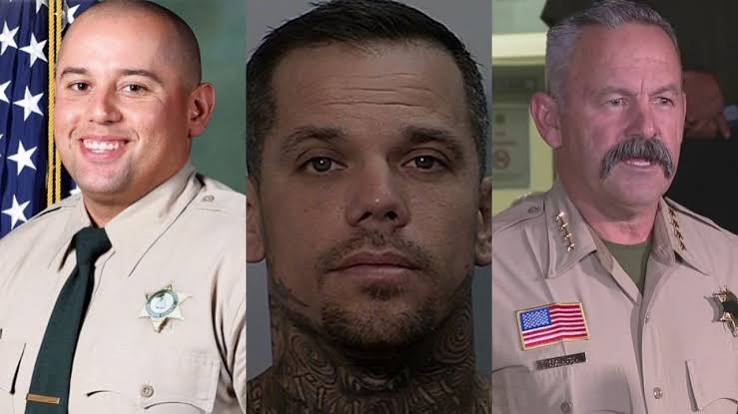
He was already facing 25 years to life. Then California let him back onto the streets. William Shea McKay had been convicted in a third-strike case, later missed his sentencing hearing and was arrested again before being released. Months later, during a routine traffic stop, he allegedly pulled a gun and killed Riverside County Deputy Isaiah Cordero. McKay fled, leading police on a chaotic freeway chase that ended in a shootout. The sheriff later asked the question that shocked California: Why was this man free?
McKay Already Had a Long History of Violence
McKay’s criminal record stretched back to the late 1990s. In 1999, he pleaded guilty to assault with a firearm and served time in prison; in 2005, he was convicted after an attack on a sleeping couple in which the victims were assaulted and money was taken from a safe. That case resulted in a 13-year sentence for robbery and assault-related offenses.
His later cases added to that record. In 2021, a judge found him guilty of false imprisonment, evading a peace officer, making criminal threats likely to cause death or great bodily injury, and receiving stolen property, while he was acquitted of more serious kidnapping charges. Those convictions counted as his third strike under California’s repeat-offender law, leaving him facing a potential sentence of 25 years to life.
That should have been the point at which McKay’s time outside custody was coming to an end. Instead, the court proceedings continued, his sentencing was delayed, and his bail was reduced from $950,000 to $500,000. McKay posted the bond in March 2022 and walked out of jail while still awaiting the final sentence in his third-strike case.

Then He Was Released Again
The case became more complicated as the months went by. In July, McKay’s attorney sought a new trial, arguing that the court had not properly advised him of his right to a jury trial rather than a bench trial, and sentencing was delayed again. In October, McKay failed to appear for a scheduled court hearing, and a warrant was issued for his arrest.
But McKay was not immediately taken back into custody on that warrant. On October 15, he was stopped by Fontana police and arrested on suspicion of transporting narcotics and possessing ammunition while being a felon. The following day, despite already being out on bail in the third-strike case, he was released again after posting a $50,000 bond, according to the San Bernardino County Sheriff’s Department.
That second release became one of the most troubling details in the aftermath of the deputy’s death. Prosecutors had already opposed the reduction of McKay’s bail after his 2021 conviction and had objected to delaying his sentencing, according to the San Bernardino County District Attorney’s Office. Yet by late December, he was once again driving freely on California roads.
A shocking case of judicial negligence. We’re breaking down the criminal history of William McKay and the details surrounding this heartbreaking tragedy. Watch now at the link below.
Then Came the Traffic Stop
On the afternoon of December 29, 2022, Riverside County Sheriff’s Deputy Isaiah Cordero stopped a black pickup truck in a residential area of Jurupa Valley. Cordero was a motorcycle deputy and had served with the Sheriff’s Department for years before earning the assignment, which was considered a coveted position within the agency. According to investigators, as the deputy approached the truck, McKay suddenly pulled a handgun and shot him.
Witnesses called 911 as Cordero lay wounded, and paramedics rushed him to the hospital. He was 32 years old. Despite efforts to save him, he died from his injuries, leaving behind a family and a law-enforcement department that had not lost a deputy in the line of duty for nearly two decades.
McKay did not remain at the scene. He drove away in the pickup, and police units quickly began pursuing him. What had started as a traffic stop was now a manhunt for a suspect accused of killing a deputy.

The Pursuit Ended on a California Freeway
The chase moved onto multiple Southern California freeways as law enforcement tried to stop McKay’s truck. Officers eventually deployed a tire-deflation device, and an armored Sheriff’s Department vehicle made repeated attempts to force the pickup off the road. The pursuit finally ended on Interstate 15 in Norco after a mechanical problem caused McKay’s truck to veer across several lanes and stop on the shoulder.
McKay was then boxed in by a BearCat armored vehicle. Authorities said he fired several rounds at deputies, and officers returned fire in a gun battle beneath a freeway overpass. When members of the SWAT team approached the truck, McKay was dead, and investigators found a 9mm semiautomatic pistol without a serial number inside the vehicle.
The chase lasted only part of the day, but the images became some of the most striking footage from the case: a black pickup speeding across the freeway, armored police vehicles closing in and a final exchange of gunfire beneath an overpass. The shooting ended McKay’s life, but it did not end the questions surrounding how he had been free to encounter Deputy Cordero in the first place.
The Sheriff Blamed the Justice System
Within hours of Cordero’s death, Riverside County Sheriff Chad Bianco publicly argued that the deputy’s death could have been prevented. Bianco pointed to McKay’s third-strike conviction and the decision to allow him to remain on bail, saying McKay should have been behind bars rather than on the street. He also criticized the judge who reduced the bail and delayed the sentencing process.
The San Bernardino County District Attorney’s Office made a similar point, though in more measured language. Prosecutors said their office had opposed the $500,000 bail reduction and had objected to delaying sentencing, adding that the failure to separate McKay from society had been followed by the loss of a law-enforcement deputy.
But the story was more complicated than simply blaming one judge. Legal experts noted that the court had discretion over bail and that McKay’s defense had continued challenging the 2021 conviction and sentencing process. The record showed a series of decisions, delays and releases involving multiple actors, making the question of responsibility considerably more complicated than the sheriff’s angry statement suggested.
That distinction matters. There is a difference between saying a judicial decision was controversial and saying that a judge legally caused a murder. What can be established is that McKay was a convicted third-strike offender awaiting sentence, he had been released on bail, he later failed to appear in court, he was arrested on another matter and released again—and ultimately encountered Cordero on the street.

The Question That Never Went Away
The case left California with a question that had little to do with the final gun battle and everything to do with what happened months earlier. How does someone with a violent criminal history, a third-strike conviction and a potential life sentence remain free long enough to be involved in another violent encounter? The answer lies in a chain of bail decisions, legal motions, postponed sentencing, a missed court appearance and another release rather than in one isolated moment.
That chain is what makes the story more disturbing than a typical crime report. The shooting of Deputy Cordero lasted seconds, and the freeway gun battle lasted minutes, but the circumstances that put McKay in that truck had been developing for months. By the time Cordero pulled him over, the argument about whether McKay should have been in custody had already been settled several times in court—but not permanently.
For Cordero’s family, none of the legal distinctions could change the outcome. His mother publicly called for the judge’s resignation at his funeral, while law-enforcement officers from across Southern California gathered to remember a deputy whose career had ended during what began as an ordinary traffic stop. The anger surrounding the case reflected a belief held by many of his colleagues that his death should never have been possible.
The case also illustrates something uncomfortable about the American criminal-justice system: preventing violence is rarely a single decision made by a single person. It depends on prosecutors, defense attorneys, judges, bail rules, sentencing procedures, probation systems and law enforcement all working at different stages. When those pieces do not align, the consequences may only become visible after something irreversible happens.
What Happened in the End?
By the end of December 29, McKay was dead and Deputy Isaiah Cordero was gone. The suspected killer could no longer be brought to trial for the shooting, but the controversy surrounding his earlier release continued, with the sheriff, the deputy’s family and prosecutors questioning how he had been allowed to remain outside custody. The circumstances of Cordero’s death were investigated separately from the earlier bail and sentencing decisions.
For many people, the most memorable part of the story is the freeway footage: a black pickup moving through traffic, police vehicles closing in and a final gun battle under an overpass. But the deeper story is less cinematic and more unsettling. Long before the pursuit began, McKay’s criminal history, conviction and repeated releases had already created a chain of events that placed him back on the road.
That is why the central question remains so difficult. It is not simply why McKay shot a deputy; the immediate answer lies in the violent confrontation during the traffic stop. The more uncomfortable question is why a man already facing the possibility of spending the rest of his life in prison was still there to meet Deputy Cordero on December 29, 2022.
William Shae McKay’s final encounter with Deputy Isaiah Cordero lasted only moments, but the chain of events behind it stretched back more than a year. McKay had a violent criminal record, had received a third-strike conviction and was facing 25 years to life, yet he was released on bail while his sentencing and legal challenges continued. After missing a court appearance and being arrested again, he was released once more before the December 2022 traffic stop that ended with Cordero’s death and McKay’s fatal freeway shootout. The case left behind a question that is still more difficult than the gun battle itself: how did a man who was already facing a possible life sentence remain free?
The details in this story come from Police1’s coverage of Deputy Isaiah Cordero’s killing, including the gunman’s criminal history, the disputed bail decisions and the sheriff’s criticism of how the case was handled.
Sources: https://www.police1.com/officer-safety/articles/gunman-who-killed-calif-deputy-should-have-been-jailed-on-three-strikes-sheriff-says-BdQFBZr5vk5KkfZy/