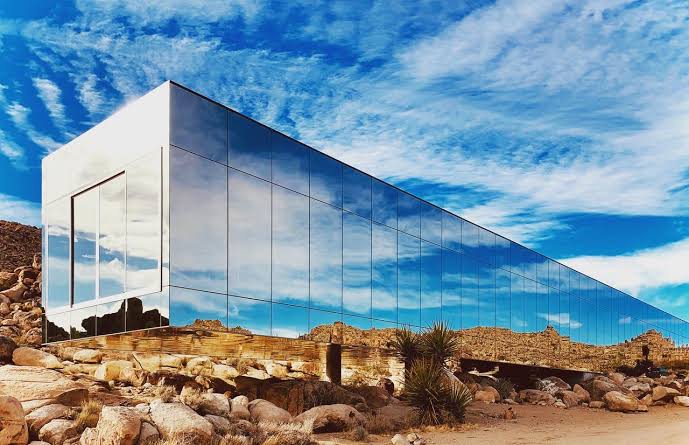
A house worth $18 million would normally be designed to make sure everyone notices it. This one does the opposite. Built in Joshua Tree, California, the Invisible House is a 5,500-square-foot glass structure whose mirrored exterior reflects the desert around it, allowing the enormous building to almost disappear from certain angles. Completed in 2019, it was designed as part residence and part art project—but behind that strange exterior is a very real luxury home with a 100-foot indoor pool and a remarkable engineering story.
The House That Doesn’t Want to Be Seen
From a distance, the Invisible House can look almost like a mistake in the landscape. Instead of a conventional facade, its exterior is covered in reflective glass, so the surrounding desert, rocks and sky appear where walls would normally be. The result is an optical illusion in which a structure more than 5,000 square feet in size seems to fade into the landscape rather than stand apart from it.
The house was built on roughly 67 acres in the high desert of Southern California, close to Joshua Tree National Park. Its long, rectangular form stretches about 225 feet across the property, making it far larger than the word “invisible” might suggest. From inside, however, the effect changes completely: the glass turns the surrounding desert into a moving backdrop, with sunlight, rocks and sky constantly reflected across the walls.
That contradiction is the reason the house works so well as an architectural curiosity. It is enormous, expensive and highly engineered, yet its defining visual trick is making itself seem less important than the landscape around it. Instead of competing with the desert, the structure essentially turns the desert into its exterior.

Why Would Anyone Build a House Like This?
The idea came from Chris and Roberta Hanley, who commissioned architect Tomas Osinski to design the property. Chris Hanley, a film producer known for projects including American Psycho and The Virgin Suicides, described the house as part art project and part residence. Its design was influenced in part by the stark monolith in 2001: A Space Odyssey and by Hanley’s friendship with artist Andy Warhol.
That artistic inspiration explains some of the house’s unusual proportions, but the mirrored exterior was not merely a visual stunt. The home uses heat-reflecting Solarcool glass intended to help control interior temperatures in the harsh desert climate while also filtering ultraviolet light. A foam roof and solar-electric system were also incorporated into the design.
In other words, the house’s most bizarre feature has a practical side. The same glass that helps make the building appear to vanish also plays a role in managing the conditions inside. The result is a rare combination of architecture, illusion and environmental engineering.
Is this the coolest Airbnb on Earth? We got an exclusive look inside the legendary Invisible House. From its mind-bending mirrored exterior to the stunning desert views, this is a tour you don’t want to miss!
Then You Walk Inside
The outside of the house can make it look almost empty, but the interior is anything but modest. One of its most striking features is a 100-foot indoor swimming pool stretching nearly half the length of the residence. The pool is heated and positioned so that the surrounding landscape remains visible through the enormous glass walls, creating the strange sensation of swimming inside the desert itself.
The house contains three bedrooms and four bathrooms, along with a high-end kitchen and large living spaces arranged around the pool. One wall measuring 224 square feet was designed specifically for projecting movies, while the primary bedroom includes a custom glass bed that makes the mattress appear to float. Charging stations for three Teslas were also included on the property.
The design is deliberately minimalist, but it is not simple. Every part of the interior is built around the same idea as the exterior: make the surrounding environment part of the experience. At sunrise, the desert appears directly through the glass; later, the changing light and stars become part of the house itself.

The Glass Alone Cost Nearly $700,000
The price of the house was not simply the result of expensive furniture and a spectacular location. Hanley told the Wall Street Journal that buying the glass for the project alone cost nearly $700,000. By the time the house was completed in 2019, it had become a highly unusual piece of residential architecture sitting in the middle of the California desert.
The property eventually went on the market for $18 million in January 2023. At the time, the listing was described as what was believed to be a record-setting asking price for a home in Joshua Tree, a small desert community whose property market had changed dramatically during the pandemic. Even if the house had sold for half the asking price, local reporting suggested it would still have been the most expensive home ever sold in Joshua Tree.
That price makes more sense when the property is viewed as something larger than an ordinary home. It is a residence, a piece of architecture, a film location and an attraction in its own right. The house had previously been rented for as much as $6,000 a day and had reportedly generated as much as $1.4 million in a single year from rental and production fees.

Joshua Tree Made the Idea Possible
The location is almost as important as the building. Joshua Tree became known for its dramatic rock formations, open desert and unusual artistic community, while its proximity to Los Angeles made it increasingly popular with visitors seeking a very different environment from the city. During the pandemic, demand for desert properties surged, contributing to one of the sharpest housing price increases in California.
The Invisible House fits that environment unusually well. Instead of building a mansion that dominates the desert, the architects created one that visually disappears into it. The surrounding 67-plus acres provide enough open space for the mirrored structure to work as intended, allowing the landscape to become part of the building’s identity.
That is also why the house is difficult to compare with a normal luxury property. A conventional $18 million home might advertise its value through stone, landscaping, gates or sheer size. The Invisible House advertises its value by making those things harder to notice.
Why the Invisible House Became Famous
The property attracted attention well before it went on the market. It became a rental and a location for film and photo productions, and it later appeared in Netflix’s The World’s Most Amazing Vacation Rentals. Its unusual design also attracted celebrities, adding another layer of attention to a house that was already difficult to ignore—even when it was trying not to be seen.
But the celebrity attention is not really what makes the house memorable. The enduring curiosity comes from a much simpler question: why would someone spend millions of dollars creating a building whose main visual trick is to disappear? The answer is partly artistic, partly practical and partly about creating an experience that could not be reproduced by a normal house.
The Invisible House is therefore less about hiding than it first appears. It does not actually vanish; the mirrored walls simply reflect what is around it. From inside, that same effect creates enormous views and an unusual connection with the landscape, turning the desert from something outside the house into part of the architecture itself.

A House Designed to Make You Look Twice
There are plenty of luxury homes in California with large pools, expensive kitchens and spectacular views. Very few are designed so that the first question is whether you can see the building at all. That is what makes the Invisible House so effective: before you ask how much it cost or what is inside, you have to figure out where the house actually is.
In that sense, the $18 million price tag is almost secondary to the idea. The house was built to create something that ordinary architecture rarely attempts—a structure that becomes more interesting by making itself disappear. It uses glass not simply as windows, but as a giant mirror, a climate-control tool and a way of turning the surrounding desert into a constantly changing facade.
The Invisible House may look like a futuristic object dropped into Joshua Tree, but the concept behind it is surprisingly simple. Instead of asking how to make a building stand out from its surroundings, its designers asked a different question: what if the building could become part of the surroundings?
That is why the house is still so fascinating. You can be standing in front of an $18 million home and, for a moment, almost not see it at all.
Joshua Tree’s Invisible House is unusual not simply because it costs $18 million, but because its most striking feature works against what expensive architecture normally tries to do. The 5,500-square-foot residence uses mirrored glass to reflect the desert around it, while the same material helps manage heat and UV exposure inside. Behind the reflective exterior is a luxury home with a 100-foot pool, three bedrooms and technology built around the landscape. It is less a house that disappears than a house designed to make the desert impossible to ignore.
This article was developed from The Guardian’s report on the unusual $18 million Invisible House in Joshua Tree, including its mirrored design, the story behind its construction and the features that made the property so distinctive. Sources: https://www.theguardian.com/us-news/2023/jan/20/joshua-tree-invisible-house-18m